Take a look at F. Scott Fitzgerald’s Bolton Hill rowhouse this Sunday

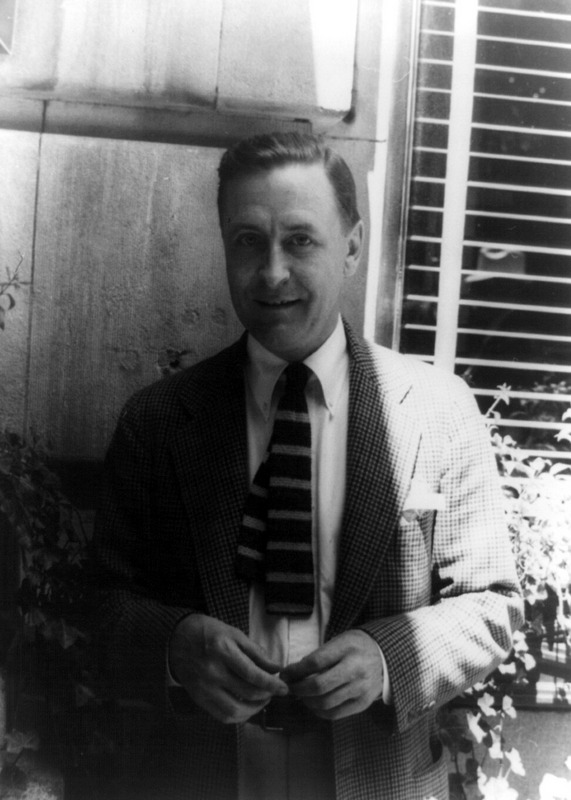
Francis Scott Fitzgerald 1937 June 4
F. Scott Fitzgerald, photographed by Carl van Vechten in 1937. Image Courtesy Library of Congress Prints and Photographs Division, LC-USZ62-88103.

Here is an exciting opportunity for anyone who loves Baltimore’s literary history: F. Scott Fitzgerald’s Bolton Hill rowhouse is now for sale! F. Scott and Zelda Fitzgerald lived in the home in the 1930s through several tumultuous years. The four bedroom, four bath house is going for $450,000. Take a look at the listing or stop by the open house before the Ravens take on the 49ers this Sunday, February 3 from 12:00pm to 2:00pm.

University of Baltimore student Nathan Dennies, a new volunteer working on Explore Baltimore Heritage, just finished a great story detailing Fitzgerald’s time at 1307 Park Avenue. Read on for an excerpt or find the full piece on Explore Baltimore Heritage. Don’t forget to download our free Explore Baltimore Heritage app for iPhone and Android!

In August 1933, F. Scott Fitzgerald moved with his family to 1307 Park Avenue. Fitzgerald had been forced out of his previous home in Towson due to a house fire attributed to his mentally ill wife, Zelda. Their rowhouse, a ten minute walk from the monument of Fitzgerald’s famous ancestor, Francis Scott Key, quickly became a place of turmoil, and was the last place where he and Zelda lived together.

Fitzgerald couldn’t get back on his feet at his new home. His first published novel in ten years, “Tender is The Night,” tanked after its April 1934 release, selling only 13,000 copies to mixed reviews, and left Fitzgerald under immense financial strain. Everyone in the house was affected. Zelda and Fitzgerald’s daughter, Francis Scott “Scottie” Fitzgerald, acted as a go-between for their landlord, forced to constantly ask her father for rent money.

Zelda, who spent her weekdays hospitalized at Sheppard Pratt in Towson, had a brief period of wellness during the first few months at 1307 Park Avenue and was allowed to go home and take painting classes at the Maryland Institute College of Art. However, her mental illness soon worsened and she was moved to the expensive Craig House sanitarium in New York, only to return to Sheppard Pratt in May 1934 in worse shape than ever.

While Zelda was in the hospital, Fitzgerald’s dependency on alcohol grew, and she even faced some hard times at the hospital. Writer H.L. Mencken, a friend of Fitzgerald who lived nearby in Mt. Vernon at the time, wrote in his journal in 1934, “The case of F. Scott Fitzgerald has become distressing. He is a boozing in a wild manner and has become a nuisance.”
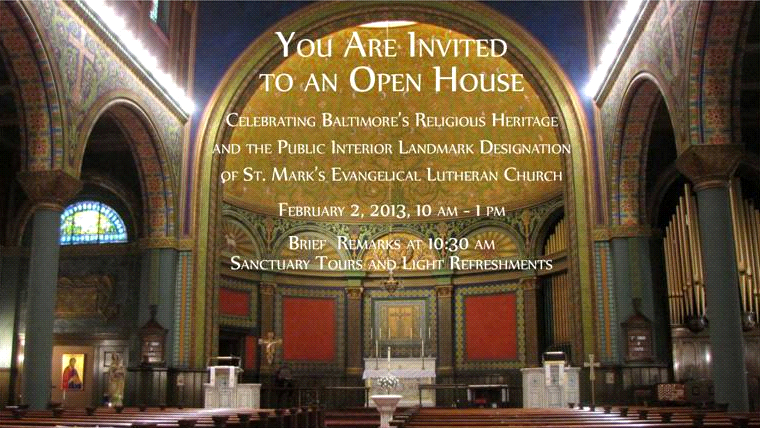
St. Mark’s Evangelical Lutheran Church celebrates Baltimore’s religious heritage with a free open house this Saturday

image001

While several churches and residences in Baltimore have Tiffany stained-glass windows, St. Mark’s Evangelical Lutheran Church is the only building with a Tiffany interior. Louis Comfort Tiffany was one of America’s most famous interior designers and artists of the late 19th – early 20th century. Today, he is best known for his stained-glass. Built in 1898, St. Mark’s (featured on Explore Baltimore Heritage) is one of only a few intact Tiffany-designed interiors left in the world. The Tiffany Glass and Decorating Company designed and produced the ornately decorated walls, mosaics, stained-glass windows, and lamps in the church.

Along with celebration the designation of St. Marks and celebrating Baltimore’s religious heritage, we’re also hoping this event will encourage other religious institutions to consider landmark designation, particularly interior designations.

St. Mark’s Evangelical Lutheran Church Open House

Saturday, February 2, 2013, 10:00 am – 1:00 pm – Remarks at 10:30am
St. Mark’s Evangelical Lutheran Church, 1900 Saint Paul Street, Baltimore, MD 21218
Sanctuary tours and light refreshments offered throughout the morning.

The open house is hosted by St. Mark’s Evangelical Lutheran Church and the Commission for Historical and Architectural Preservation (CHAP). For questions or to RSVP, please contact Lauren Schiszik, CHAP staff at lauren.schiszik@baltimorecity.gov or at 410-396-5796.

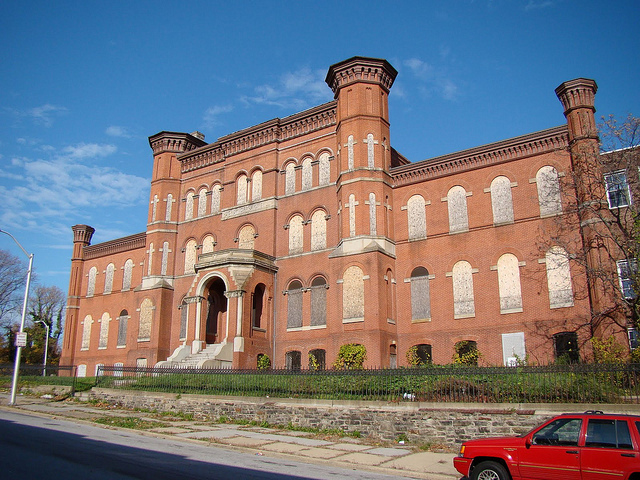
Learn to combine tax credits & weatherization with workshops in Mt. Washington and Union Square

We’re excited for Baltimore Green Fest this Saturday but we also have two more workshops with Retrofit Baltimore coming up in February and March. Our free one-hour workshops explain how to combine a home energy retrofit and city and state historic tax credits. These programs can help you save money on your heating bills and receive a tax credit on the cost of your upcoming home maintenance and rehabilitation projects!

Many neighborhoods both in north Baltimore – Roland Park, Mt. Washington, Guilford, Hamden – and in southwest Baltimore – Union Square, Hollins Market, Pigtown, Ridgely’s Delight – are located within historic districts and are eligible for the state historic tax credit program. Learn more about historic tax credits in our comprehensive guide, check if you are in a historic district, then RSVP for a workshop today!

Weatherization & Historic Tax Credits Workshop on February 12

Tuesday, February 12, 6:30pm to 7:30pm
Baltimore Clayworks – Mt. Washington, 5707 Smith Avenue, Baltimore, MD 21209
RSVP today!

Free on-street is available in the Mt. Washington Village shopping area after 6:00pm. Please note this workshop will take place in the Baltimore Clayworks Gallery on the second floor – not in the Clayworks workshop. The Gallery is also located a short distance from the Mt. Washington Light Rail station.

Weatherization & Historic Tax Credits Workshop on March 14

Thursday, March 14, 7:00 pm to 8:00 pm
Neighborhood Design Center, 1401 Hollins Street, Baltimore, MD 21223
RSVP today!

Free on-street parking is available in the area and the Neighborhood Design Center is only a few blocks from the Charm City Circulator Orange Route stop 211 at Hollins Market.

Questions? Please contact Eli Pousson, Baltimore Heritage at pousson@baltimoreheritage.org or Whitney Graham, Retrofit Baltimore at wgraham@retrofitbaltimore.org.

Good news for Baltimore’s Hebrew Orphan Asylum in 2013

We are excited to begin the year with some good news for the future of Baltimore’s Hebrew Orphan Asylum. With the Coppin Heights Community Development Corporation taking the lead, we have made great strides towards the preservation and reuse of this important West Baltimore landmark.

  • Maryland’s Department of Housing and Community Development has granted the Coppin Heights CDC $100,000 to stabilize the building. Not only does stabilization address the building’s severely compromised roof but it also allows architects and engineers to work safely inside to assess conditions and complete redevelopment plans.
  • Coppin Heights CDC has now secured $10 million in state and federal funding with support from the Maryland Sustainable Communities Tax Credit program, the Federal Historic Preservation Tax Credit program, and the New Markets Tax Credit program. This is great progress towards securing the resources necessary to restore the building and bring it back as an asset to the neighborhoods of Greater Rosemont.
  • Finally, just this afternoon, Lt. Gov. Anthony Brown announced that West Baltimore, including the area around the Hebrew Orphan Asylum,  one of five new Health Enterprise Zones across the state—a program that opens up new incentives for providing medical care to residents in under served neighborhoods like West Baltimore. The announcement comes as a welcome news, as the Hebrew Orphan Asylum is slated to be transformed into the Center for Health Care and Healthy Living to help address the same health disparities that the new Health Enterprise Zone is designed to reduce.

At Coppin State University, the building’s current owner, Dr. Mortimer Neufville is stepping in to serve as interim president after the resignation of Dr. Reginald Avery. Dr. Neufville takes the helm in a new day for the Hebrew Orphan Asylum as both CSU and the larger University of Maryland system have expressed their strong support for the project and are working together to make sure the building is restored and reused. Things are moving quickly for the Hebrew Orphan Asylum and we are more than optimistic that 2013 will see great steps forward for its preservation and reuse as a center for revitalization in West Baltimore.

My morning nose-to-nose with plaster up in the scaffolding at the Baltimore Basilica

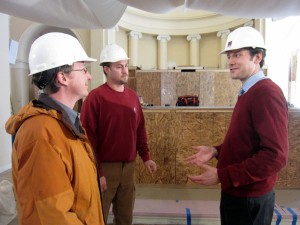
IMG_9165Yesterday morning, Tyler Tate from Lewis Contractors gave my colleague Eli and me a real treat: a visit up into the scaffolding that has been standing in the main sanctuary of the Baltimore Basilica to repair damage from the summer’s earthquake. The scaffolding, almost miraculously, spans the pews below and reaches to the top of the dome. The earthquake cracked plaster, compromised arches, and caused damage throughout the building, and the scaffolding essentially allowed the work crews to reach every inch of the interior. Weekend services (and even weddings) have bravely continued throughout the restoration thanks to the draperies that have hidden much of the scaffolding. The project is now winding down and the scaffolding is being removed, but we wanted to share some photos of our visit and what the ceiling of the Basilica looks like from up-close. I think that after our nose-to-nose look at the plaster, paint and stabilization work, the Basilica will be more stunning following this restoration than it was even after the major restoration work a few years ago.

In addition to Lewis Contractors and the Archdiocese of Baltimore, the project team includes architects Cho Benn Holback, plaster repair experts Hayles and Howe, and paint specialist Thomas Moore Studios. Fandango Productions provided the drapes over the scaffolding – a first for their business.

Restoration in process at the Basilica of the Assumption, January 10, 2013