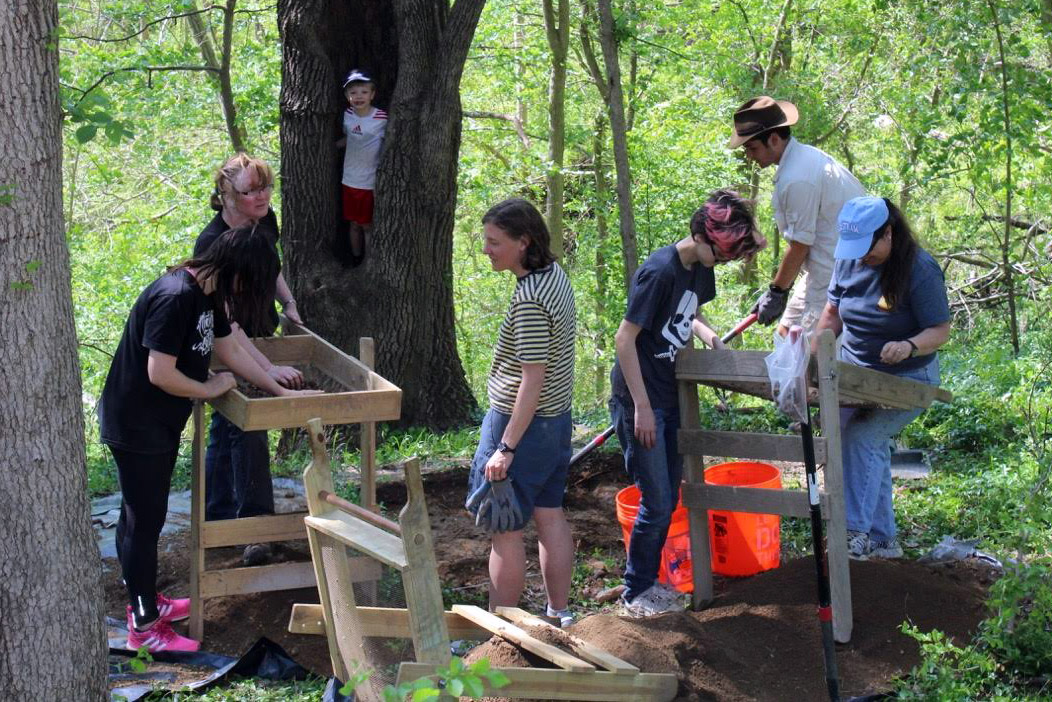
Thanks to Lisa Kraus and Jason Shellenhamer for this update from day 4 of the Herring Run Archaeology Project. You can find their updates on our blog, the project website, and on Facebook. You can also subscribe to the project email list to read these posts in your inbox.
Jason Shellenhamer. 2016 April 26
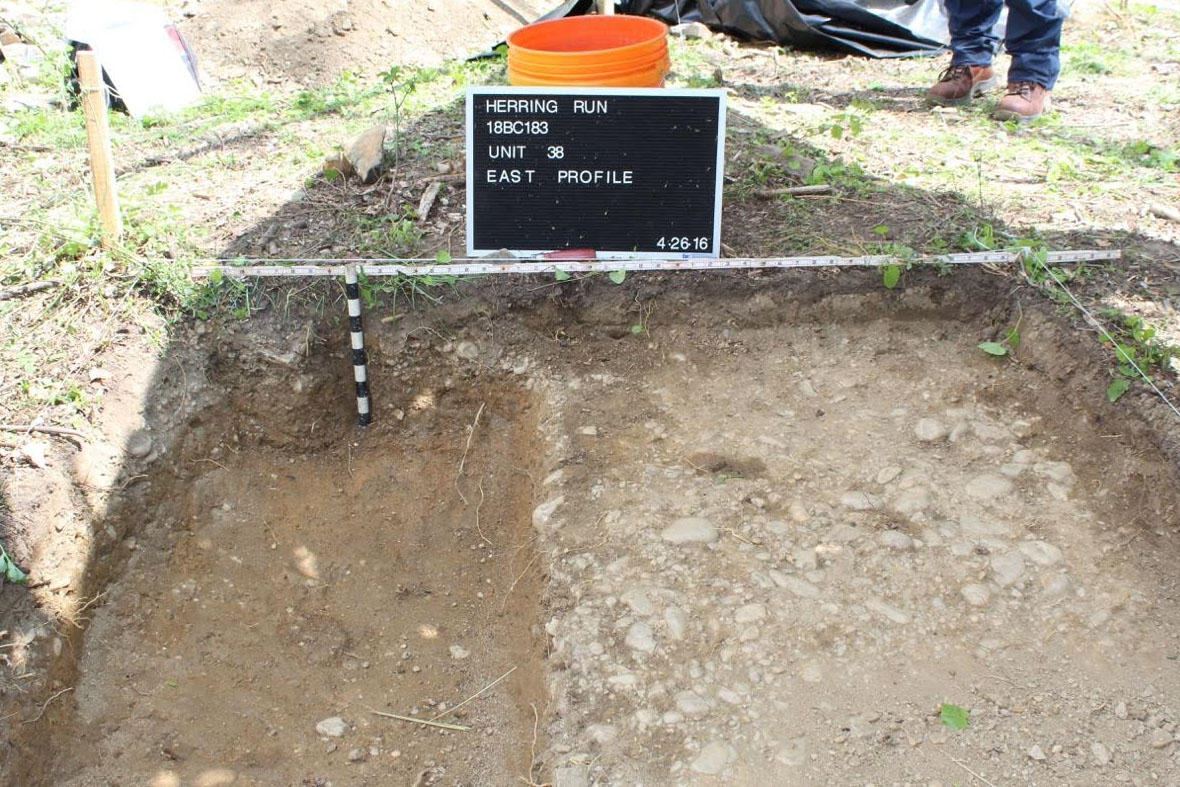
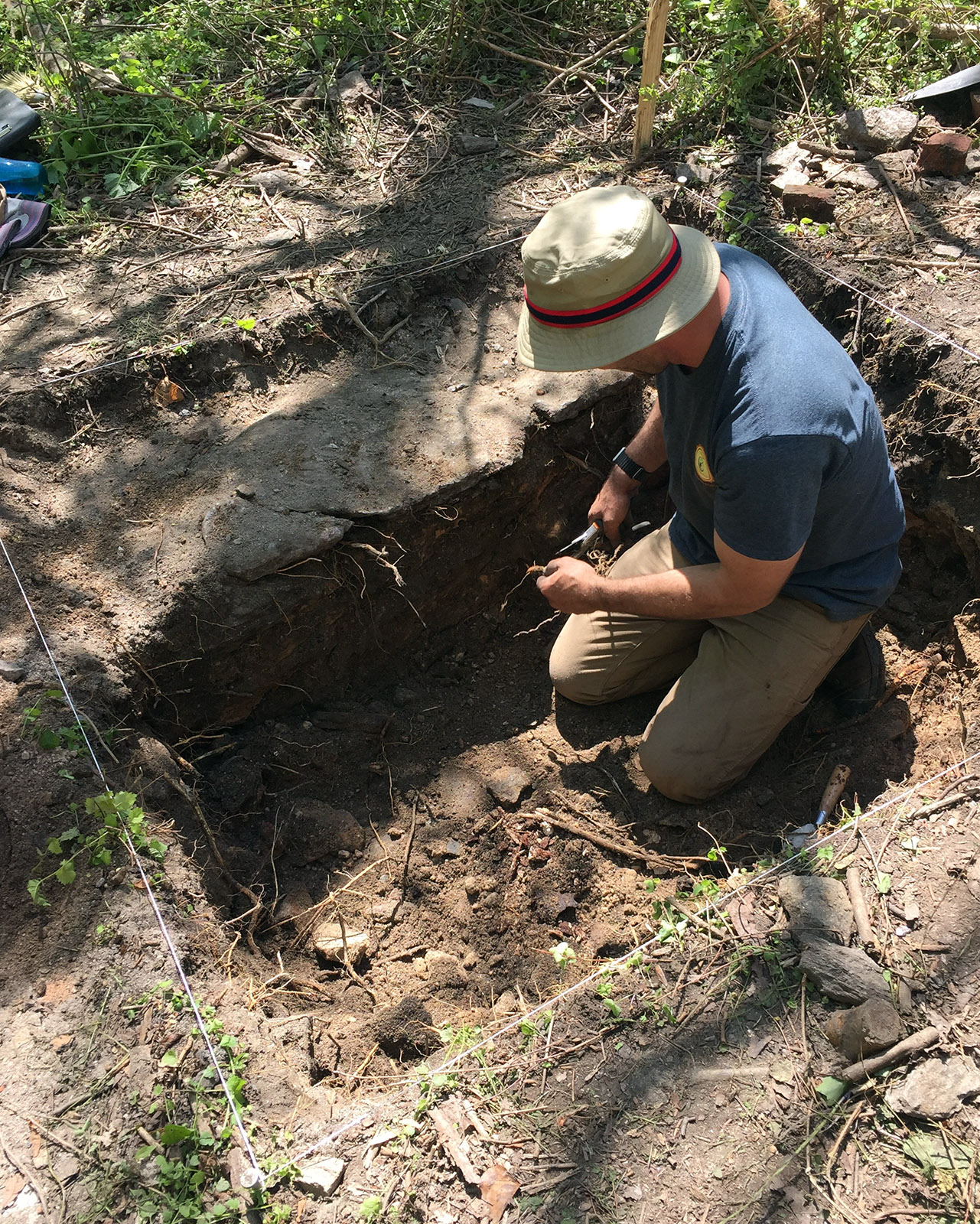
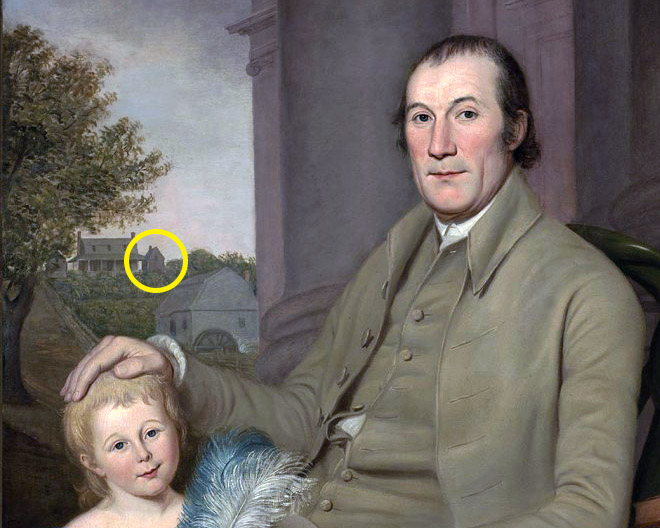
Today was a very exciting day! Up at the manor house, we identified a new architectural feature—a possible gravel pathway—which may help us answer one of our more pressing questions: which way did the house face? In the Peale painting of William Smith and his grandson, the house appears to face west, but it is difficult to tell. With this new feature and other clues, we hope to piece together a more complete picture of the house and grounds.
2016 April 26
In other news: from the very beginning, we’ve found traces of an earlier occupation at the site, and we know that John Broad and his family occupied from 1690 (and likely earlier) through the 1740s. Today, we’ve finally found intact deposits associated only with this earlier occupation!
2016 April 26
We know very, very little about life in this region at that time, so this is a tremendous discovery—and this makes Eutaw the earliest historical archaeological site in Baltimore City to date!
Thanks to Lisa Kraus and Jason Shellenhamer for this update from day 3 of the Herring Run Archaeology Project dig. You can find their updates on our blog, the project website, and on Facebook. You can also subscribe to the project email list to read these posts in your inbox.
Photograph by Jason Shellenhamer.
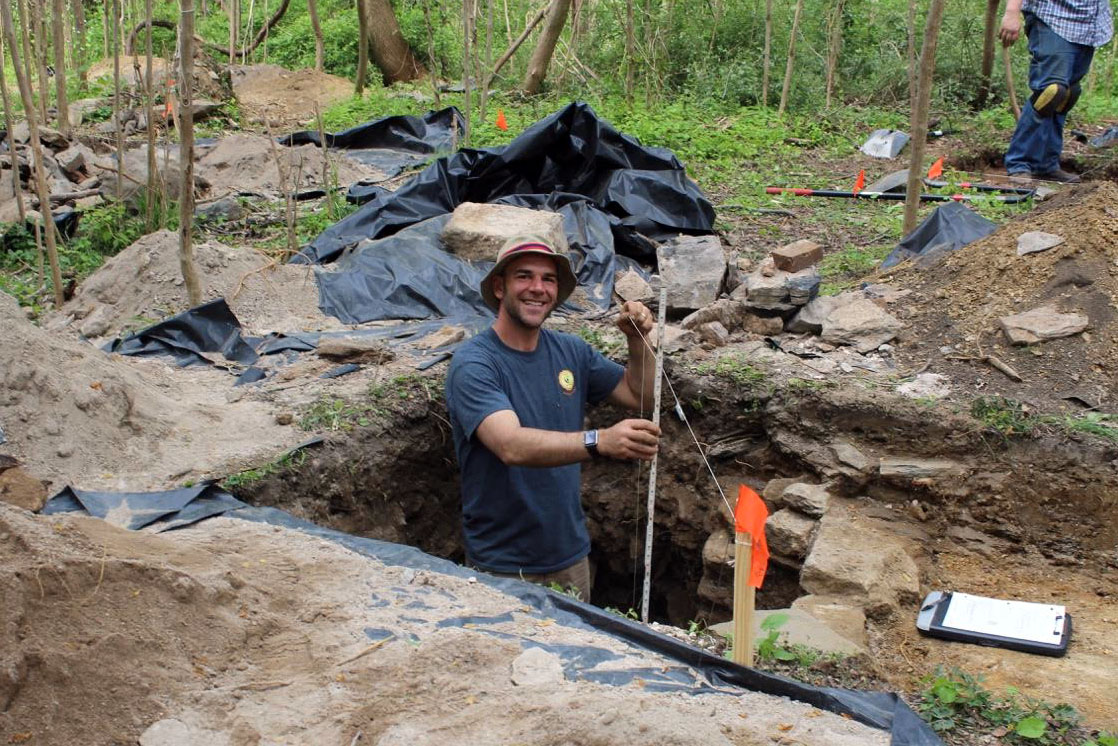
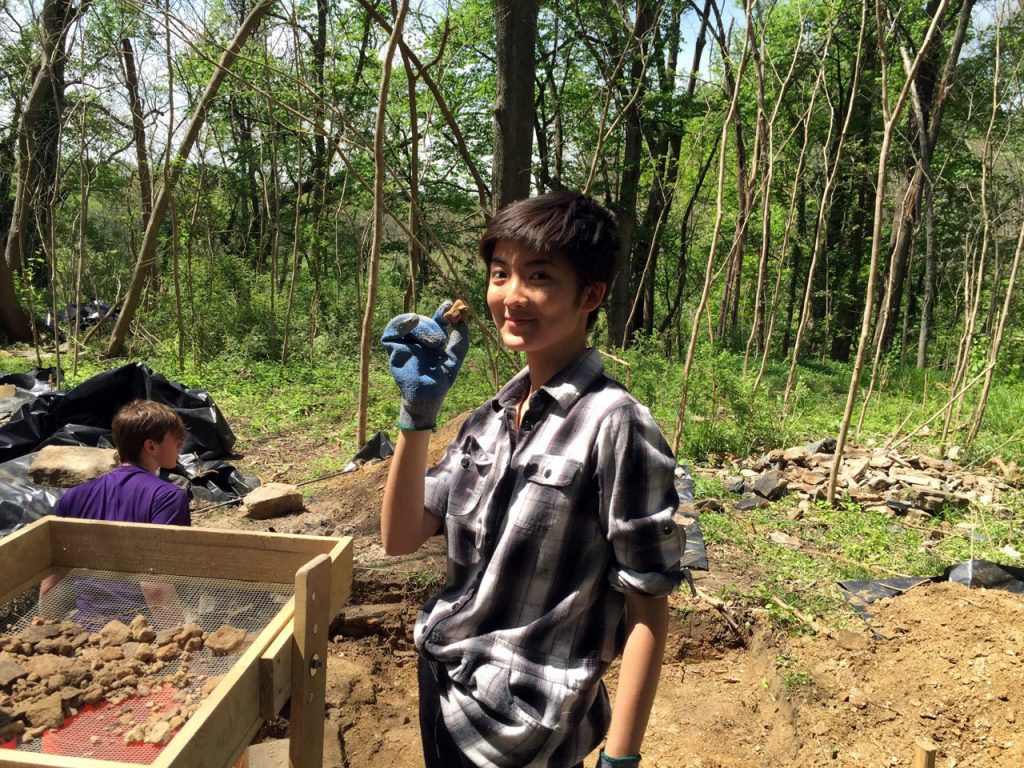
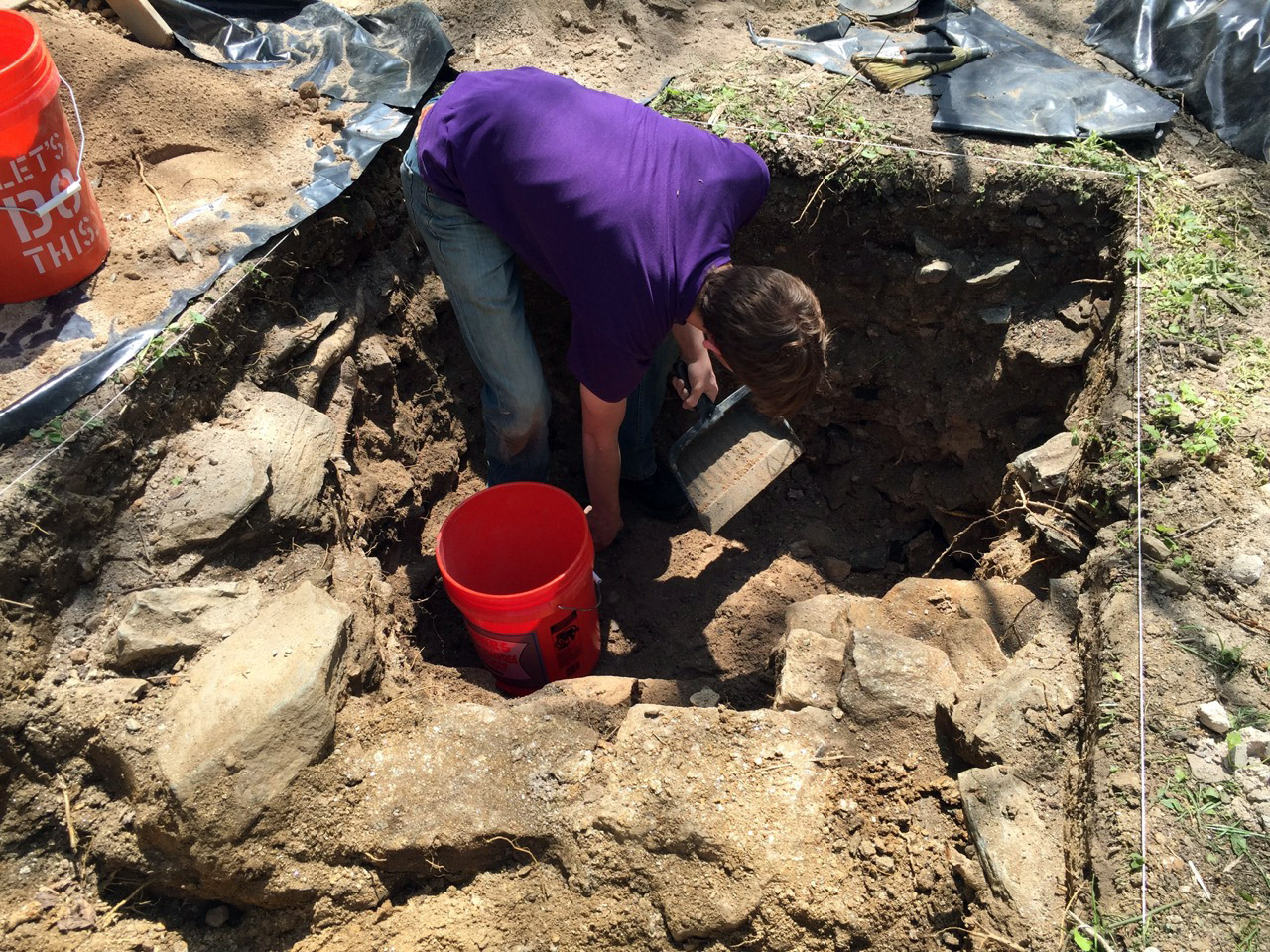
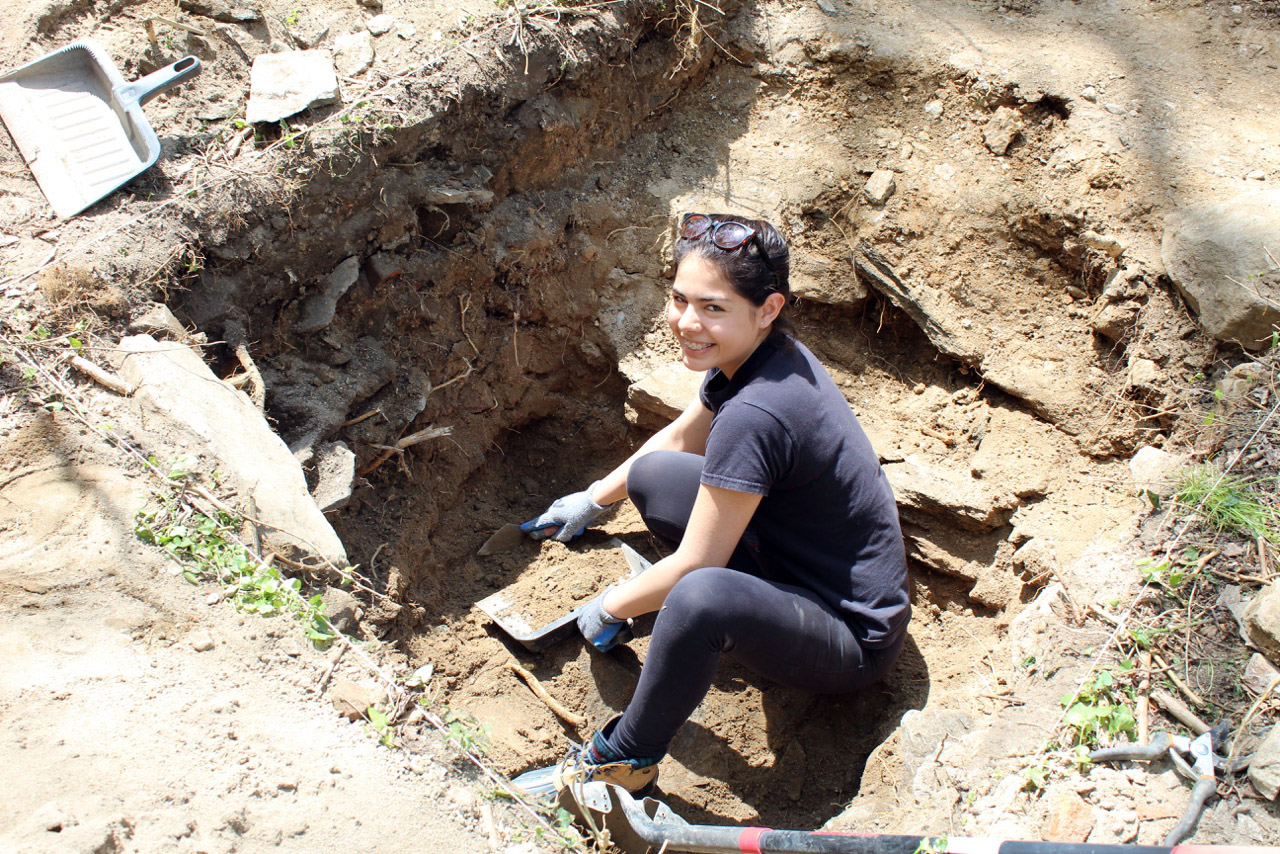
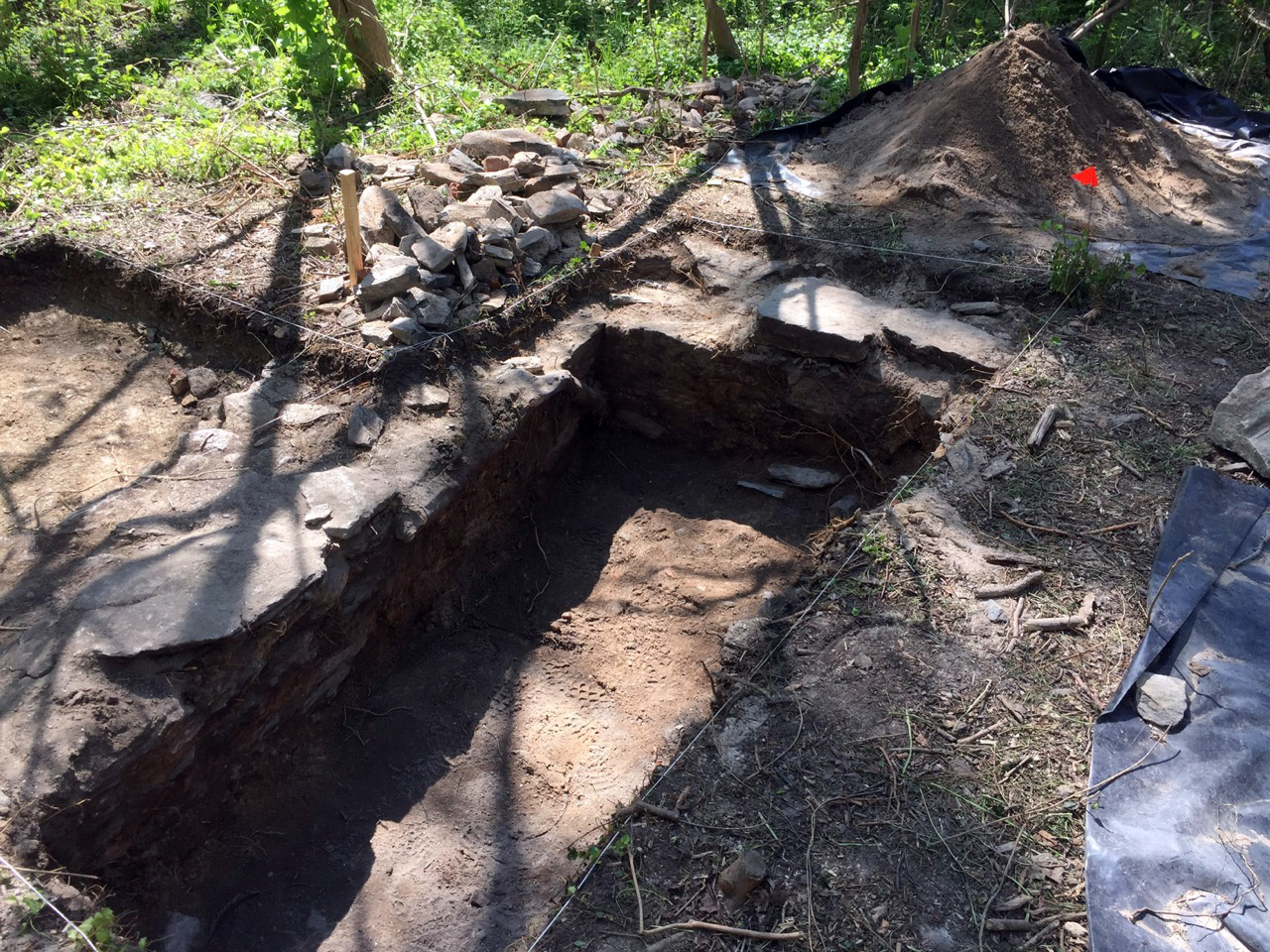
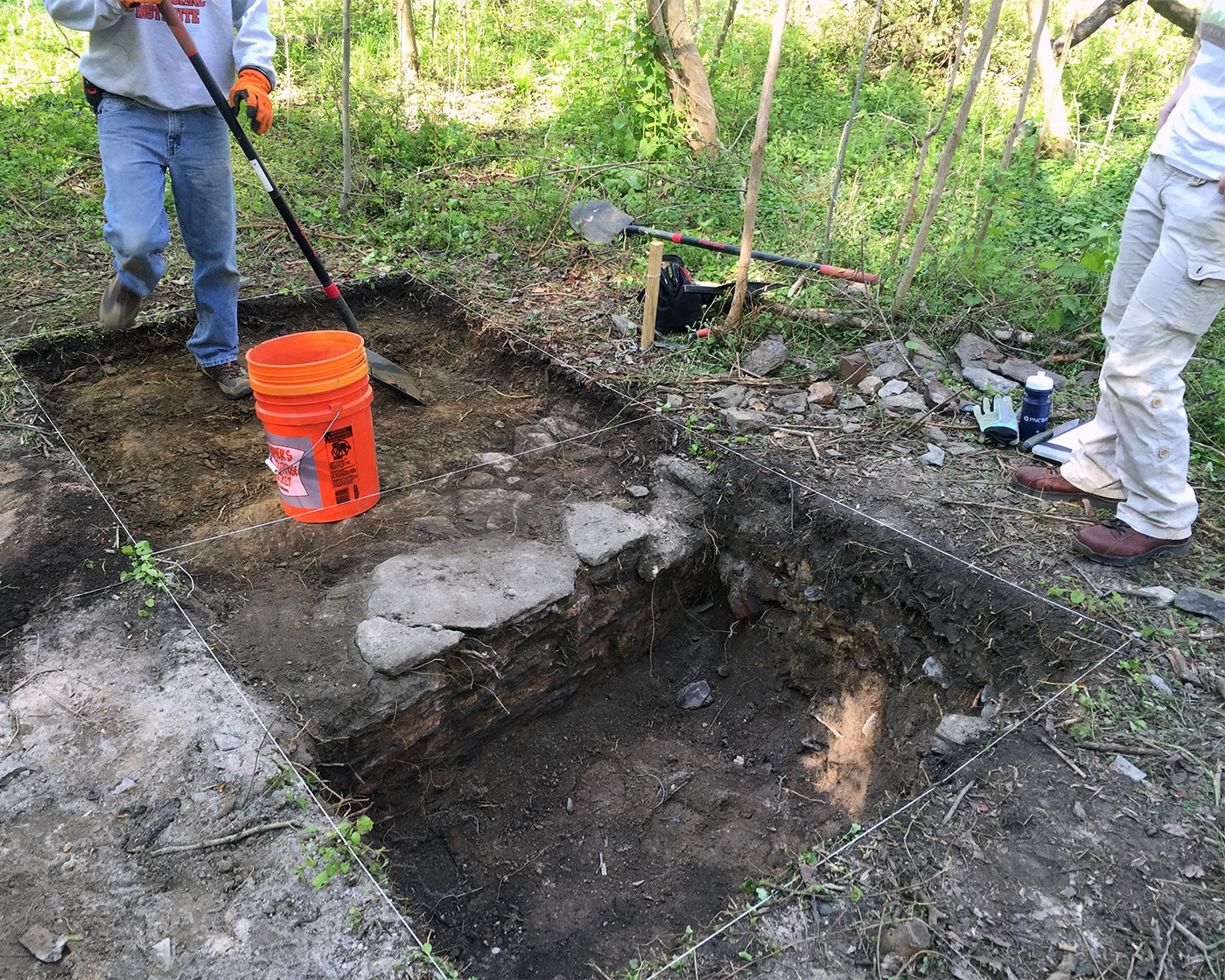
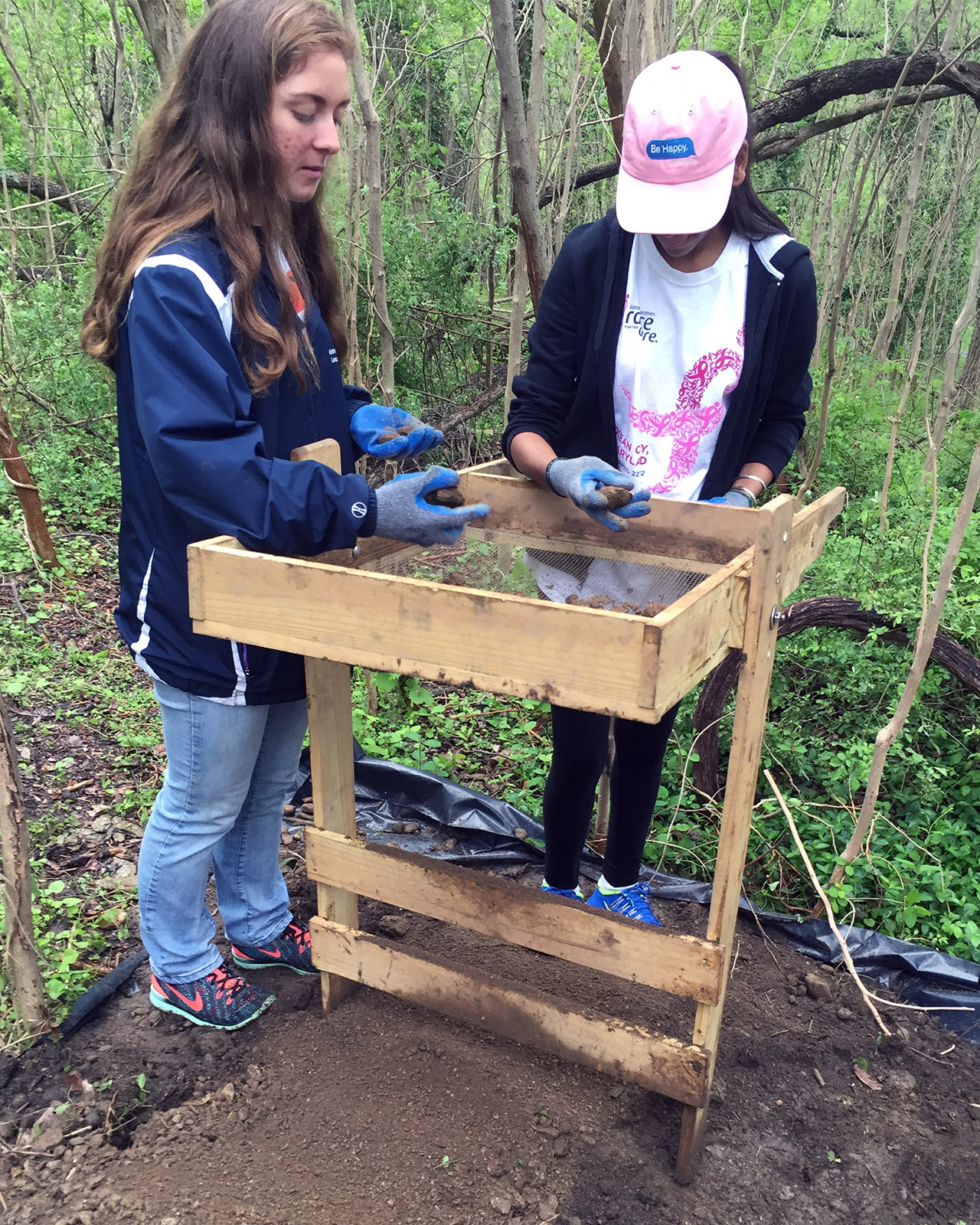
The work at Eutaw continues on Day 3 of our second field season. By the end of the day we completed excavation in three new areas on the perimeter and interior of the former plantation dwelling. Testing in all the units within the house’s former cellar continue to produce similar artifacts that one might expect from a house that burnt down in 1865 such as nails, brick, mortar.
However, each area we explore in the house also produced several distinct groups of artifacts that are not found in other areas. These subtle, yet important distinctions have allowed us to start a preliminary reconstruction of the location and uses of various rooms within the former farm house.
Photograph by Jason Shellenhamer.
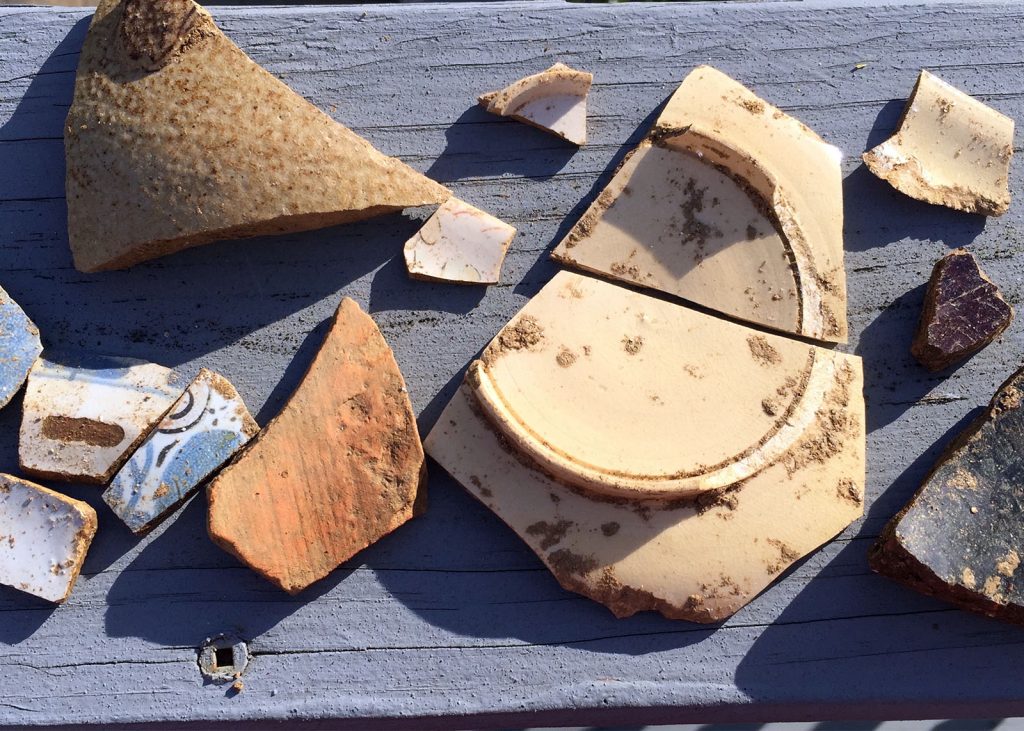
For instance, all of the expensive white, gold leaf porcelain dinner plates and tea service have been found near the northwest corner of the home, but those same artifacts are absent elsewhere in the house. Given that a dinner party occurred at the time of the house fire, it seems likely that the presence of those ceramics in that area alone may suggest the location of the family’s formal dining room, or at at the very least a pantry where the family kept their formal sets of dinner service.
Photograph by Jason Shellenhamer.
Other locations we explored so far provided other insights into the uses of other areas of the home, including the formal front entrance, kitchens, and side entrances.
Thanks to Lisa Kraus and Jason Shellenhamer for this update from April 23 and April 24—the first weekend of digging with the Herring Run Archaeology Project this spring. You can find their updates on our blog, the project website, and on Facebook. You can also subscribe to the project email list to read these posts in your inbox.
Photograph by Lisa Kraus.
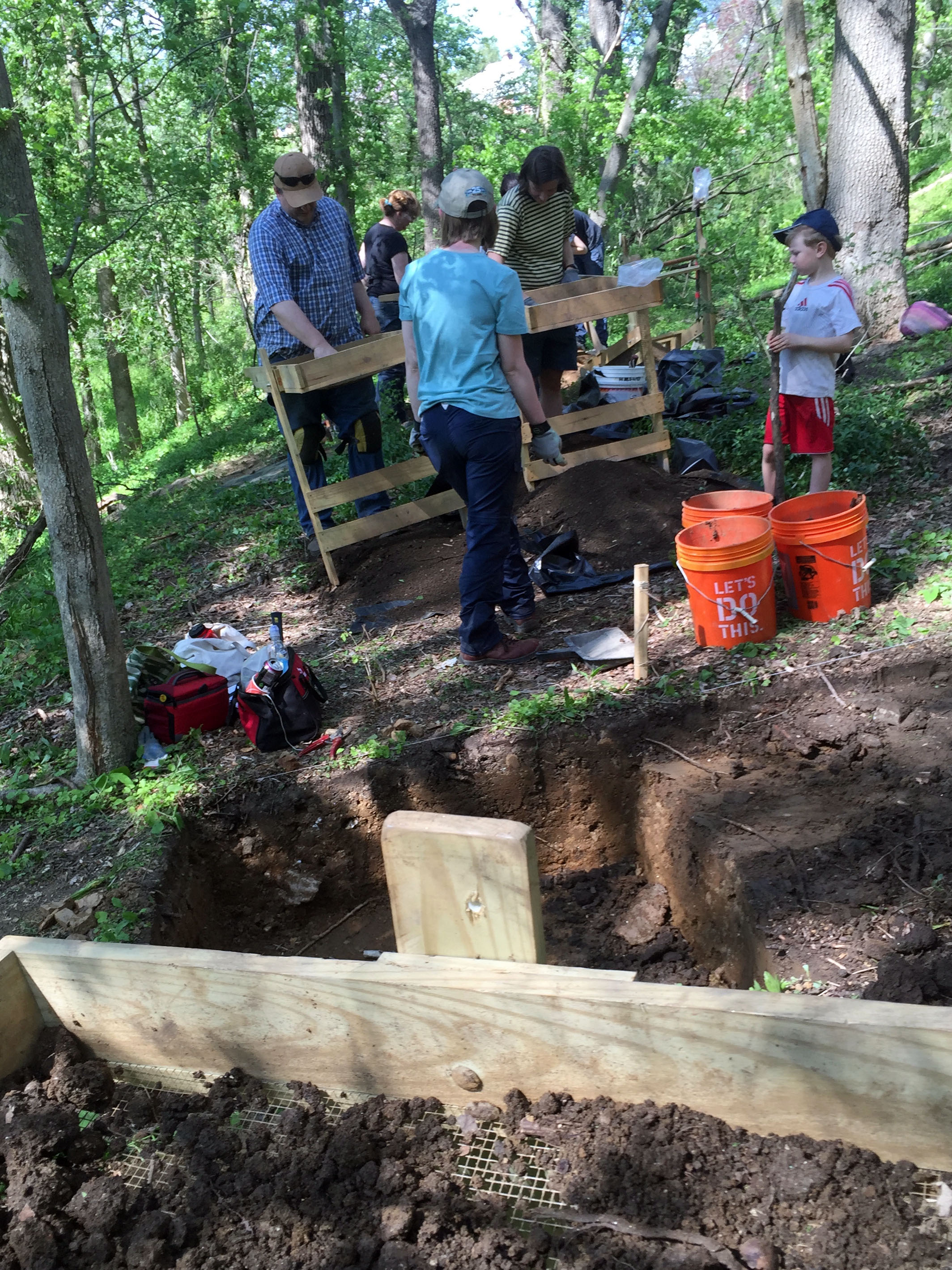
Our second season of fieldwork has begun, and we’ve already made some fantastic discoveries!
We’re exploring more of the Eutaw manor house, and have now firmly identified a second building that was likely the kitchen. We’ll be continuing to explore these two structures tomorrow, but we’re also hoping to begin excavation of the possible stable and slave quarter we’ve tentatively identified nearby.
Photograph by Lisa Kraus.
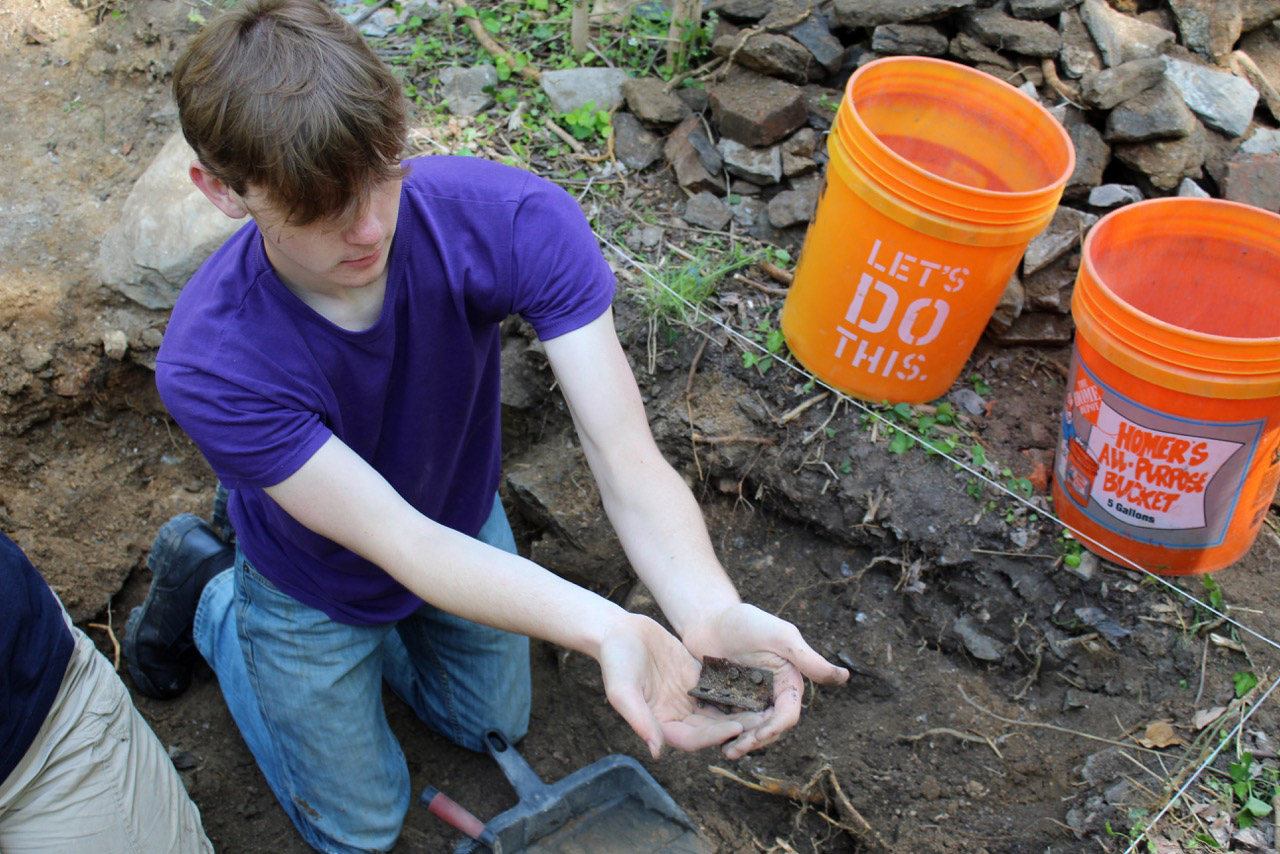
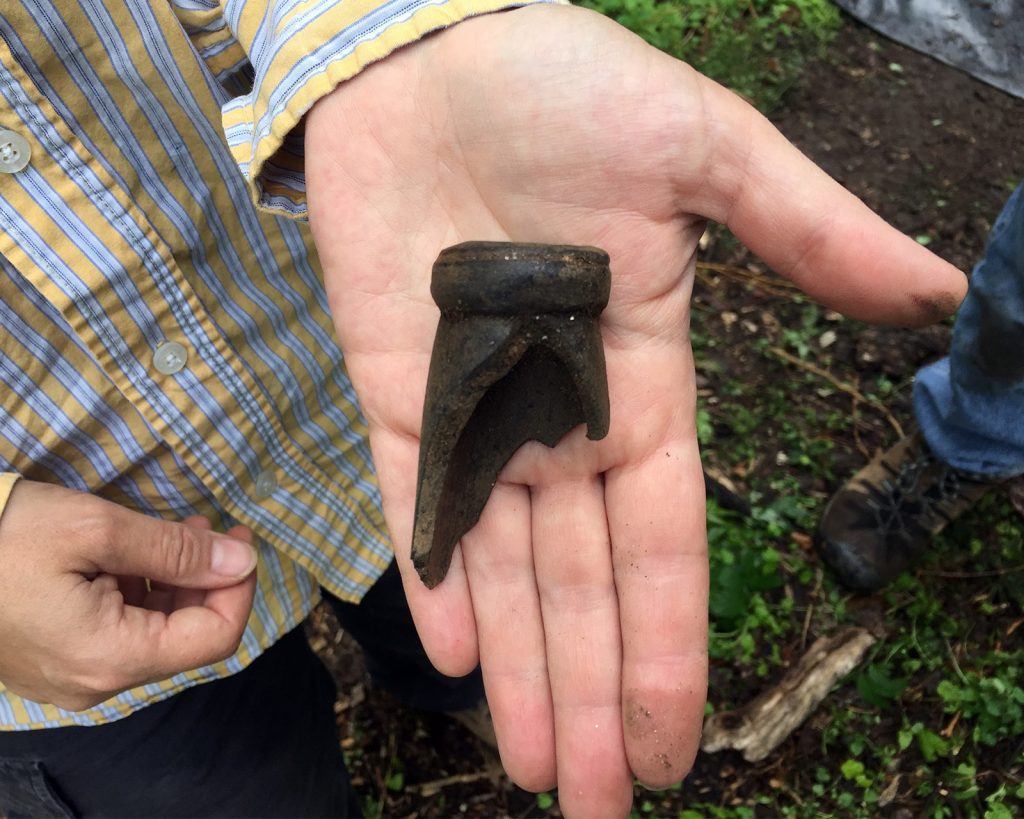
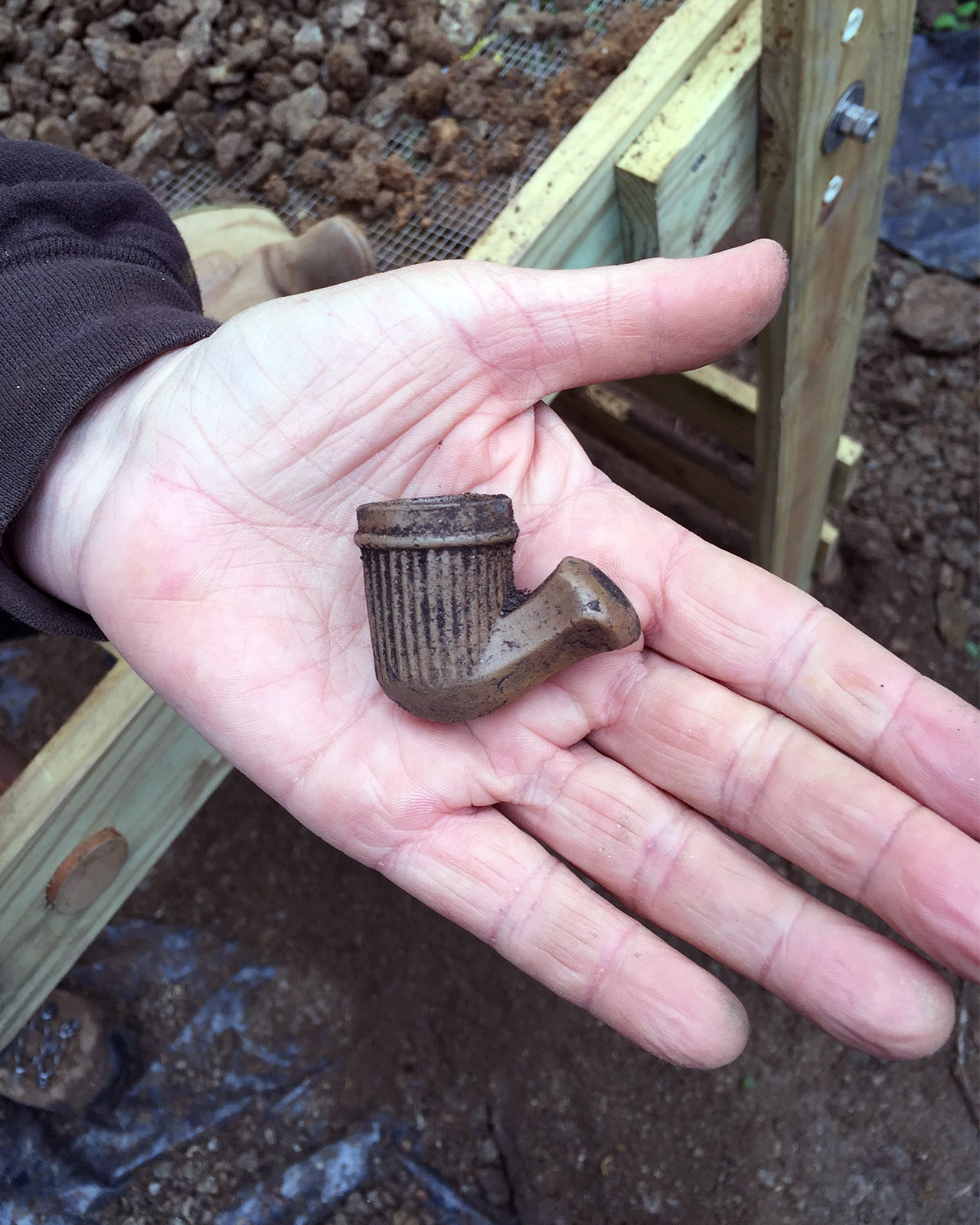
In the manor mouse, we’ve finally located one of the chimneys, and have found some interesting artifacts, including a 1773 half penny, numerous decorative pieces of window hardware, a beautiful piece of an 18th-century hand-blown wine bottle, a 19th-century pipe bowl, and too many other things to mention.
1773 penny. Photograph by Lisa Kraus.Photograph by Lisa Kraus.
At the end of last year’s fieldwork, we identified what appeared to be a second, smaller structure just west of the Manor House. We’ve now identified it as an out kitchen, a small building separate from the main house where food was stored and prepared.
Detail from Portrait of William Smith and His Grandson, Charles Wilson Peale, 1788. Courtesy Virginia Museum of Fine Arts.
This was likely one of the two smaller buildings depicted in the painting of Eutaw by Charles Wilson Peale (circled in yellow in the detail above). We’ll be posting more updates as the fieldwork progresses, and hope to see you in the field!
This year marks a full century of Pompeian Olive Oil making olive oil in Baltimore, and we hope you can join us on our May 17 afternoon tour of their Pulaski Highway factory, including a peek at a 300-year-old olive press, the processing plant, and expert cooking tips along the way.
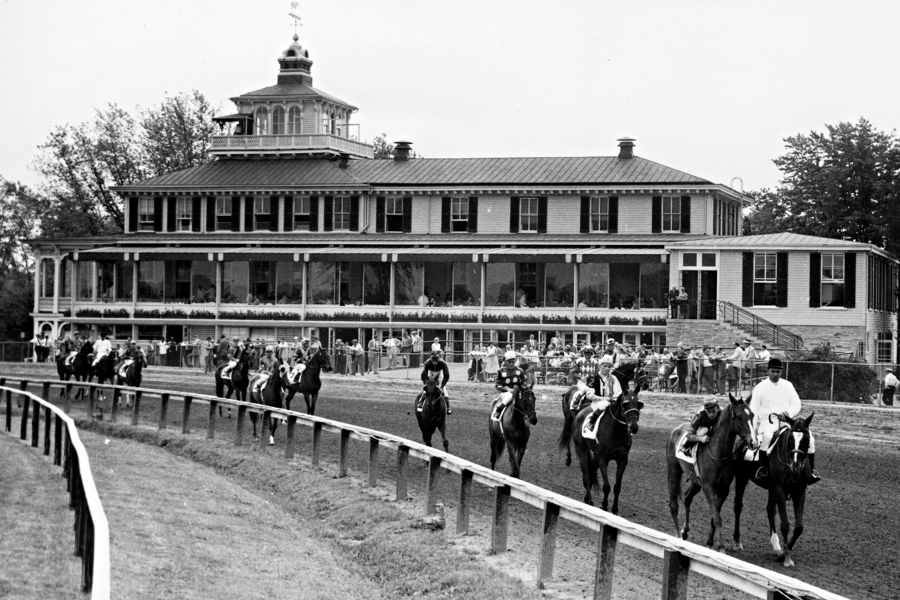
On the morning of May 17, you can join us in getting ready for Preakness with a morning tour of Pimlico Racetrack from its stables (including Preakness horses in training) to the Jockey’s locker room and famed clubhouse with its signature weather vane. And don’t forget about our tour next week of the Maryland House, our state’s contribution to the 1876 Centennial Exhibition in Philadelphia, with our partner Preservation Maryland.
Spring also means our Monumental City Tours are up and running the first four Sunday mornings of every month from now until Thanksgiving. Bring a friend and join us on these one-hour jaunts to learn more about Baltimore: Jonestown and the Shot Tower, Landmarks and Lions Downtown, Mt. Vernon and the Washington Monument, and the Patterson Park Observatory.
Lastly, our annual Baltimore by Foot tour series starts off this weekend in Seton Hill. We are thrilled with the huge response these tours have generated—we only have spaces left on the Hunting Ridge and Harbor East to Jonestown tours, so make sure to sign up today to save your spot.
This past January, Governor Larry Hogan and Mayor Stephanie Rawlings-Blake announced Project CORE—a plan for the state to spend $75 million on tearing down and stabilizing vacant buildings and $600 million on incentives for redevelopment over the next seven years. Mayor Rawlings Blake called it “demolition dollars on steroids.”
In February, Governor Hogan added CORE (short for Creating Opportunities for Renewal and Enterprise) to his supplemental budget. The General Assembly approved $7.1 million for Project CORE in 2016 and committed to offer the rest of the funding over the next three years. Baltimore City pledged to match the state’s funding with up to $20.5 million. Although the final details on the amount of funding are still being determined, we expect the overall project will include around $100 million over the next four years. Overall, Project CORE is expected to fund the demolition of as many as 4,000 vacant buildings.
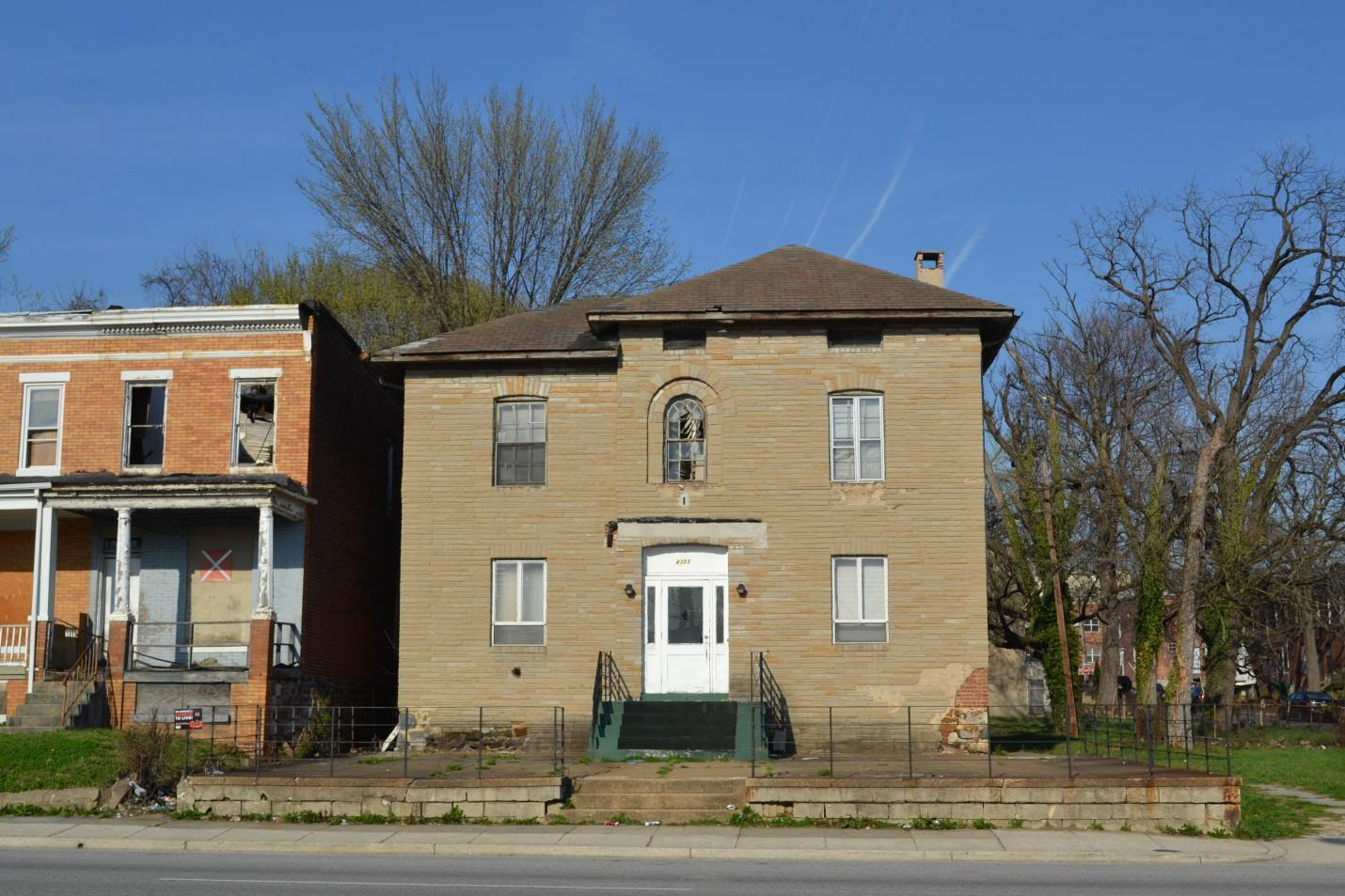
4303 Park Heights Avenue in Central Park Heights. Courtesy DHCD.
We know we can’t save every vacant house in Baltimore but we know that demolition alone won’t solve the city’s problems either. Baltimore Heritage is seeking a balanced approach that preserves buildings that are important to community residents and invests in alternatives to demolition in all historic neighborhoods. To reach this goal, we need to take a close look at the city’s vacant buildings. We need to understand what buildings may be demolishing under Project CORE and why. Finally, we need to hear from you. What do you think about CORE and the demolition of vacant buildings in Baltimore?
How many vacant houses does Baltimore have? Where are they located?
Baltimore Housing keeps track of over 16,000 vacant buildings. Over two-thirds of the city vacant building notices are found in areas that the Baltimore City Planning Department’s housing market typology calls “stressed markets”—neighborhoods with deteriorated buildings, many vacant properties, and more renters than homeowners.
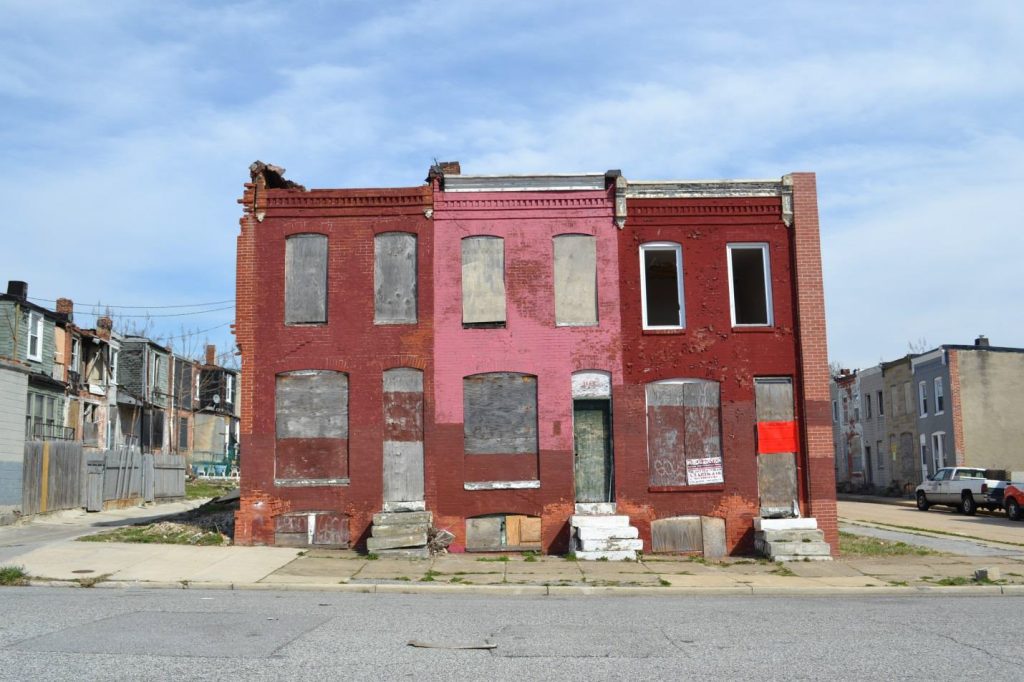
2023-2027 Herbert Street in Mondawmin. Courtesy DHCD.
Nearly all of these buildings are fifty years old or older. Over 7,000 of the vacant buildings are in National Register designated historic districts. Eleven districts contain over 100 vacant buildings and two districts, the Old West Baltimore Historic District and Baltimore East/South Clifton Park Historic District, each have over 1,500.
The large number of vacant properties in historically African American neighborhoods like Old West Baltimore is no coincidence. For decades, mortgage discrimination against black homeowners, housing segregation, and employment discrimination have driven disinvestment in African American neighborhoods. This is one reason some housing justice advocates are concerned about demolition policies that follow existing market conditions. For example, a recent report by the Baltimore Housing Roundtable noted the troubling similarity between the city’s housing market typology in 2014 and the “redlining” maps created by the U.S. Home Owners Loan Corporation in the 1930s.
What buildings are affected by Project CORE?
Last month, Baltimore Housing and the Maryland Department of Housing and Community Development (DHCD) shared their 2016 plan for 75 demolition “clusters” (each cluster ranging in size from two to twenty-three buildings) for a total of 468 buildings in twenty-nine neighborhoods. We have published a list of these demolition clusters and created a simple map based on that data. Photographs of the buildings proposed for demolition are available in this report from DHCD.
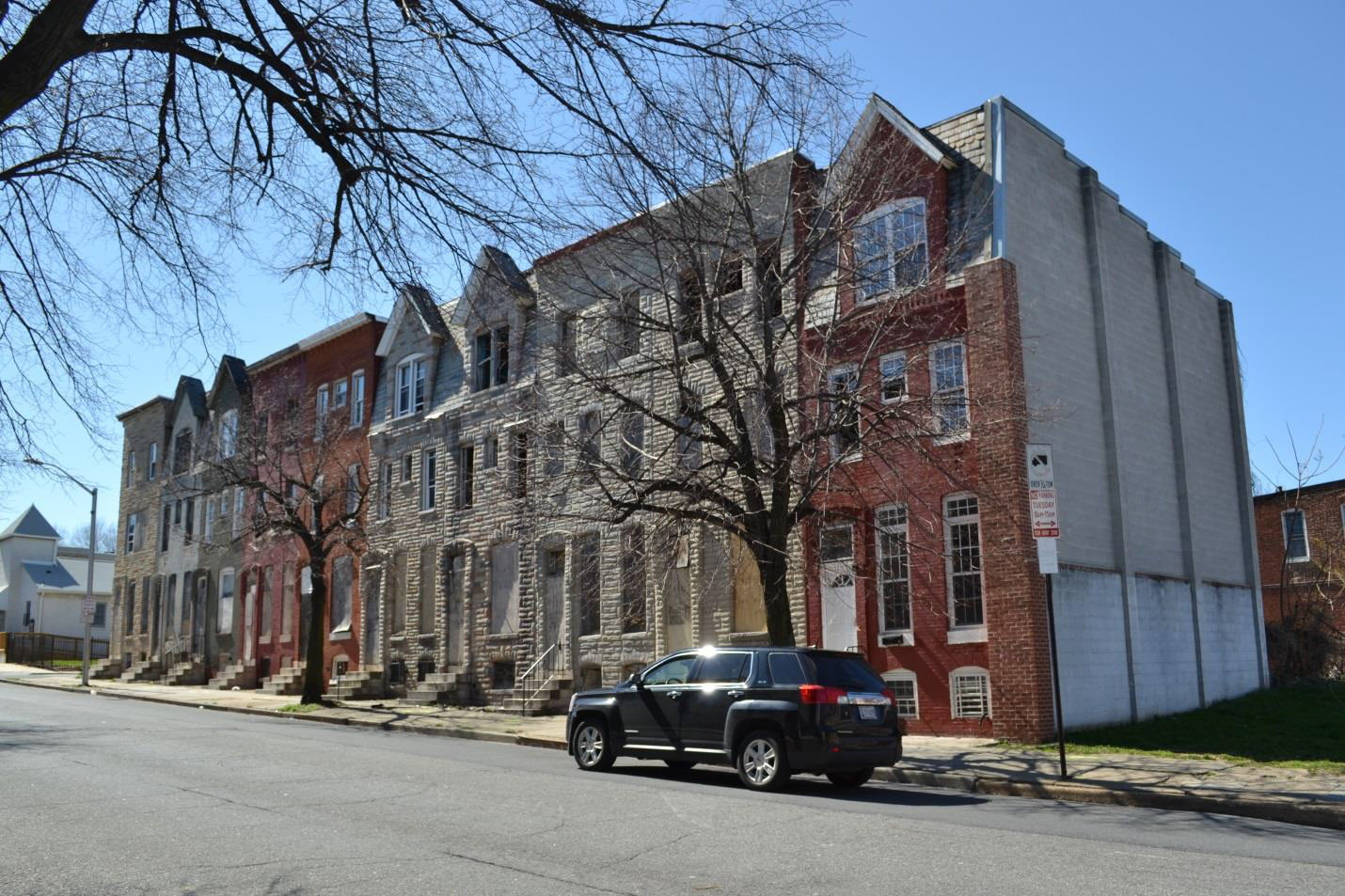
554-572 Presstman Street in Upton. Courtesy DHCD.
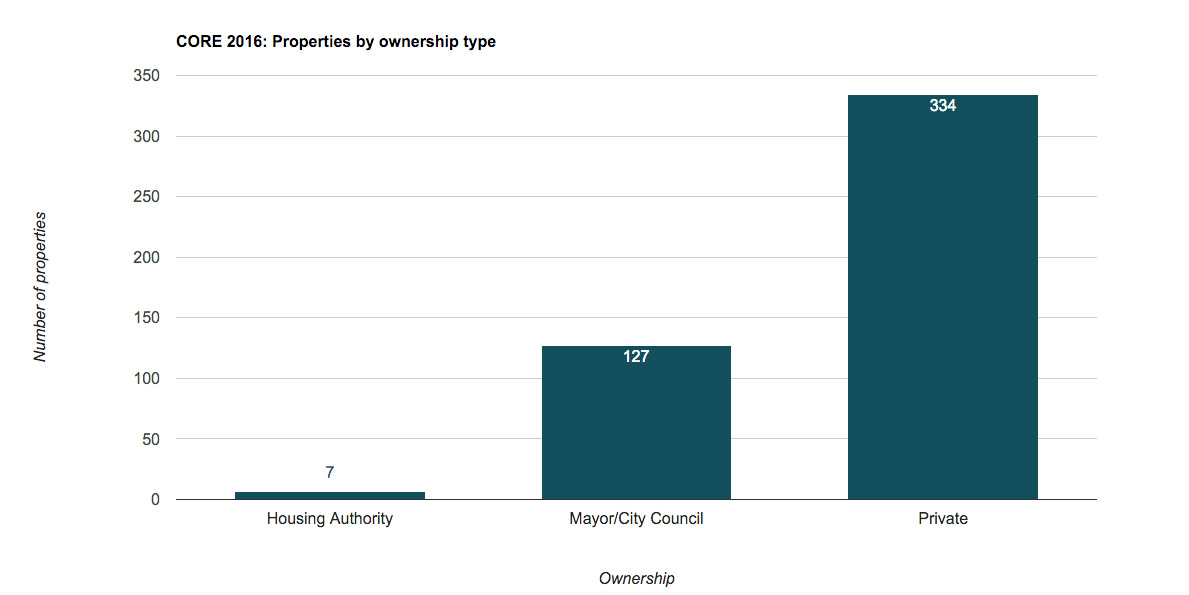
Approximately 71% of the buildings selected for demolition are in private hands, with most of the remaining properties owned by Baltimore City (Mayor/City Council) and a few held by the Housing Authority of Baltimore City.
Neighborhoods with five or more demolition clusters include Broadway East, Shipley Hill, Middle East, and Sandtown-Winchester. About half the of demolition clusters are inside historic districts, including Baltimore East/South Clifton Park, Old West Baltimore, Franklin Square, Old East Baltimore, Coldstream Homestead Montebello, and East Monument. Other affected neighborhoods include Mondawmin, Upton, Coldstream Homestead Montebello, and Central Park Heights
Additional details on the proposal and affected properties are available through the Baltimore Housing demolition map (showing CORE and other funded demolition) and the Baltimore codeMap which shows past demolition projects funded by the 2012 National Mortgage Settlement (labeled as the 2012 AG Demo Cluster) and other sources.
Why are these buildings selected for demolition?
Over a decade ago, Baltimore Housing moved from tearing down individual vacant buildings to tearing down whole blocks. Arguably, this approach saves the city money by avoiding the cost of rebuilding concrete block party walls adjoining still occupied homes. Similarly, the city avoids displacing homeowners or renters where possible—avoiding the cost of relocating residents and purchasing replacement homes.
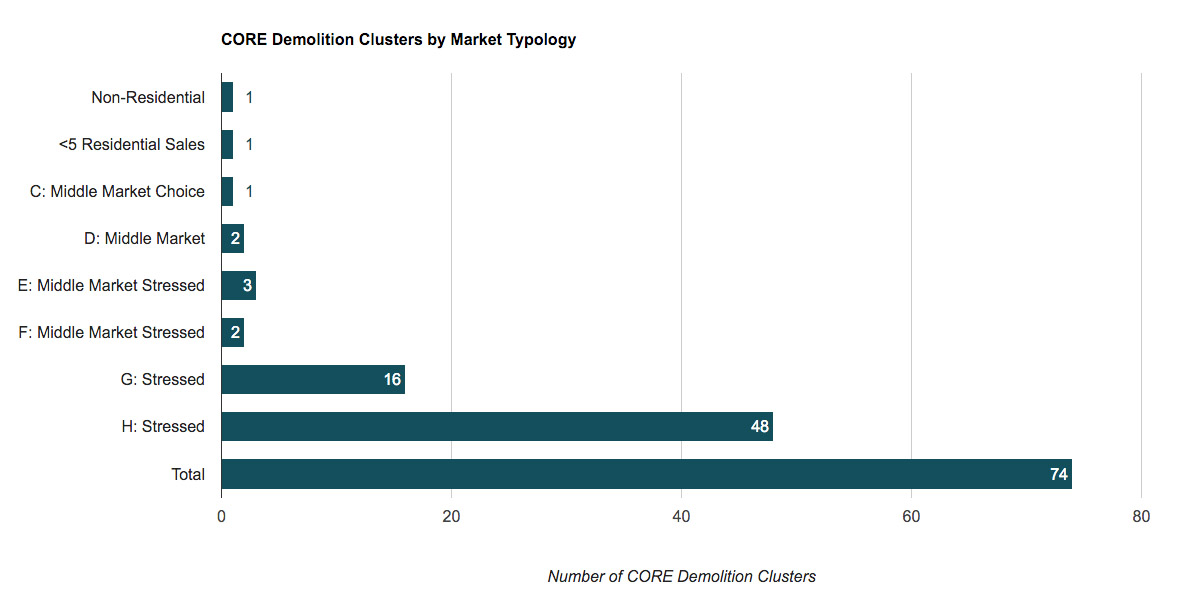
Baltimore Housing has argued for demolition not only for “blight elimination” (removing groups of buildings that may threaten public safety) but also on removing houses in neighborhoods where they believe that the demand for housing is never going to return to a level where private developers can profit from the rehab of distressed vacant buildings. 64 of the 74 CORE demolition clusters are located in these “stressed” markets according to the City’s housing typology.
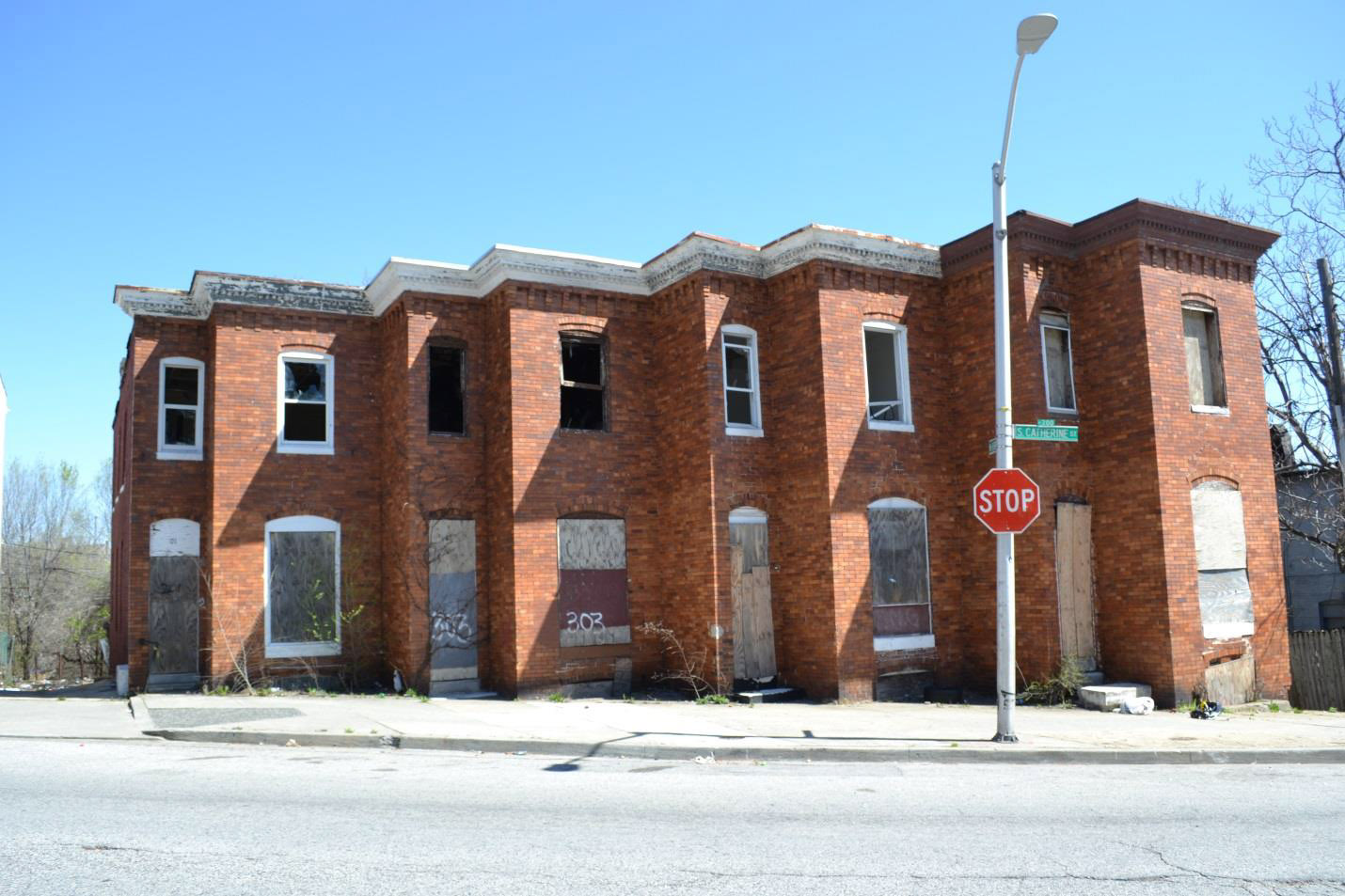
In addition, the city’s demolition strategy is intended to complement other community planning efforts. For example, the buildings in the Shipley Hill neighborhood are targeted for demolition in part to try to improve the safety of students walking to nearby Frederick Elementary School.
301-307 S. Catherine Street in Shipley Hill. Courtesy DHCD.
What can Baltimore Heritage do about vacant houses?
The first step in our efforts on CORE and vacant houses more broadly is to understand the issue and make sure that Baltimore residents have a clear and complete understanding of the proposed demolitions. Vacancy is a complicated issue and community residents deserve a voice in what we do about it.
Unfortunately, many of the traditional tools or incentives used to promote historic preservation—landmark designation or state tax credits for private homeowners—simply don’t help when owners don’t have the money to fix up vacant houses. We must take a more comprehensive approach that acknowledges the necessity of demolition in some cases, fights to fund preservation where possible, and advocates for broader policies (such as investments in public transit) that build opportunity for residents in neighborhoods suffering from decades of discrimination and neglect.
3208-3210 Elgin Avenue in Walbrook. Courtesy DHCD.
The state funding for demolition comes with the requirement that Maryland Department of Housing and Community Development (DHCD) lead a preservation review process that offers Baltimore Heritage and our statewide partner Preservation Maryland an opportunity to comment on the plans and advocate for “mitigation” to offset some of the impact of demolishing historic houses in historic neighborhoods. Of the millions in city and state funds allocated to demolition in the next four years, we are asking CORE to spend 10% on preservation-based approaches to vacant housing. This funding could support:
Stabilization of vacant buildings with potential for reuse
Grants or low-interest loans for private developers to reuse vacant buildings in stressed markets
Support for community partners to work with residents on vacant housing issues
Later this week, we are meeting with DHCD, the Maryland Historical Trust, Baltimore Housing, and our partners Preservation Maryland and the Baltimore National Heritage Area to discuss mitigation and the next steps in the review process. We expect the state to complete this first round of review in the next few weeks.
Moving forward, we plan to follow this issue closely and we welcome your comments, suggestions or questions on vacant housing and preservation and Project CORE.
Update: DHCD has removed two of the demolition clusters from the list. 4116-4118 Hayward (2 properties) and 1113-117 N Collington (3 properties) are now expected to be rehabilitated instead of demolished.