Spring is right around the corner and with it comes a host of new heritage tours. On March 7, we hope you can join us to explore the catacombs underneath Baltimore’s First Presbyterian Church, now called Westminster Hall, and the graves that surround it, including the final resting place of Edgar Allan Poe. March 7 is the first of four tours we’re doing at Westminster: we are offering them again on April 4, May 2, and June 6 and hope you can make it to one of them.
In April, our annual Baltimore by Foot neighborhood walking tour series begins! Please join us and our local guides this year on one or all of the following tours:
At our annual preservation micro-grant event in October, Baltimore Heritage gave archaeologist Adam Fracchia $250 to help with his archaeological exploration of the lives of enslaved people and convict labor at the ruins of the former Northampton furnace iron foundry (near Hampton Mansion). The project has already yielded many fascinating results! Please enjoy our guest blog post by Dr. Fracchia (fracchia@umd.edu) below.
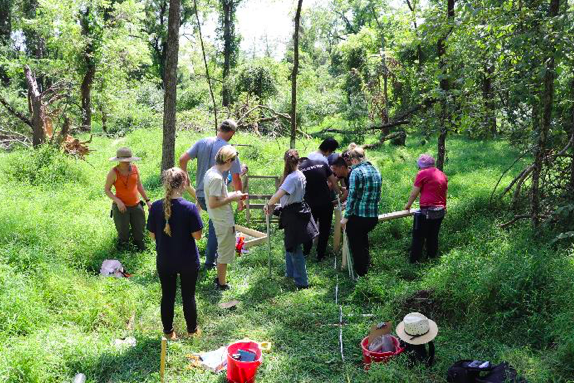
Students began excavating in the early fall of 2019.
In December of 2019, the first season of the Northampton Furnace Archaeology Project came to a successful conclusion. The Project’s goals were to better understand and document the lives of the convicts, indentured servants, and the enslaved peoples forced to work at the iron furnace operated by the Ridgley family from 1762 to the late 1820s. The iron furnace, which produced pig iron and cast iron including cannons and shot used in the Revolutionary War, generated the Ridgley’s great wealth and supported their lavish lifestyle.
The archaeological field school operated through the University of Delaware, Newark, sought to find material evidence of their lives that would add these workers to the history and narrative of the Hampton plantation. Starting in August, the students and I began a field survey of the furnace landscape. They documented and mapped different features on this industrial landscape such as the earthen dam, quarries, the furnace, outbuildings, and structures.
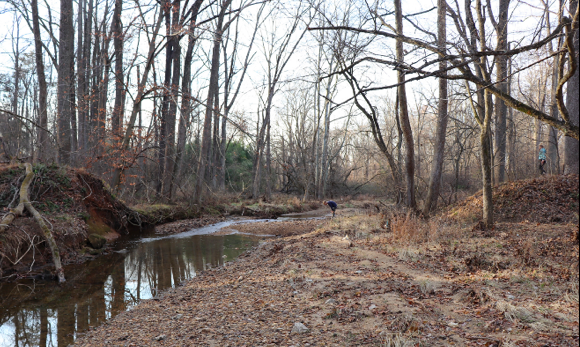
The remains of the earthen dam used to channel water to the water driven furnace bellows.
Through the excavation of shovel test pits, the students surveyed a large area where workers were believed to have lived. Five test units were also excavated around the remains of a structure that may have dated to the period of the furnace. The students were able to document these structures below the surface and map and describe the different soil strata that detail the history of the site. Some artifacts were found dating to the furnace period. Evidence was also found of the farm that post-dated the furnace and was in operation until the flooding and creation of the Loch Raven Reservoir in the early twentieth century.
The students presented their preliminary findings to the public at Hampton NHS in December and the analysis of the archaeological data is currently ongoing. Much of the landscape of the furnace is buried or hidden under the later farm or is more ephemeral. The Project seeks an external contractor to conduct a higher resolution LIDAR scan of the core furnace area. This detailed scan of the elevation would allow us to better locate structures, such as the log houses, where the workers may have been living. This project is just the beginning of an effort to detail the lives of the workers at the furnace. We sincerely thank Baltimore Heritage for their support and encouragement with this project.
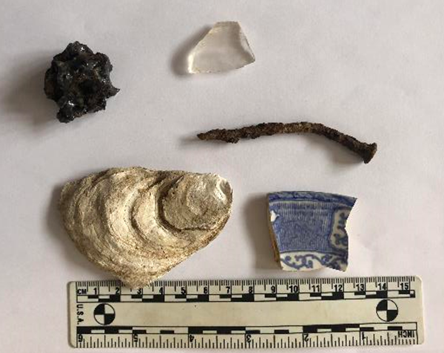
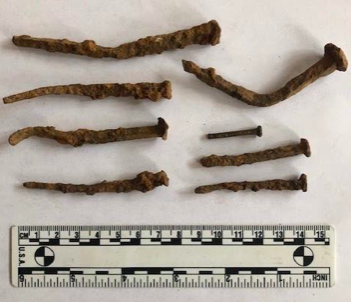
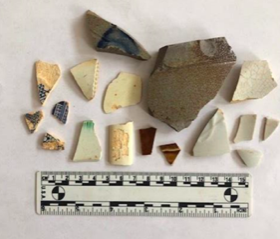
A mix of iron handwrought and cut nails.A mix of fragments of 18th and 19th-century ceramics.
For more information, check out the project’s blog!
Did you know that Baltimore was the capital of the United States for three months during the American Revolution? On February 2, join Baltimore historian and educator Wayne R. Schaumburg as we look at Baltimore and its citizens’ role in the American Revolution.
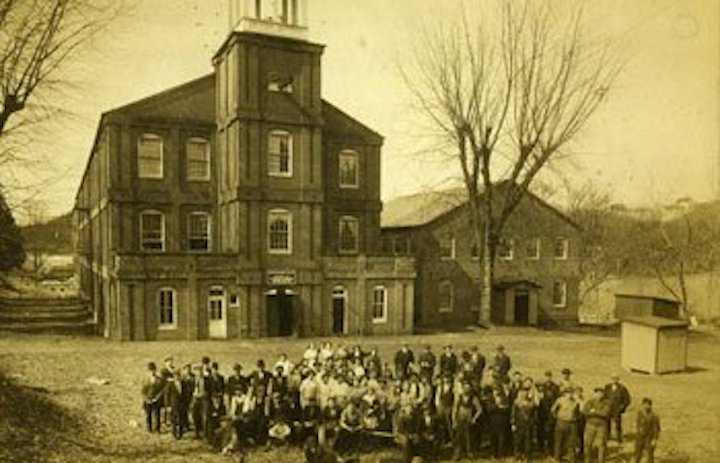
Also, did you know that historic Laurel (today a short hop down Interstate 95) is connected to Baltimore by the B&O Railroad? Originally called Laurel Factory, the settlement started as a 19th century milltown. On February 9, join us and our guide Ann Bennett, Executive Director of the Laurel Historical Society, as we look at restored millworkers houses and the ruins of the mill itself.
Finally, did you know Zeke’s Coffee is a local roaster and a family-owned business? Join us on February 12 in an encore tour to see how Zeke’s roasts its beans and creates its delicious blends. It’s the best smelling tour we’ve been on in a while.
We hope to see you at all or some of these fun events. You may be surprised at what you didn’t know you didn’t know, just like us.
Happy New Year! We are kicking off the year exploring some of Baltimore longstanding historical questions. First up on February 2 is Baltimore historian and educator Wayne R. Schaumburg, who will talk on Baltimore’s role in the American Revolution, including the burning question: did George Washington sleep here?
On February 9, we are pleased that Baltimore historian Jamie Hunt will be back with a Valentine’s Day-themed tour of romance in Mount Vernon. For two centuries, the neighborhood has seen spectacular love stories, bitter feuds, and more than a few juicy trysts. Indulge in sweet intrigue and uncover some Gilded Age gossip with us.
Finally, you may ask how historic Laurel is connected to Baltimore? Originally called Laurel Factory, the settlement started as a 19th century milltown with ties to Baltimore along the B&O Railroad. On February 9, join us and our guide Ann Bennett, Executive Director of the Laurel Historical Society, for a walking tour of the town. As we soak in the historic atmosphere alongside the Patuxent River, you’ll be asking yourself why you hadn’t explored Laurel sooner.
We can’t wait to spend the beginning of 2020 with you at these tours and talks.
We are happy to share that Baltimore Heritage has begun accepting nominations for our 2020 Preservation Awards. Please send us a nomination and help us celebrate award-worthy work, from rehabbing buildings to volunteering as a tour guide or on an archeology dig. Nominations are due February 21 and self nominations are encouraged.
Our awards recognize preservation work of all kinds. Our Heritage Achievement Awards honor people who have made a contribution to Baltimore’s historic buildings and neighborhoods, including authors, advocates, community organizers, and neighbors who volunteer their time and talents.
Our Preservation Project Awards honor owners, architects, contractors, and craftspeople who have completed bricks-and-mortar projects, from restoring a historic rowhouse to creating new spaces in a former brewery or factory. We know that preservation work comes in all sizes and often requires a whole team of people, and we seek to recognize everybody who makes a rehab project happen.