Join us for The Raven Forevermore: A Poe House Fundraiser

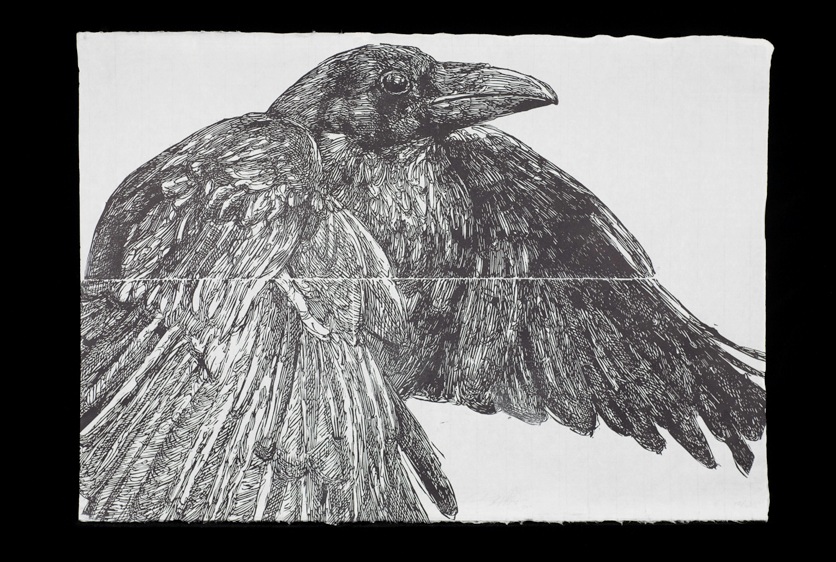
Many of you have heard that after many years of stewardship, Baltimore City is no longer providing funds for the operation, programming and upkeep of the Edgar Allan Poe House and Museum. We are pleased to be a partner in one of the creative efforts underway to raise support for this city landmark. Gaia, a MICA-trained and critically acclaimed emerging artist with gallery shows in Chicago, New York and Washington and street art from Madrid to Seoul, has donated 100 limited edition prints of his block print “The Raven (Forevermore), 2011” to help the Poe House.

We are hosting a special reception with the artist at the historic Railway Express building to learn about the Poe House and raise money for its upkeep through the sale of this generously donated artwork. The invitation-only event is free (even the wine and cheese!) and you will have an opportunity to purchase a print before they go on sale to the public. All proceeds from the sale will go directly to the Poe House. Baltimore art collectors Claribel and Etta Cone had to go all the way to Paris to find up and coming artists like Picasso and Matisse. All you have to do is get yourself to the Railway Express Building. I hope you can join us.

Event Details

July 14, 2011
Urbanite@Case[werks] in the Railway Express Building
1501 St. Paul Street, Suite 116 (across from Penn Station)
6:00 pm to 8:00 pm
Free!
RSVP Today!

Read more

2011 Preservation Awards: Baron and Company Cigars Building

In June, Baltimore Heritage recognized 14 great historic preservation projects and people who have contributed significantly to the preservation of Baltimore’s historic places. Read on over the course of the summer as we cover these buildings and people, beginning with the Baron and Company Cigar Building.

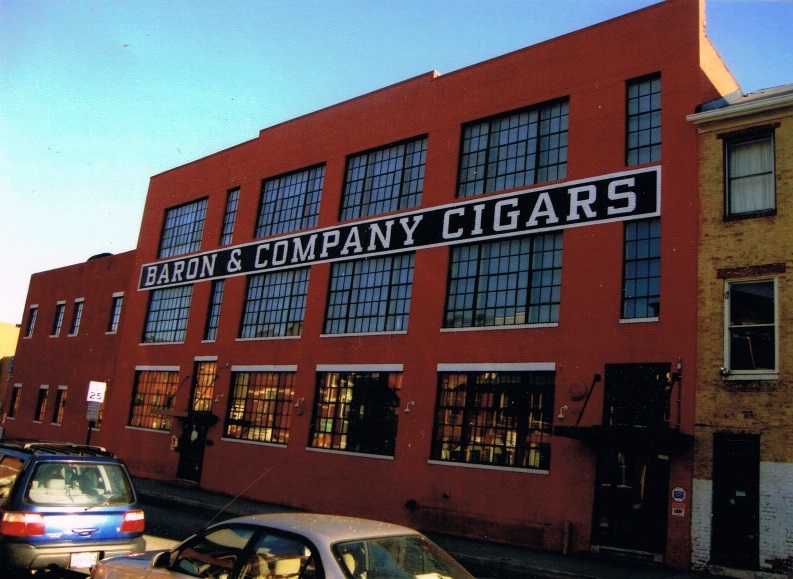
The Baron and Company Cigar building at 1007 East Pratt Street lies within the South Central Historic District, along Central Avenue just east of Little Italy. Most of the structures in this area are vernacular rowhouses but a few, including the Cigar Building, are much larger industrial buildings that help give the area its distinctive flair. Baron and Company Cigars first occupied the space beginning about 1880, and by 1910 a company called the American Coat Pad Company had moved in. American Coat Pad was an apparel company that distributed throughout the United States, Mexico and Canada devoting itself exclusively to the little poofy parts of men’s and women’s coat fronts. In 2010, Mr. James Seay and his company, Premier Rides, Inc., along with Fishell  Architecture, renovated the building into office space for a number of companies and light manufacturers.

The current restoration included saving and restoring existing doors, replicating metal windows where the originals had deteriorated too badly to be salvaged, and keeping the original metal shutters. The interior spaces were largely compatible for light manufacturing, and were kept intact, with much patching of plaster of course. Many of the original interior doors were salvageable and were kept, as was much of the original wooden flooring. Overall, the work seems squarely in keeping with the purposes for which this late 19th century industrial building was built. Starting out life as a cigar company, then as a clothing manufacturer, it has a new lease on life as offices and light manufacturing.

Read on for more shots of the building from before and after this award winning rehabilitation!
Read more

Civil War Archeology in Lafayette Square

The markings of Baltimore’s Civil War heritage are all around us, from downtown landmarks like President Street Station, to military buttons, ceramic ware, and bits of metal of every variety that lie literally under our feet. To help commemorate the 150th anniversary of the beginning of the Civil War this year, please join Baltimore Heritage and the Friends of West Baltimore Squares on July 9 as we dig into the history of Civil War-era Baltimore with an archeological investigation in Lafayette Square. We’re not sure what we’ll find under the topsoil, but we do know that the Square was the site of Lafayette Barracks during the civil war, a military camp and hospital that housed 1000 people strong. With support from the Archaeological Society of Maryland, the Maryland Historical Trust, and the local community, we are conducting an archaeological investigation of Lafayette Barracks, the military camp and hospital located in the park during the Civil War. Please stop by to talk to the archeologists, learn about urban archeology, and West Baltimore’s Civil War history. Throughout the afternoon, we will be offering walking tours, exhibits on the architectural history of the Square, and even grilled hotdogs!

Civil War Archeology in Lafayette Square

Saturday, July 9, 2011
Lafayette Square Park (West Lafayette Avenue & North Arlington Street)
11:00 AM to 3:00 PM
Tours, talks, and exhibits throughout the day and hotdogs at noon. On-street parking available. to look up directions, use 1100 W. Lafayette Avenue, Baltimore 21217.
RSVP Today!

From 1861 through 1865, as the United States were split by civil war, Lafayette Square in West Baltimore became a bustling military encampment and a rich scene of Baltimore’s Civil War life. Originally known as Camp Hoffman–named for Henry W. Hoffman, collector for the Port of Baltimore–the camp housed at least five Maryland Union regiments as well as troops from New York and other northern states. The Camp, including a hospital, sutler’s store, kitchen and parade grounds, served as a rendezvous point for Maryland and Delaware Union troops with as many as to 1,000 soldiers preparing for active duty at a time. In the blocks around the camp, one could find military bands marching down to Jarvis Hospital on Baltimore Street, drunken brawls at local bars between soldiers and civilians, deserters escaping through Druid Hill Park shot down by cavalrymen, and escaped slaves from the Eastern Shore taking refuge with Union troops before seeking freedom to the north. John Scharf, Baltimore’s foremost historian during the late 19th century, described Lafayette Square in 1865 as “filled with ugly wooden sheds, swarming with rough troops, while not one of the elegant mansions now surrounding it had been reared.”

Our archaeological investigation, led by archeologists Brandon Bies, MAA and Dr. David Gadsby, seeks to learn more about people who lived and worked at Lafayette Barracks during the Civil War by searching for any artifacts or surviving physical evidence that they left behind. With a dozen trained volunteers, our team will use metal detectors to search out metal artifacts, such as buttons or bullets, and open up a small area of excavation to search for the remains of Camp Hoffman. Stop by on July 9 to learn more about West Baltimore’s Civil War history and the process of historical archeology. We’ll be leading short walking tours every hour, sharing exhibits on the history and community of Lafayette Square, and hosting the Baltimore Civil War Museum with exhibits on archeology at President Street Station. Please RSVP if you’re planning to join us! Questions? Contact Eli Pousson at pousson@baltimoreheritage.org or 301-204-3337.

Behind the Scenes Tour of Baltimore’s Battle Monument

Did you notice that Baltimore’s Battle Monument at Calvert and Fayette Streets was recently covered in scaffolding and black tarps? What’s happening is a whole-monument restoration effort in advance of the commemoration of the War of 1812 beginning next year. Thanks to the Baltimore Commission for Historical and Architectural Preservation and monument restoration specialists S.A.T., Inc., we have a rare opportunity to peek behind the tarps, so to speak, to learn about the monument close up and how the experts are going about restoring nearly 200 year old marble, iron, and bronze. Please join us!

Battle Monument

Calvert and Fayette Streets
Wednesday, June 29, 2011 | Noon to 1:00 p.m.
$10/members, $15/non-members
RSVP Today!

Please Note: Due to very real space constraints at the monument site, space on this tour is limited to 25 people. Sorry! We’ll fill up on a first to RSVP, first served bases. This is a hard hat tour that may include climbing a few stairs on scaffolding. We will supply the hard hats.
Read more