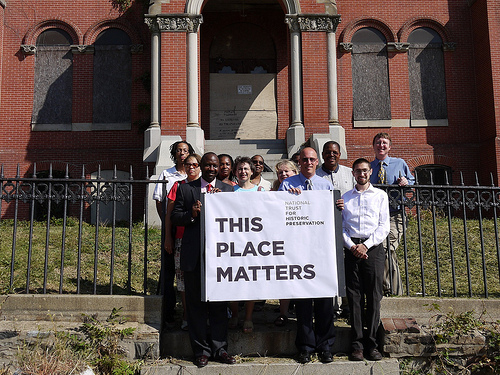
Come out for a short talk on the history of one of West Baltimore’s grandest landmarks: the 1876 Hebrew Orphan Asylum. Generations of Baltimore residents may recall this building as Lutheran Hospital or West Baltimore General, but it began its history in 1876, built by the Hebrew Benevolent Society as a home for Jewish orphans and dependent children. This striking brick castle, designed by the German-born Edward Lupus and Baltimore-native Henry A. Roby, has endured over 130 years and is now the oldest Jewish orphanage building in the United States.
We’ll discuss history of the building and share a look at the efforts by Coppin State University and Baltimore Heritage to preserve and reuse it. The historic Hebrew Orphan Asylum building has great potential to anchor transit-oriented development around the future Rosemont Red Line light rail station. Eli Pousson, Field Officer with Baltimore Heritage in partnership with the National Trust for Historic Preservation, will lead the discussion. Mr. Pousson led the effort to nominate the building to the National Register of Historic Places and continues to work with Coppin State University and the new Friends of the Hebrew Orphan Asylum to support the revitalization of this tremendous Baltimore landmark.
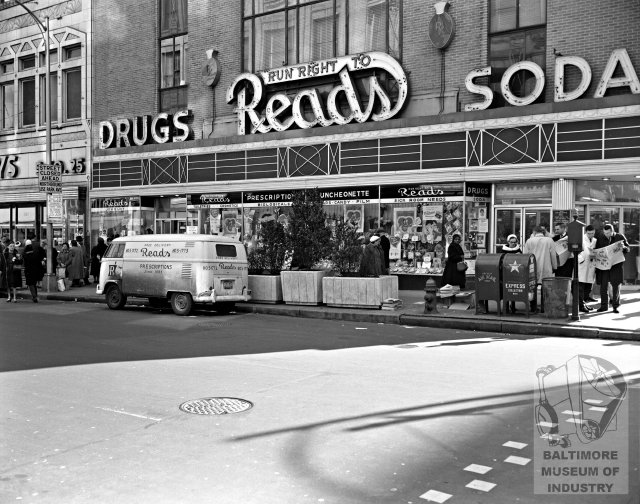
Howard & Lexington Streets 1963, BGE Collection at the Baltimore Museum of Industry
One of the West Side’s least well known but most important stories is the history of the former Read’s Drug Store at Howard and Lexington Streets and its landmark role in Baltimore’s civil rights movement. Built in 1934 by Baltimore architects Smith & May, the press heralded this Art Deco structure as a local landmark from its beginning– a modern flagship store for the Read’s chain, continuing their 50-year presence at the bustling heart of the downtown retail district.
Like many downtown commercial establishments in the early 1950s, the Read’s chain maintained a strict policy of racial segregation at their lunch counters. In 1955, a group of Morgan State students came together with the leadership of the recently organized Baltimore Committee on Racial Equality to organize a sit-in protest at the lunch counter of the Read’s Drug Store at Howard and Lexington Streets. They succeeded in this effort, marking this building as a witness to the first successful student-led sit-in protest in Baltimore and defining a powerful model for the more famous lunch-counter sit-in of Greensboro, North Carolina in 1960. This building is currently threatened with total demolition by the proposed development of the Superblock by the Baltimore Development Corporation and Lexington Square Partners. Baltimore Heritage, together with partners and supporters from across the city, is advocating for the city to reconsider this proposal and encourage the preservation and re-use of this essential landmark in Baltimore’s civil rights history.
You probably know already that this has been a big year for Baltimore Heritage. We brought hundreds of people out to 37 historic buildings and neighborhoods across the city and spent countless hours on research, documentation, and advocacy in neighborhoods including Ridgely’s Delight, Lafayette Square, Fell’s Point, and Downtown’s West Side.
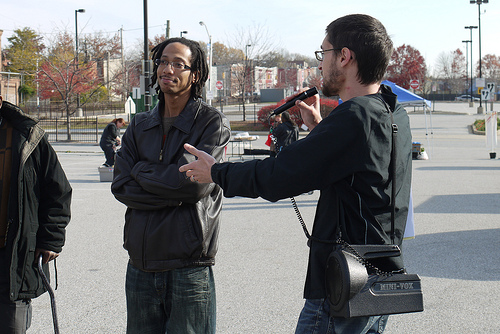
One of this year’s most exciting programs was our fall series on Race and Place in Baltimore Neighborhoods with leaders and scholars in Upton, Greater Rosemont, and Sharp Leadenhall. In Greater Rosemont, we worked closely with members of the Evergreen Protective Association and Dr. Ed Orser from UMBC. Our group met regularly over the summer to discuss the history of the neighborhood and plan a route for our walking tour. When the event finally arrived on October 23, we had an incredible turnout of over 55 people joining us for a tour and staying for a discussion that linked the area’s complicated past to its future revitalization around the Red Line light rail corridor.
We repeated the tour a few days before Thanksgiving with a more modest turnout of 20 people–who still helped to make the last day of the West Baltimore Farmer’s Market a great success as they stocked up on fruits and vegetables for the holiday meal. That afternoon, I received one of the kindest remarks that I heard all year-
“Like all of Baltimore Heritage tours I find myself exploring new places (or old places in a new way) and gaining a deeper understanding of the City. The memory of this tour will carry over to my Thanksgiving meal, and the wonderful fall and winter crops I picked up at the West Baltimore farmer’s market. A wonderful reminder of my own pilgrimage on a warm Saturday morning in November.”
I know that our work matters to my friends and colleagues in West Baltimore and to people across the city. On the last day of the year, please support our work with a small donation of $35, $50, or anything that works well for you. Thank you very much for your generous support and have a happy New Year!
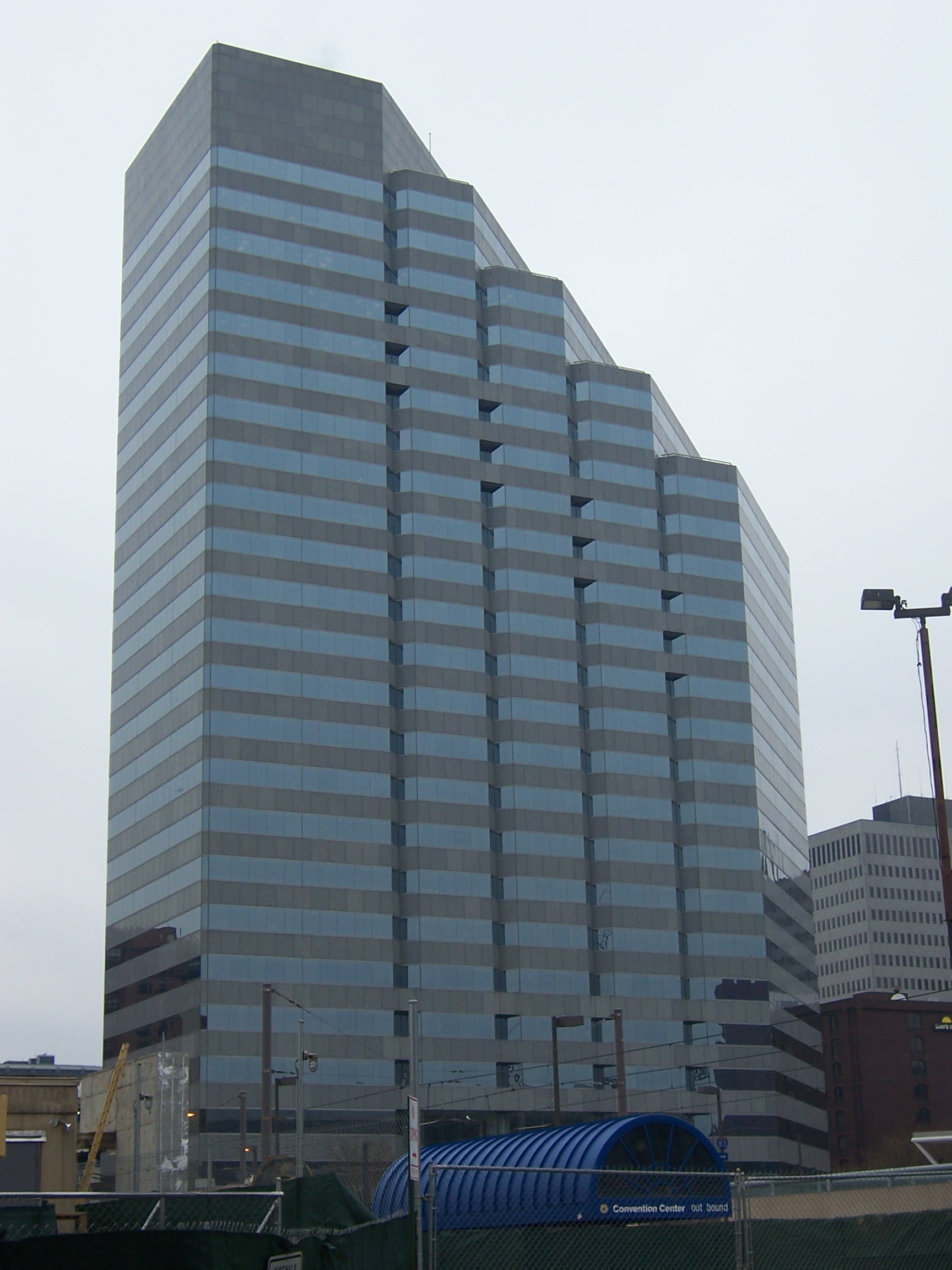
Today’s feature is our final post from Dr. John Breihan in our year long Baltimore Building of the Week series. Thank you to Dr. Breihan for a tremendous exploration of Baltimore’s rich architectural history and the many building’s saved by generations of Baltimore preservationists. At the very end of our 50th Anniversary Year, this week’s feature reflects on the future of architectural history and historic preservation in Baltimore with a discussion of the 1986 250 West Pratt Street building.
Image courtesy Jack Breihan
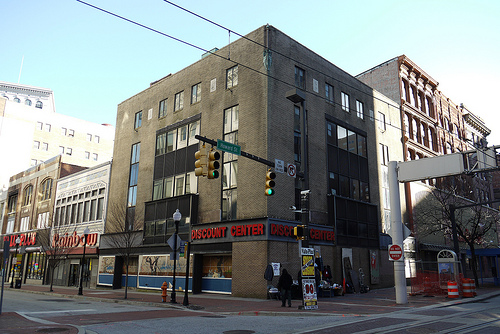
Which of today’s Baltimore buildings will we fight to preserve in the future? My leading candidate is the rather anonymous office tower known only by its address (My suggestion, The Flight of Stairs Building, not having caught on). Designed by America’s foremost corporate architectural firm, Skidmore, Owings, and Merrill, and opened in 1986, 250 West Pratt is sheathed in high-tech polished marble and mirror glass. Here, form does indeed follow function, as the widely-spaced vertical indentations in the principal facades really correspond to structural steel columns bearing exceptionally wide-span beams. Cool and elegantly abstract, this is an iconic building for the decade of the 1980s.
One day around the year 2050, when its air conditioning plant or fiberoptic cables have become hopelessly obsolete, some future development corporation may call for the demolition of 250 West Pratt (which by then will have at least acquired a name, say, Twitter Tower). Baltimore Heritage, then celebrating its centennial year, will again remind Baltimoreans how their beautiful and unique city is enriched and inspired by these buildings and monuments of the past.
One of the most significant challenges on the West Side over the past decade has been the preservation and redevelopment of the “Superblock” bounded by Lexington, Fayette, Liberty and Howard streets. These few blocks include a diverse collection of 19th and 20th century historic buildings reflecting the West Side’s past as a thriving center of downtown retail. Among the many contributing buildings within the West Side’s Market Center Historic District are the 1929 Brager-Gutman Building, the 1938 Art Deco Kresge’s Department Store, and the 1934 Read’s Drug Store to name only a few. In 2001, Baltimore City and the State of Maryland established a preservation agreement (known as the Memorandum of Agreement or MOA) that gave the Maryland Historical Trust the authority to review development proposals on the West Side. By 2003, the Baltimore Development Corporation began soliciting bids on the development of the Superblock, then selected Lexington Square Partners as the developer for the area bounded by Howard, Lexington, Park, and Fayette Streets.
Since 2004, Lexington Square Partners has submitted at least five plans for the redevelopment of the site to the Maryland Historical Trust (MHT) and each time MHT has concluded that the plans do not meet the required preservation standards (Baltimore Brew covered this issue in February 2010). The most recent proposal this past November requires the partial or total demolition of 14 of 17 contributing historic buildings in the area, including the complete demolition of 9 structures, the demolition of all but facades on 5, and the full preservation of only 3 historic buildings. Despite this failure to support the preservation principles created to guide the revitalization of the West Side, just yesterday BDC received a 6-month extension to their agreement with Lexington Square Partners from the Baltimore Board of Estimates.
This is not an abstract debate between the relative merits of historic preservation and economic development. Rather, we are dedicated to successfully joining both agendas, recognizing the potential of the West Side’s historic buildings to contribute to the renewed vitality of Baltimore’s downtown. For example, the former Reads Drug Store at the corner of Lexington and Howard Streets (proposed for demolition in current plans) holds a important place in the city’s history as the site of an early sit-in protest against segregated lunch counters. Built in 1934 on the 300th anniversary of the founding of Maryland, the store features several architectural details on a Maryland theme with panels of sailing ships on the outside. At the bustling corner of Lexington Street and Howard Street, the store served as the flagship location of the Read’s chain located at the heart of Downtown. The building is perhaps most historically significant, however, for its role as a witness to Baltimore’s Civil Rights Movement. On January 20, 1955, Dean McQuay Kiah of Morgan State University, along with the Congress of Racial Equality (CORE) and a group of Morgan students staged a sit-in at this location to protest the racial segregation of Read’s lunch counters. The sit-in led to the desegregation of the entire Read’s chain throughout the region and helped provide a model that guided later and better known student-led sit-ins in places like Woolworth’s in Greensboro, North Carolina in 1960. These exceptional and irreplaceable buildings contribute to the rich architectural heritage of the West Side and should be seen clearly not as barriers but as assets to continued development.