Behind the Scenes Tour of the Secret Paths of Roland Park & Original Home of the Odyssey & Baltimore Lab Schools

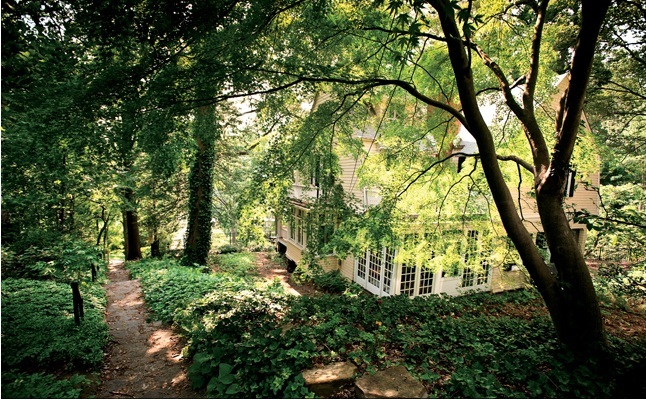
Image of Roland Park courtesy of the Urbanite.

Okay, maybe the footways in Roland Park aren’t that much of a secret, but they are somewhat hidden and are an important part of the neighborhood’s Olmsted design. Please plan to join us for our next Behind the Scenes Tour on Saturday, November 5th at 2:00 p.m. We will start with a short walking tour led by Judy Dobbs of the Friends of Maryland’s Olmsted Parks & Landscapes, who will escort us along some of the Olmsted paths through Roland Park. We will end where we begin, at the house where the Odyssey and Baltimore Lab Schools got their start, 4906 Roland Avenue, for a tour by current owner Ms. Elissa Strati.

Secret Paths of Roland Park & Odyssey/Lab School House

Saturday, November 5, 2:00 pm – 3:30 pm
$10/members, $15/non-members.
RSVP for the tour today!

We will start and end the tour at 4906 Roland Avenue. Parking is available on the street. We will go rain or shine.


The Roland Park Company developed Roland Park in the late 1800s. Incorporated into its plans was a series of 18 footpaths, designed to expedite foot traffic between sections of the neighborhood, especially those where the terrain made it difficult to build roads. Designed by the firm of Frederick Law Olmsted, Jr., the paths were part of a hierarchical system of roads in front of houses, service lanes in the rear, and footpaths that provided convenient ways to cross through the neighborhood in a natural setting. Each path is named with a distinctly country ring: Squirrel, Hilltop, Laurel, Tulip. Others are decidedly British: Audley End, Tintern, St. Margaret’s, Litchfield. In 1991, the paths were refurbished and cedar posts installed with handmade white oak replicas of the original breadboard signs to mark many of the trails.

The house at 4906 Roland Avenue that we will tour has had many lives. Originally built c. 1900 as a single-family home, it has spent much of its life as a place of learning. By 1946 it had become the Homeland Academy, followed in the 1970s by the School of Contemporary Education. In 1994, The Odyssey School opened its doors for the first time for children with language learning differences. In 2000, The Odyssey School moved to its current home in Stevensonville. The Baltimore Lab School, an off-shoot of the Washington DC Lab School, set down its first roots in this house on Roland Avenue until moving to the Old Goucher College building in Baltimore. In 2005, the house was purchased by Alfred and Elissa Strata, who had the arduous task of converting the long-time school back into a single-family home. Ms. Strata will share her tales of discovery and woe in bringing this beautiful turn-of-the-century home full circle to its original purpose.

Support our work through the Maryland Charity Campaign

Our work to protect and preserve Baltimore’s heritage is only possible thanks to the support of members who believe in our mission. If you are a state employee, this is a great time to become a member of Baltimore Heritage by making a gift through the Maryland Charity Campaign. The Maryland Charity Campaign is an annual workplace giving program that offers state employees the opportunity to contribute to charities using a convenient payroll deduction.

Make your gift of $35, $50, or whatever amount is right for you by filling in 5486 on your pledge card or the online form. For the first time this year, you can make an “Evergreen gift,” and your annual pledge amount can continue to renew annually through December 2013. Gifts made via check or credit cards are for one year and do not rollover. If you are not a state employee, you can still become a member by giving online today. In a very direct way, your help makes all that we do possible. Thank you for your past support and for joining us as we expand our leadership in protecting our shared history and revitalizing our historic neighborhoods.

Behind the Scenes Tour of the Tuscany-Canterbury Apartments

Doorway, The LombardyWhere in Baltimore can you stroll the streets and feel you have visited England, France, Italy, and Spain within a few short blocks? Why in the north Baltimore neighborhood of Tuscany-Canterbury, of course. This historic neighborhood offers an eclectic mix of architecture that, somehow, seamlessly blends together very well. Our focus for the next tour will be on the larger architectural gems of the neighborhood, the apartment buildings. Please plan to join us for a short walking tour of the area’s unique apartment buildings followed by a rare opportunity to view the City from the penthouse of 100 W. University Parkway. David Curtin, a local realtor, has graciously offered us a tour of his penthouse apartment, and to share his magnificent view of the City.

Tuscany-Canterbury Apartment Buildings Tour

Wednesday, October 26, 5:30 pm – 7:00 pm
$15/members, $20/non-members. Wine & cheese will be served.
RSVP for the tour today!

We will start the walking tour portion of the tour in front of the Warrington at 3908 N. Charles Street. We will finish at 100 W. University Parkway for wine and cheese, entering on the University Parkway side. Parking is available on the street.

Tuscany-Canterbury in home to several elegant apartment buildings that harken back to a day when apartment dwelling was in vogue. Many units original floor plans rivaled the square footage of nearby single-family homes. We will start our walking tour at the Warrington, designed by the renowned Baltimore architecture firm of Wyatt and Nolting. Built in 1927, it was the first high-rise and was met with much opposition by the neighborhood. In stark contrast, just north of the Warrington is the modernistic Highfield House, designed by German architect Mies van der Rohe, and completed in 1964. It was the second of two buildings designed by Mies in Baltimore; One Charles Center was the first. Highfield House was added to the National Register of Historic Places in 2007.

The Ambassador was built in 1930 by the Mullan Company, and designed by Washington, DC architect Louis Roulou. The lobby is elegantly appointed with Venetian glass and an elaborate ceiling. Along the way we will also get to see the oldest house in Tuscany-Canterbury as well as other single family homes. Our last stop will be at 100 West University, also a Wyatt and Nolting design, where our host David Curtin will share with us his magnificent view of the city from his penthouse garden apartment.

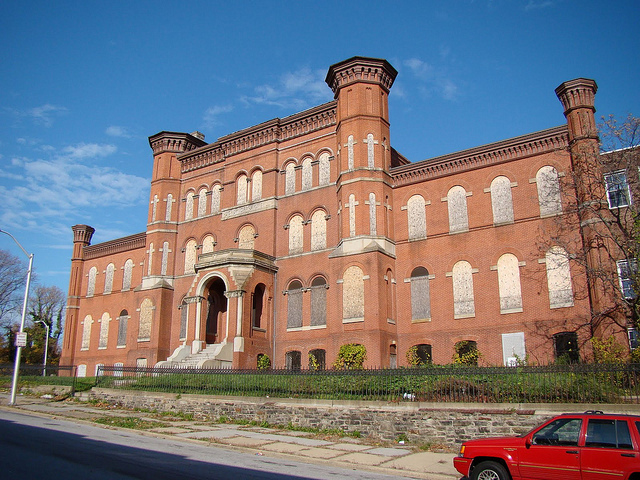
Envisioning a new use for the Hebrew Orphan Asylum

The Coppin Heights Community Development Corporation recently completed a new Hebrew Orphan Asylum Adaptive Reuse Study with support from Baltimore Heritage, Preservation Maryland, and the National Trust for Historic Preservation. This report (available for download here) evaluates the restoration of this rare 19th century purpose-built orphanage and explores opportunities to return the building to use as a center for health care and healthy living. This study is a step forward in our ongoing effort to preserve the Hebrew Orphan Asylum.

In partnership with Coppin State University, the Coppin Heights CDC’s plan calls for creating a healthy foods market and a community health center in the building. Not only would this use provide an essential service to a West Baltimore community with limited access to fresh food and healthcare, it would also continue a rich tradition of social service at the Hebrew Orphan Asylum that began nearly 140 years ago.

Despite this good news, serious concerns remain as the distressed condition of the building–highlighted by the collapse this past February–urgently demands the immediate development of a financing plan to support the building’s stabilization and rehabilitation. Financing for projects similar to the Asylum often comes from a wide range of sources: tax credits, private commercial loans, and private donors just to name a few. To support this effort, Baltimore Heritage and the Coppin Heights CDC worked together to submit an application to the the state and federal historic rehabilitation tax credit programs. If the application is successful, the state and federal tax credits could provide up to an estimated $4,000,000 for rehabilitation– a tremendous investment in the future of the Hebrew Orphan Asylum and the neighborhoods of Greater Rosemont.

Please connect with the Friends of the Hebrew Orphan Asylum on Facebook to show your support for this landmark while following future developments for this great landmark.

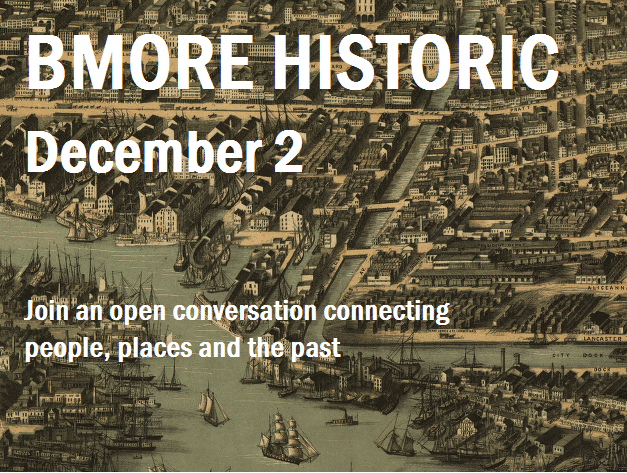
Join an open conversation connecting people, places and the past at Bmore Historic

We’re excited to announce a new event for local historians, museum professionals, preservationists, archivists, activists, scholars, students and anyone who cares about engaging communities around our shared heritage. Join us on December 2, 2011 at the Maryland Historical Society for Bmore Historic— an unconference on public history, historic preservation and community development in Baltimore and across the state of Maryland.

What is an “unconference”?

Anyone who goes to conferences knows that the most productive conversations often take place in the hallway or over drinks at the end of the day. An unconference takes this idea and runs with it. Unlike most traditional academic or professional meetings, an unconference is created and managed by the participants, with the topics of discussion sessions or workshops determined by everyone who attends on the day of the meeting, rather than in advance by the organizers. New unconferences are being organized around the country with examples including PubCamp for professionals in public media, Book Camp on books & publishing, THATCamp for scholars working with digital humanities, and (locally) CreateBaltimore unconference for art & technology. You don’t need to worry about preparing a PowerPoint or a formal paper, we’re just looking for people who are excited about historic places and ready share their knowledge and collaborate with

Why should I participate?

Bmore Historic is an opportunity to share your work, learn from others, get new ideas and develop new partnerships. This meeting is not limited just to scholars or professionals. Students, volunteer preservation activists, Main Street board members, museum docents, educators and others are all encouraged to register and attend. We hope that Bmore Historic can help strengthen connections between people who work with public history, preservation and community development across the region while expanding the diversity of the broader heritage community.

How do I register?

Online registration for the meeting is now open on our website. We’re accepting registrations on a first come, first served basis with confirmations starting in early November. After we confirm your registration, you’ll have a chance to share your session ideas in a blog post on the Bmore Historic website and check out ideas from other participants.

What does it cost?

We’re committed to charging $20 or less. With the space generously donated by the Maryland Historical Society, our costs are limited and we’re currently seeking funds to reduce the charge for all participants. This charge will be finalized by early November. If you are interested in sponsoring Bmore Historic, please get in touch with Eli Pousson at pousson@baltimoreheritage.org.

We’ll kick off the meeting on the evening of December 1 with “Giving the Past Presence: Public History Experiments in New York City” — a UMBC Humanities Forum with Marci Reaven, former director of City Lore and co-founder of Place Matters. We hope this talk can provide an inspiration for the conversations the next day. On December 2, we’ll be at the Maryland Historical Society with sessions in the morning and afternoon. Breakfast and lunch are both provided.

Bmore Historic is being organized in partnership with the Greater Baltimore History Alliance, the Maryland Association of History Museums, the Maryland Historical Society, the Maryland Historical Trust, Preservation Maryland, and the UMBC Orser Center for the Study of Place, Community, and Culture. If you have any questions, please get in touch with Eli Pousson at pousson@baltimoreheritage.org or 301-204-3337. We hope to see you in December!