As we head towards the end of the year, I want to say thank you to all of our volunteers, supporters, and members for making this another exciting year of preservation and education at Baltimore Heritage. I also want to ask you to renew your membership (if you haven’t already!).
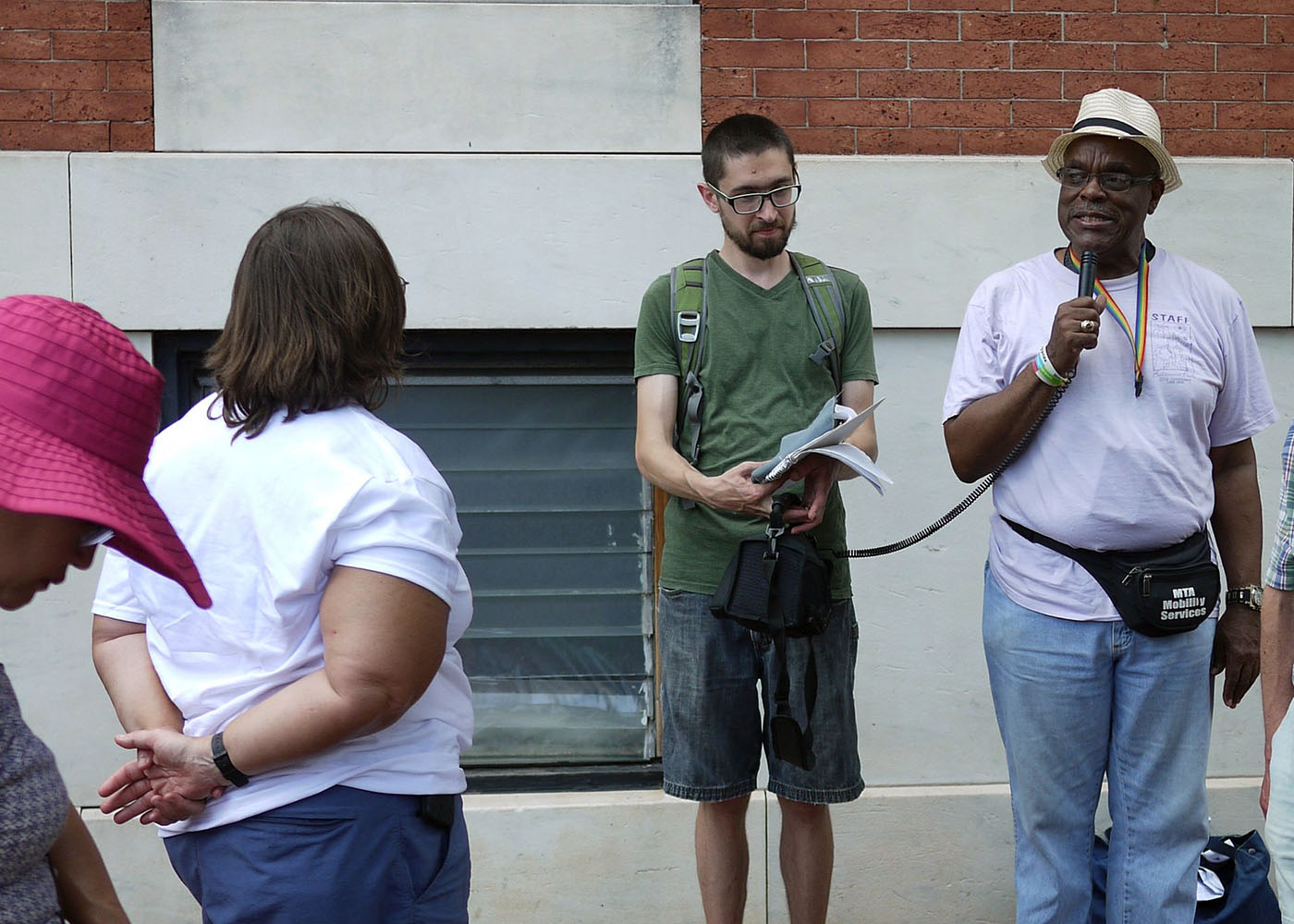
Eli Pousson and Louis Hughes, Mount Vernon Pride Walking Tour. Photograph by Nicole Stanovsky, 2015 May 31.
Membership giving is the largest single source of support for our organization every year. Contributions from members are critical for all that we do, from the Centennial Homes program honoring Baltimore families living in the same house for a century or more to the walking and building tours we organize throughout the year.
Member support also has given us the foundation to launch two major new initiatives in 2015. The first is Baltimore’s Civil Rights Heritage: Looking for Landmarks from the Movement—a partnership with the Maryland Historical Trust to document and preserve places associated with the long history of the Civil Rights movement in Baltimore. Of course, this effort became even more urgent in November with the demolition of Freedom House, the home to Baltimore’s first black City councilman and the long-time headquarters for the NAACP.
The second project is our new Local Preservation School—a unique effort supported by the National Park Service to build an open online educational resource for volunteer preservation advocates around the country. We’re looking forward to offering our first course—Explore Baltimore Heritage 101—in January 2016. This free class will teach people both online and in person how to research and write about historic places.
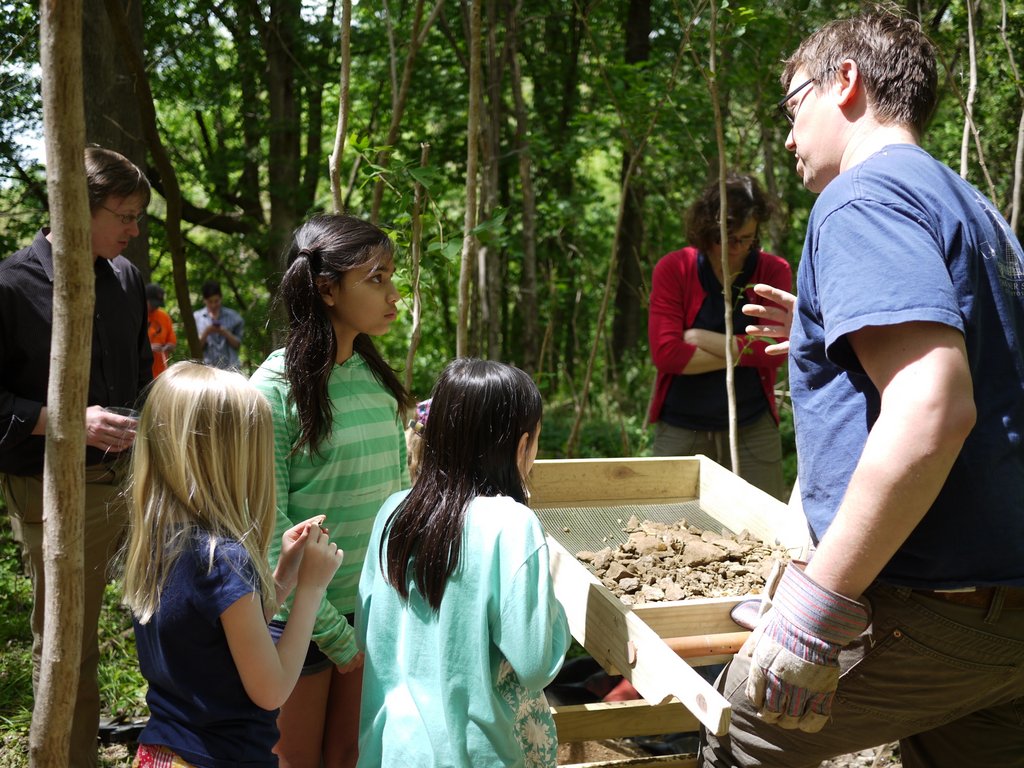
With your help, the year ahead is full of promise and opportunity. You can count on a full year of walking, biking, and historic building tours. With our community partners in Northeast Baltimore, we are working to bring public archaeology back to Herring Run Park in the spring. And, of course, we are continuing our advocacy to preserve and revitalize irreplaceable historic places from the West Side of downtown to the Hebrew Orphan Asylum.
Photograph by Eli Pousson, 2015 May 13.
Membership begins at $35 for individuals and $50 for families and it only takes a few minutes to donate through our website. Thank you again for your support.
P.S. Baltimore Heritage membership makes a great holiday present! With tour and event discounts, it is a gift that keeps on giving throughout the year. Please email me at hopkins@baltimoreheritage.org or call 410-332-9992 for more information.
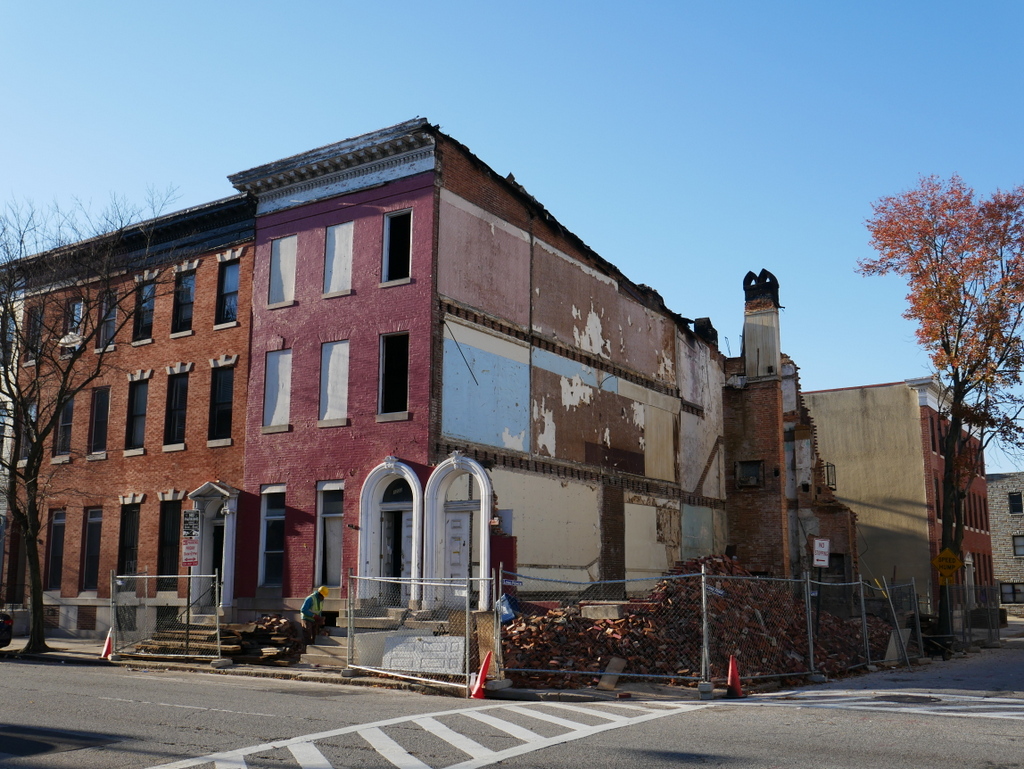
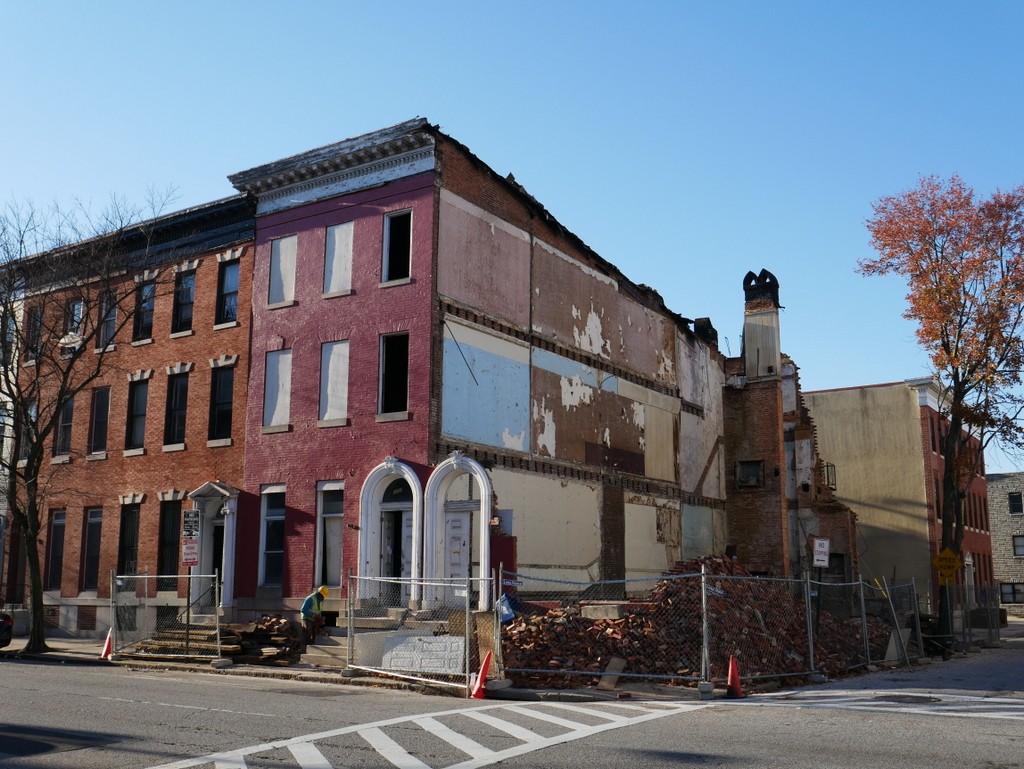
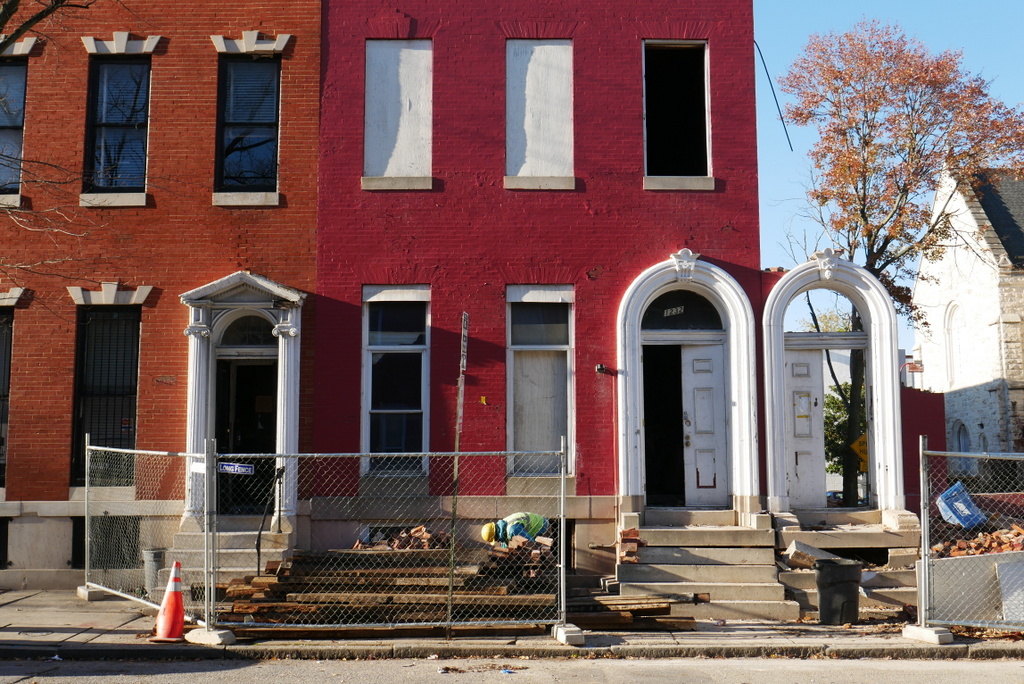
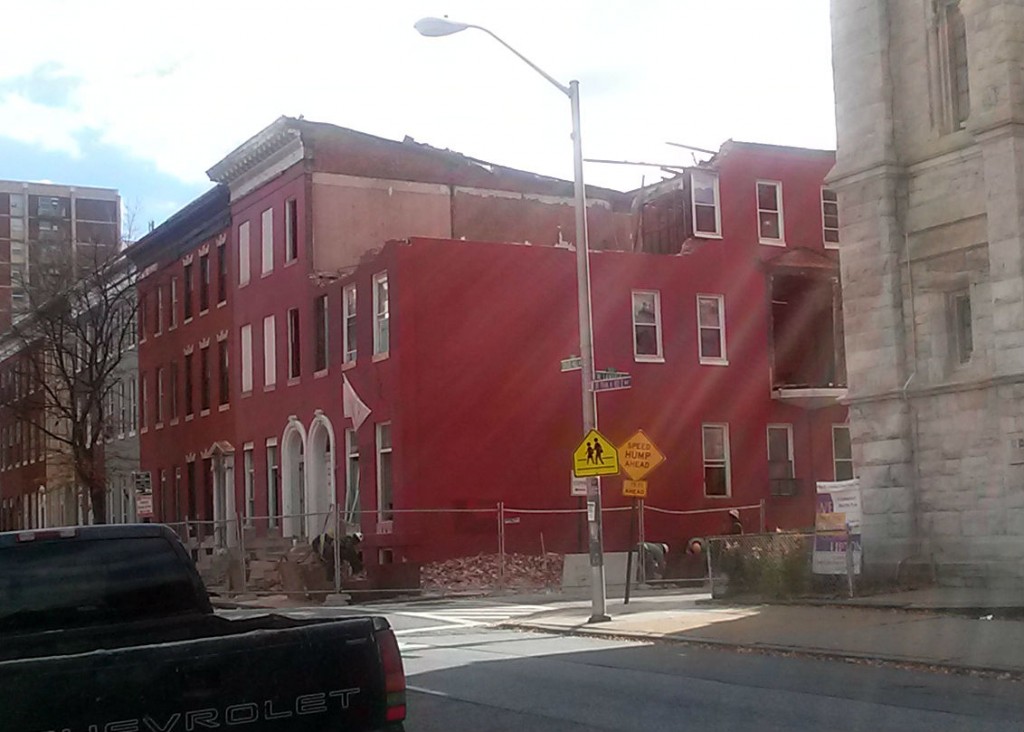
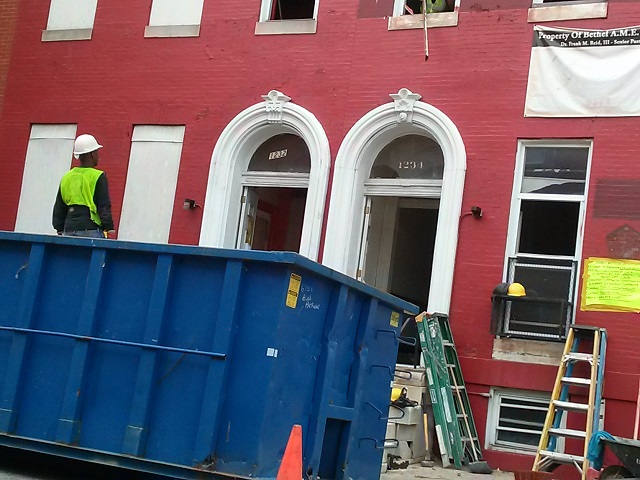
1234 Druid Hill Avenue had a story unlike any other. Harry S. Cummings, Baltimore’s first black City Councilman lived at the handsome rowhouse with his family from 1899 to 1911. In the 1950s and 1960s, the building served as offices to the local chapter of the NAACP, hosting Martin Luther King and Eleanor Roosevelt when they came to Baltimore to work with key leaders like Lillie Mae Carroll Jackson. In 1970, the property became “Freedom House” and continued to serve as a central hub of activism before Dr. Jackson donated the house to Bethel AME Church in 1977. Today, the house is demolition site piled high with bricks and debris.
Yesterday afternoon, Baltimore Heritage supported a rally organized by civil rights and heritage leaders Marvin Cheatham and Louis Fields to protest the demolition of the Freedom House by Bethel AME Church and start a conversation around saving threatened historic Civil Rights landmarks in the neighborhood. As we shared on Wednesday, members of the Marble Hill Community Association, who have been working to encourage the preservation of the Freedom House for years, were unable to stop the demolition when they contacted city officials with concerns in September and October. Regrettably, Baltimore Heritage only learned about this issue after the demolition began.
1232-1234 Druid Hill Avenue, 2015 November 13
You can read more about the rally in the Baltimore Sun or see coverage from WJZ CBS. We are seeking a meeting with the leadership of Bethel AME Church and City Councilman Eric Costello to better understand how this demolition took place and what we can do to protect the building next door at 1232 Druid Hill Avenue from the immediate threat of demolition. We are also working with Baltimore’s preservation commission and neighborhood residents to expand the boundaries of the Upton’s Marble Hill CHAP District.
Where do we go from here?
The rally gave our community a place to voice concerns and to make plans for the future. We lost one important building this week but there are many more that still need our help. We have already identified seven Civil Rights landmarks in Upton alone that are threatened by neglect. You can help by sharing your knowledge about buildings or sites associated with Baltimore’s Civil Rights movement more information about these and other properties or by exploring our map of Civil Rights site to learn more.
Here are three of the buildings in historic Marble Hill that we are working to preserve:
Mitchell Family Law Office
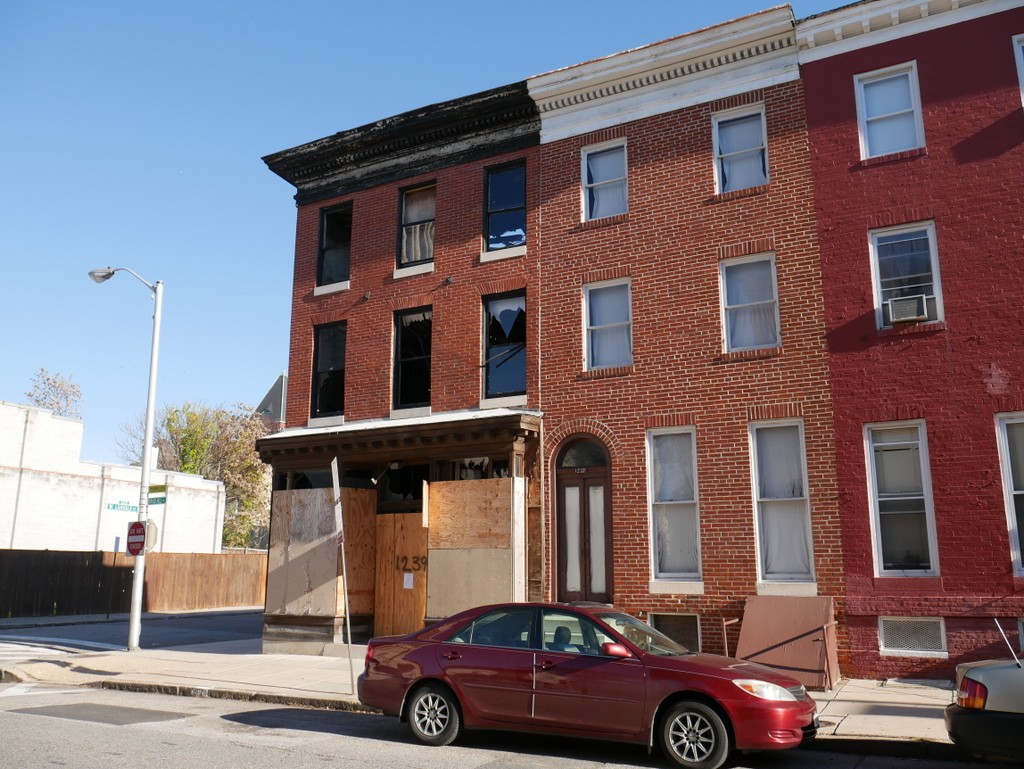
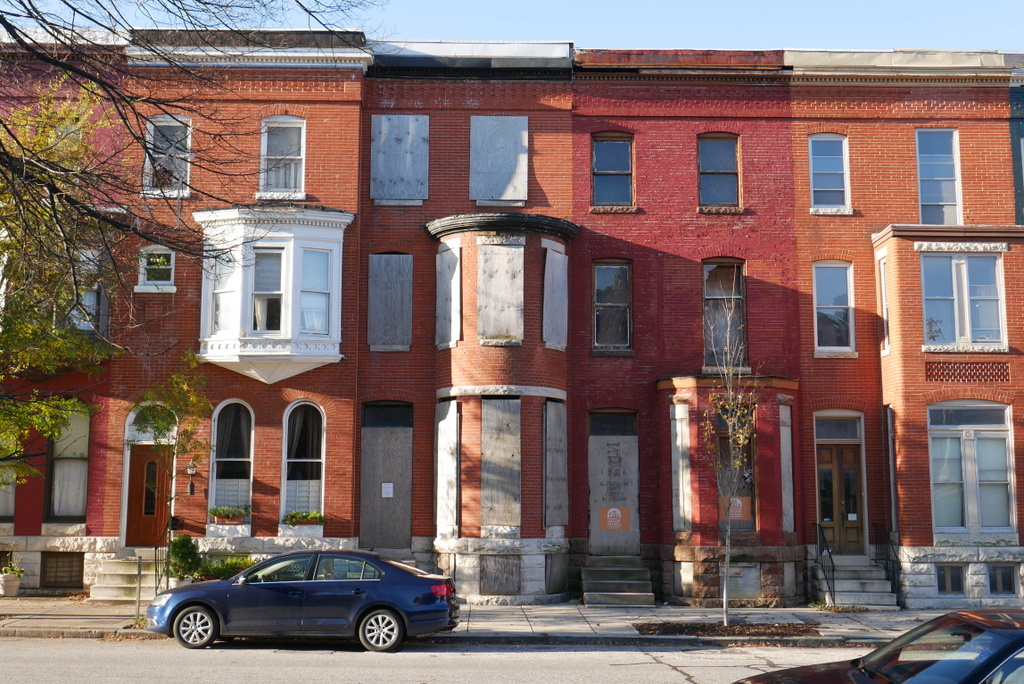
1239 Druid Hill Avenue, 2015 November 13
1239 Druid Hill Avenue served as law offices for Juanita Jackson Mitchell, Clarence Mitchell, Jr. and other members of the Mitchell family. An accomplished lawyer and activist, Juanita Jackson Mitchell organized the Citywide Young People’s Forum in the 1930s to push for more opportunity for black youth during the Great Depression. Clarence Mitchell, Jr. served as the long-time lobbyist for the NAACP and played a key role in the passage of major Civil Rights legislation. The roof of 1239 Druid Hill Avenue collapsed during the winter of 2014 and the building is severely threatened by neglect.
Juanita Jackson and Clarence Mitchell, Jr. House
1324 Druid Hill Avenue, 2015 November 13
Juanita Jackson and Clarence Mitchell moved to 1324 Druid Hill Avenue in 1942, the same year Clarence started working at the Fair Employment Practices Commission set up by President Roosevelt to fight workplace discrimination during WWII. Visitors at the home included Paul Robeson, Duke Ellington, and Marian Anderson. The couple raised five sons at the house and continued to live there until the end of their lives. Baltimore City stabilized the roof and rear wall of the building in 2013 but it remains vacant and in poor condition.
Druid Health Center/Home of the Friendless
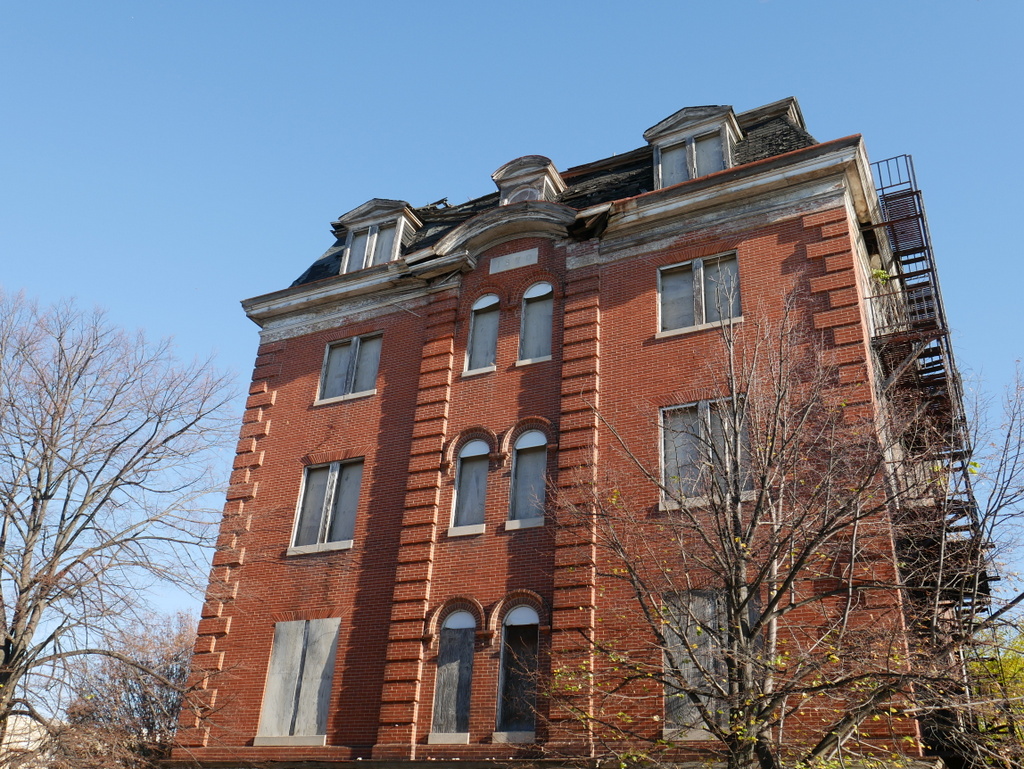
1313 Druid Hill Avenue, 2015 November 13
A former orphanage (listed on the National Register of Historic Places as the Home of the Friendless), the Druid Hill Health Center at 1313 Druid Hill Avenue was the first public health center for African Americans in Baltimore. Years of vacancy and neglect have caused the building to deteriorate and neighborhood residents have pushed the city to stabilize the structure without success. A local developer recently submitted a proposal for 14 artist residences with preliminary support by the Marble Hill Community Association.
Why are we fighting to save Civil Rights heritage?
We believe that these buildings are important for the stories they hold and the lessons they teach. We also recognize that we cannot separate historic preservation from the difficult issues of vacancy and disinvestment in Upton and in many of Baltimore’s historically African American communities. To save Baltimore’s Civil Rights sites, we must listen to the people who live nearby and work together to revitalize their neighborhoods.
We do not yet have the solution to the decades-old problems of disinvestment that threaten so many homes in Marble Hill, but we do believe that preserving historic buildings is part of a solution. The stories behind these buildings help us understand Baltimore’s history of segregation and discrimination—a history that still contributes to challenges in these neighborhoods today. As Baltimore’s own Frederick Douglass remarked in 1884:
It is not well to forget the past. Memory was given to man for some wise purpose. The past is… the mirror in which we may discern the dim outlines of the future.
With Frederick Douglass’s words in mind, we are working to turn Civil Rights landmarks throughout the city back into assets for Baltimore neighborhoods and address the inequality that continues in too many Baltimore communities. Please help us find ways to save our city’s diverse heritage and build a stronger and more equitable future for Baltimore by contributing to our growing list of identified Civil Rights heritage sites and subscribing for updates on this important work.
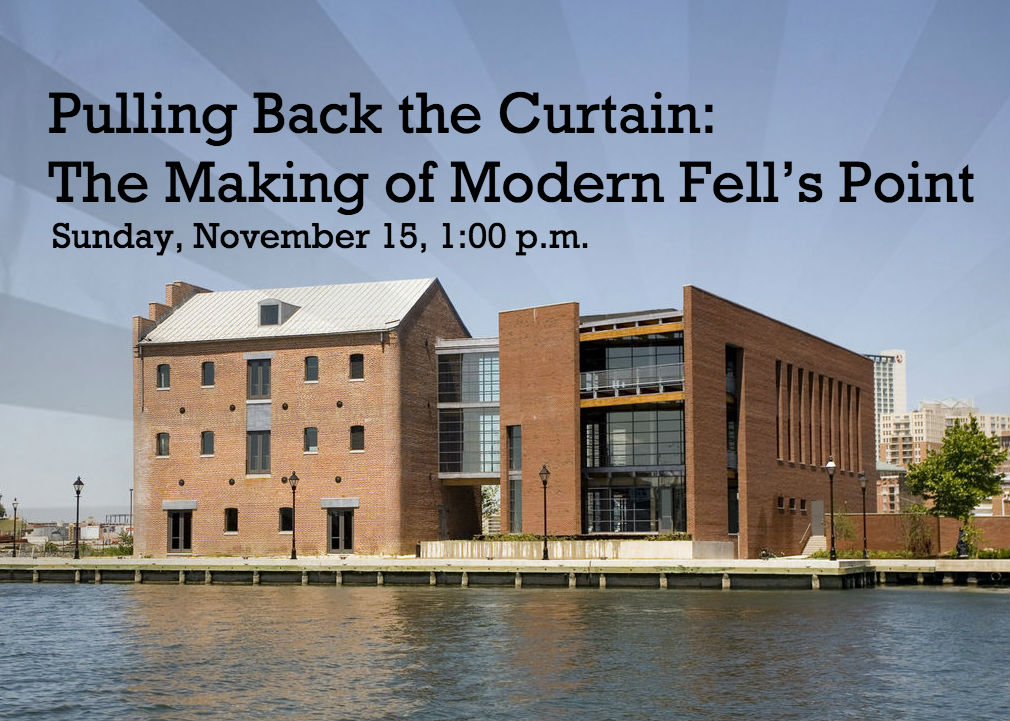
This Sunday, November 15, architect David Gleason is leading the final walking tour of Fell’s Point in our series celebrating the 250th anniversary of the Robert Long House with the Preservation Society. Mr. Gleason’s tour will focus on the making of modern Fell’s Point, from the fabled “Highway Fight” in the 1960s and 1970s to ongoing efforts to ensure that this waterfront community retains its charm.
We are also pleased to announce two holiday-themed tours in early December. On December 1, we are exploring Mt. Clare, the richly preserved 1760 colonial home of Charles Carroll that will be decked out for the holidays. And on December 9, you can find us at St. Mary’s Seminary, the grand edifice on Northern Parkway that is home to the nation’s oldest Catholic seminary.
Finally, if you haven’t yet been up in the Washington Monument or Patterson Park Observatory, join our Monumental City Sunday morning tours of these great places this month.
Special thanks to Lisa Kraus, volunteer with the Northeast Baltimore History Roundtable, for sharing this guest post on a new preservation issue in the Westfield neighborhood.
Nestled in a tiny patch of woods at the heart of Northeast Baltimore’s Westfield neighborhood, the Christopher Family Graveyard has been all but forgotten over the last fifty years. An unknown number of Christopher family members were buried in the plot sold out of the family in 1962. Over the years, the lot has become overgrown, and only a few neighbors and family members remember that the cemetery is even there. The tombstones that once marked the graves have been displaced, damaged by vandalism, and stolen. Now there is a new proposal by the property-owner to develop the land and place a road where the cemetery still stands.
Family cemeteries like this one pose a unique set of problems not only for the descendants of the people buried there, but for city planners, developers, and neighbors. The state agency that oversees graveyards, the Maryland Office of Cemetery Oversight, does not regulate abandoned cemeteries, family cemeteries, or non-operational cemeteries. Cemeteries are sometimes listed in the National Register of Historic Places if they meet special criteria but small family cemeteries do not generally qualify. Even if they did, listing in the Register does not afford any protection if the land is privately owned. And while these resting places may contain valuable archaeological data, their cultural significance as inviolate places where the dead are memorialized typically takes precedence over any research questions their excavation might help to address.
The preservation threat to the Christopher Family Graveyard highlights questions that often arise when a family burying-place is found unexpectedly on land slated for development. How do cemeteries vanish from official documentation such as land records? How old is the cemetery, who is buried there, and how long was it in use? How many burials might there be, and what can be done to find out? And perhaps most important of all: who decides the fate of this modest family burial plot?
Baltimore Department of Public Works 1941 Survey
Intensive historical background research can address some of these questions. The Christopher Family Graveyard appears in maps and surveys as late as 1941, but current maps do not depict a cemetery at this location. This appears to be due, at least in part, to the manner in which the land was transferred away from the Christopher family in the early 1960s. The property was foreclosed upon by the City, and subsequently sold to a non-family owner. While our research is continuing, one consequence of the foreclosure and sale by the City was that the subsequent deeds for the property did not mention the cemetery.
Although the foreclosure, makes it difficult to trace the land back using deed research, but with diligence, this obstacle can be overcome. The land records reveal that the Christopher family lived on the land that included the quarter-acre plot set aside for the cemetery from 1773 until the land was foreclosed in 1962. The land parcel was known, in the 18th century, as “Royston’s Study,” and was originally surveyed for John Royston in 1724. John Christopher purchased Royston’s Study, which originally included fifty acres, on July 29, 1773.
1851 Deed to John Gambrill.
The cemetery first appears in a deed dated October 2, 1851, in which all the land, except the quarter-acre containing the graveyard, was sold to John Gambrill, with the following provision:
“reserving, however, the right to access to and egress from the said graveyard, over the land hereby conveyed, to the heirs and relatives of said John Christopher, deceased, at and for the sum of two thousand dollars.”
Although the land was sold, the family of John Christopher (most likely the son of the John Christopher who originally purchased of the land) paid the Gambrills for the right to access the family plot, which remained in their possession.
The following year, Elijah Christopher bought back a little more than two acres of the family property. According to the 1860, 1870, and 1880 federal census, Elijah worked as a wheelwright and carriage maker, an occupation that undoubtedly benefited from the property’s location fronting on Harford Road (known then as the Baltimore and Harford Turnpike). Elijah and his family remained on the property, and likely handed it down through the generations until 1962. Elijah appeared as the owner of the parcel on G.M. Hopkins’ 1877 Map of Baltimore.
G.M. Hopkins’ 1877 Map of Baltimore. JScholarship.
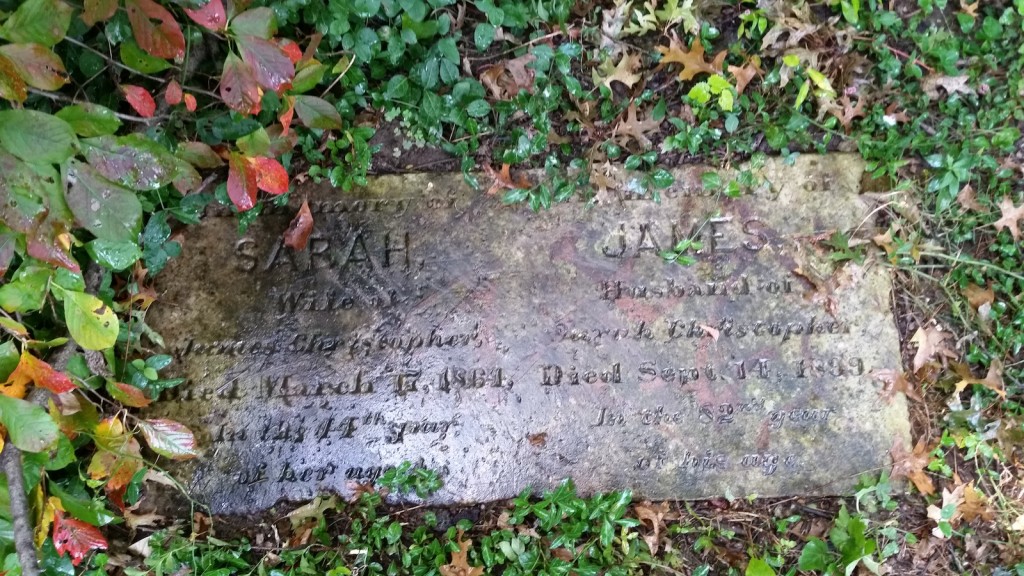
That the cemetery exists is not only demonstrable through an examination of land records; one headstone remains on the plot, that of James and Sarah Christopher. James’ date of death is listed as 1899.
Without conducting a careful excavation of the cemetery and the area immediately surrounding it, it is impossible to know the number of burials that may be present. Although the fact that the quarter-acre plot was reserved in the 1851 deed of sale suggests that the burials could be confined to that one parcel, the family had occupied the land for almost eighty years by that time. It is possible, even likely, that burials exist outside the known cemetery boundaries.
As for what will become of the little cemetery, that has yet to be seen. Human remains, gravestones, monuments and markers may be removed from an abandoned, private cemetery, if the removal is authorized by the local State’s Attorney. State law then requires remains and any markers to be placed in an accessible place in another cemetery.
In addition, cemeteries can be sold for other uses if a court decision is made in favor of redeveloping the land. The court generally requires the proceeds from the sale of the land to be used to remove all human remains and monuments from the property. When a judgment for the sale of a cemetery for use for another purpose has been entered, the buyer of the cemetery receives the title to the land free of the claims of the owners of the cemetery and of the holders of burial lots in the cemetery.
Was this issue the subject of the 1965 court case? Have the burials already been removed? If so, these facts remain to be documented, and it seems unlikely, since several current neighbors remember more monuments being present as recently as ten years ago. The descendants of the Christopher family who still live in the area have a variety of preferences concerning the development of the land, but all agree that at a minimum, they wish to ensure that their ancestors’ graves are either avoided by the proposed development, or else moved before a cul-de-sac is constructed over the cemetery parcel.
Last week, Bethel AME Church demolished 1234 Druid Hill Avenue, a rowhouse located just outside Upton’s Marble Hill historic district with strong connections to Baltimore’s Civil Rights movement. The demolition came as a shock to neighborhood activists who had urged city officials to investigate and protect the property when Bethel AME began work on the building in late September.
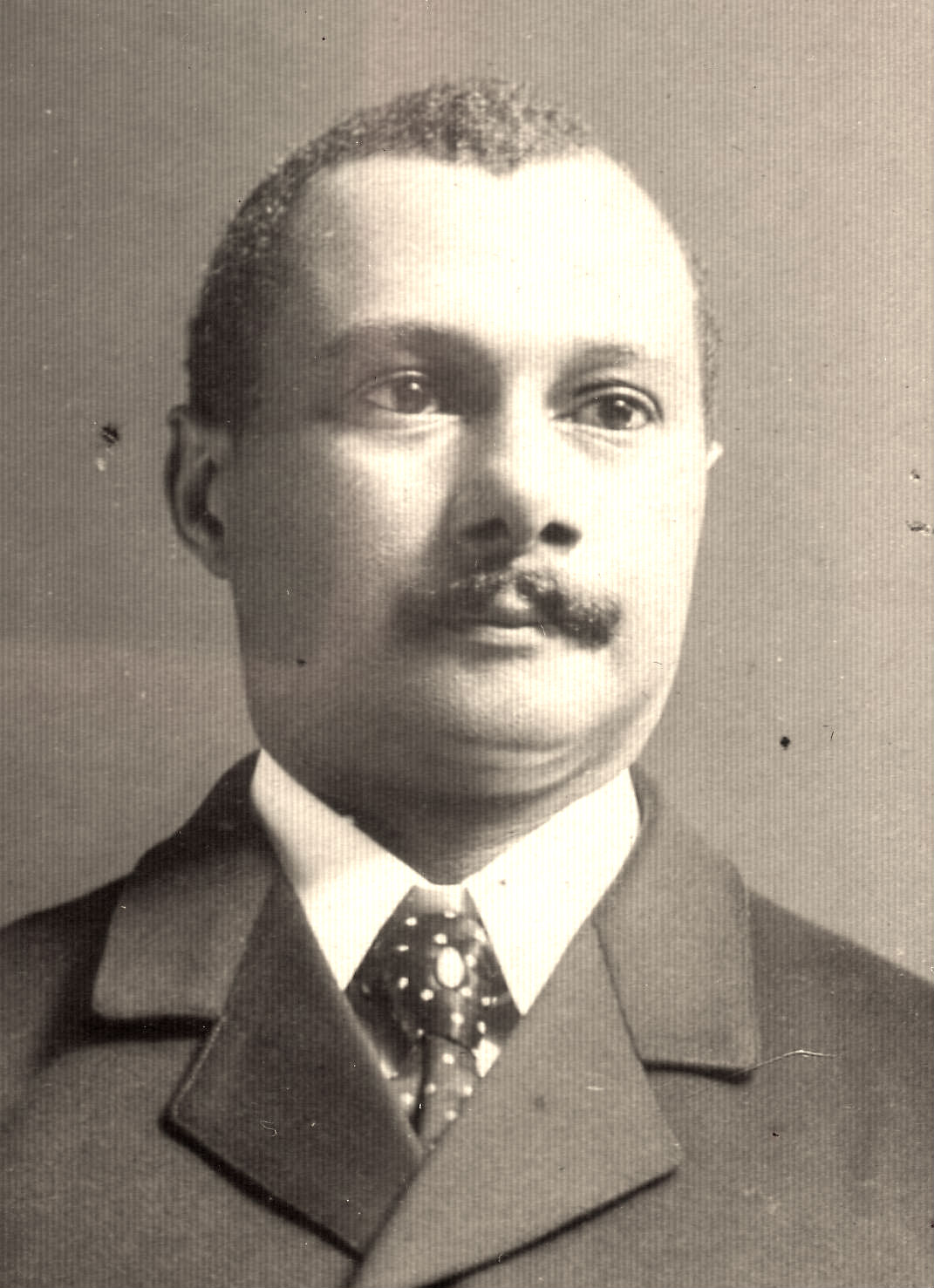
Demoltion contractor at 1234 Druid Hill Avenue, September 2015. Photo courtesy Dr. Steva A. Komeh, The Historic Marble Hill Community Association.Harry S. Cummings. Courtesy University of Maryland.
1234 Druid Hill Avenue is known to a generation of local Civil Rights activists as “Freedom House”—serving as an office to the local chapter of the NAACP, hosting meetings with Clarence Mitchell, Lillie Mae Carroll Jackson, luncheons with Eleanor Roosevelt and even Martin Luther King, Jr. Known as a “mighty little organization,” Freedom House was established by the Baltimore NAACP in 1970 under the leadership of Dr. Lillie M. Jackson. By December 1977, the organization had “received many citations including the AFRO’s highest honor for its successful crusades in reducing unemployment, crime and delinquency.”
Just as importantly, 1234 Druid Hill Avenue had been the home of Harry Sythe Cummings and his family from 1899 to 1911. In 1889, Cummings graduated from the University of Maryland Law School (one of the first two black men to do so) and, in 1890, became the first African American elected to a Baltimore City Council seat.
How did Baltimore lose the Freedom House?
Carol Ott, July 2015. Baltimore Slumlord Watch.
1234 Druid Hill Avenue and its neighbor at 1232 have been owned or controlled by Bethel AME Church for decades. In recent years, the buildings deteriorated significantly and, in July 2015, Baltimore Slumlord Watch highlighted their poor condition. Bethel AME Church responded to these issues by securing a city building permit for both buildings in late September that allowed non-structural alterations and limited demolition (e.g. removing debris, interior drywall, nonbearing walls). Unfortunately, in October the church changed their plans and received approval from the Baltimore Housing Department to demolish 1234 Druid Hill Avenue—without notifying preservation advocates or the local chapter of the NAACP.
It is currently unclear whether the demolition permit for 1234 also applies to 1232. Continuing confusion around the status of the permit for this planned demolition has been a source of frustration for concerned residents. If reports by residents are accurate, Bethel AME Church is planning to continue to demolish 1232 Druid Hill Avenue within the next few days.
What can be done to preserve Baltimore’s Civil Rights heritage?
The destruction of the Freedom House on Druid Hill Avenue is a shocking wake-up call for anyone concerned about the preservation of Baltimore’s Civil Rights heritage. Persistent vacancy and demolition by neglect are destroying historic buildings that tell the important story of the Civil Rights movement in Baltimore and around the country. Please join Baltimore Heritage as we support tomorrow’s rally urging Bethel AME Church to preserve 1232 Druid Hill Avenue and fight for the protection of West Baltimore’s Civil Rights landmarks. Baltimore Heritage is asking neighborhood leaders and elected officials to support a comprehensive effort to address the deteriorating condition of the landmarks of Baltimore Civil Rights history and ensure their preservation for future generations to discover.
Learn more about our work to document and protect Civil Rights landmarks. For questions or additional information about tomorrow’s rally, please contact Louis Fields, President, African American Tourism Council of Maryland, Inc. at 443-983-7974.