Behind the Scenes Tour of the Tuscany-Canterbury Apartments

Doorway, The LombardyWhere in Baltimore can you stroll the streets and feel you have visited England, France, Italy, and Spain within a few short blocks? Why in the north Baltimore neighborhood of Tuscany-Canterbury, of course. This historic neighborhood offers an eclectic mix of architecture that, somehow, seamlessly blends together very well. Our focus for the next tour will be on the larger architectural gems of the neighborhood, the apartment buildings. Please plan to join us for a short walking tour of the area’s unique apartment buildings followed by a rare opportunity to view the City from the penthouse of 100 W. University Parkway. David Curtin, a local realtor, has graciously offered us a tour of his penthouse apartment, and to share his magnificent view of the City.

Tuscany-Canterbury Apartment Buildings Tour

Wednesday, October 26, 5:30 pm – 7:00 pm
$15/members, $20/non-members. Wine & cheese will be served.
RSVP for the tour today!

We will start the walking tour portion of the tour in front of the Warrington at 3908 N. Charles Street. We will finish at 100 W. University Parkway for wine and cheese, entering on the University Parkway side. Parking is available on the street.

Tuscany-Canterbury in home to several elegant apartment buildings that harken back to a day when apartment dwelling was in vogue. Many units original floor plans rivaled the square footage of nearby single-family homes. We will start our walking tour at the Warrington, designed by the renowned Baltimore architecture firm of Wyatt and Nolting. Built in 1927, it was the first high-rise and was met with much opposition by the neighborhood. In stark contrast, just north of the Warrington is the modernistic Highfield House, designed by German architect Mies van der Rohe, and completed in 1964. It was the second of two buildings designed by Mies in Baltimore; One Charles Center was the first. Highfield House was added to the National Register of Historic Places in 2007.

The Ambassador was built in 1930 by the Mullan Company, and designed by Washington, DC architect Louis Roulou. The lobby is elegantly appointed with Venetian glass and an elaborate ceiling. Along the way we will also get to see the oldest house in Tuscany-Canterbury as well as other single family homes. Our last stop will be at 100 West University, also a Wyatt and Nolting design, where our host David Curtin will share with us his magnificent view of the city from his penthouse garden apartment.

Envisioning a new use for the Hebrew Orphan Asylum

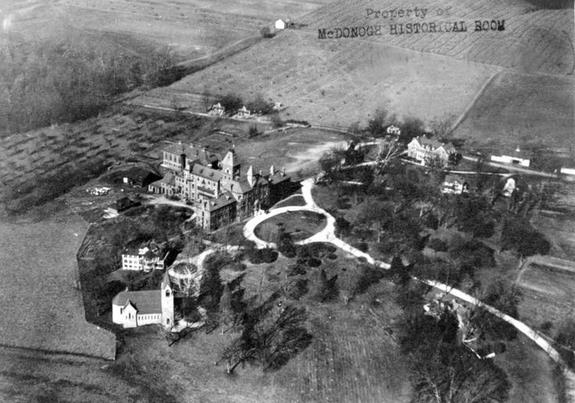
The Coppin Heights Community Development Corporation recently completed a new Hebrew Orphan Asylum Adaptive Reuse Study with support from Baltimore Heritage, Preservation Maryland, and the National Trust for Historic Preservation. This report (available for download here) evaluates the restoration of this rare 19th century purpose-built orphanage and explores opportunities to return the building to use as a center for health care and healthy living. This study is a step forward in our ongoing effort to preserve the Hebrew Orphan Asylum.

In partnership with Coppin State University, the Coppin Heights CDC’s plan calls for creating a healthy foods market and a community health center in the building. Not only would this use provide an essential service to a West Baltimore community with limited access to fresh food and healthcare, it would also continue a rich tradition of social service at the Hebrew Orphan Asylum that began nearly 140 years ago.

Despite this good news, serious concerns remain as the distressed condition of the building–highlighted by the collapse this past February–urgently demands the immediate development of a financing plan to support the building’s stabilization and rehabilitation. Financing for projects similar to the Asylum often comes from a wide range of sources: tax credits, private commercial loans, and private donors just to name a few. To support this effort, Baltimore Heritage and the Coppin Heights CDC worked together to submit an application to the the state and federal historic rehabilitation tax credit programs. If the application is successful, the state and federal tax credits could provide up to an estimated $4,000,000 for rehabilitation– a tremendous investment in the future of the Hebrew Orphan Asylum and the neighborhoods of Greater Rosemont.

Please connect with the Friends of the Hebrew Orphan Asylum on Facebook to show your support for this landmark while following future developments for this great landmark.

Join an open conversation connecting people, places and the past at Bmore Historic

We’re excited to announce a new event for local historians, museum professionals, preservationists, archivists, activists, scholars, students and anyone who cares about engaging communities around our shared heritage. Join us on December 2, 2011 at the Maryland Historical Society for Bmore Historic— an unconference on public history, historic preservation and community development in Baltimore and across the state of Maryland.

What is an “unconference”?

Anyone who goes to conferences knows that the most productive conversations often take place in the hallway or over drinks at the end of the day. An unconference takes this idea and runs with it. Unlike most traditional academic or professional meetings, an unconference is created and managed by the participants, with the topics of discussion sessions or workshops determined by everyone who attends on the day of the meeting, rather than in advance by the organizers. New unconferences are being organized around the country with examples including PubCamp for professionals in public media, Book Camp on books & publishing, THATCamp for scholars working with digital humanities, and (locally) CreateBaltimore unconference for art & technology. You don’t need to worry about preparing a PowerPoint or a formal paper, we’re just looking for people who are excited about historic places and ready share their knowledge and collaborate with

Why should I participate?

Bmore Historic is an opportunity to share your work, learn from others, get new ideas and develop new partnerships. This meeting is not limited just to scholars or professionals. Students, volunteer preservation activists, Main Street board members, museum docents, educators and others are all encouraged to register and attend. We hope that Bmore Historic can help strengthen connections between people who work with public history, preservation and community development across the region while expanding the diversity of the broader heritage community.

How do I register?

Online registration for the meeting is now open on our website. We’re accepting registrations on a first come, first served basis with confirmations starting in early November. After we confirm your registration, you’ll have a chance to share your session ideas in a blog post on the Bmore Historic website and check out ideas from other participants.

What does it cost?

We’re committed to charging $20 or less. With the space generously donated by the Maryland Historical Society, our costs are limited and we’re currently seeking funds to reduce the charge for all participants. This charge will be finalized by early November. If you are interested in sponsoring Bmore Historic, please get in touch with Eli Pousson at pousson@baltimoreheritage.org.

We’ll kick off the meeting on the evening of December 1 with “Giving the Past Presence: Public History Experiments in New York City” — a UMBC Humanities Forum with Marci Reaven, former director of City Lore and co-founder of Place Matters. We hope this talk can provide an inspiration for the conversations the next day. On December 2, we’ll be at the Maryland Historical Society with sessions in the morning and afternoon. Breakfast and lunch are both provided.

Bmore Historic is being organized in partnership with the Greater Baltimore History Alliance, the Maryland Association of History Museums, the Maryland Historical Society, the Maryland Historical Trust, Preservation Maryland, and the UMBC Orser Center for the Study of Place, Community, and Culture. If you have any questions, please get in touch with Eli Pousson at pousson@baltimoreheritage.org or 301-204-3337. We hope to see you in December!

Civil War 150: West Baltimore’s Civil War History by Bike — Rescheduled

Many people know that President Street Station has its roots in the Civil War, but few know that Civil War history can be found throughout the city, including many sites in West Baltimore. In fact, West Baltimore neighborhoods served a central role in the conflict– housing Union troops on their south to fight, caring for injured soldiers, and witnessing the many ways in which the conflict on the battlefield came home to the city 150 years ago. As the home to the B&O Railroad, West Baltimore supported the movement of troops by train (a key advantage for the Union) and protected the city from invasion by Confederate troops through a ring of camps, hospitals and fortifications in Carroll Park, on Baltimore Street, in Lafayette Square and more.

West Baltimore’s Civil War History by Bike

Update: Due to today’s rainy and snowy weather, we have rescheduled our tour to Saturday, November 5, 10:00 am. Please contact Eli Pousson at pousson@baltimoreheritage.org or 301-204-3337 with any questions or concerns.

October 29, 2011, 10:00 am to 11:30 am
$10 for members & non-members, RSVP today!

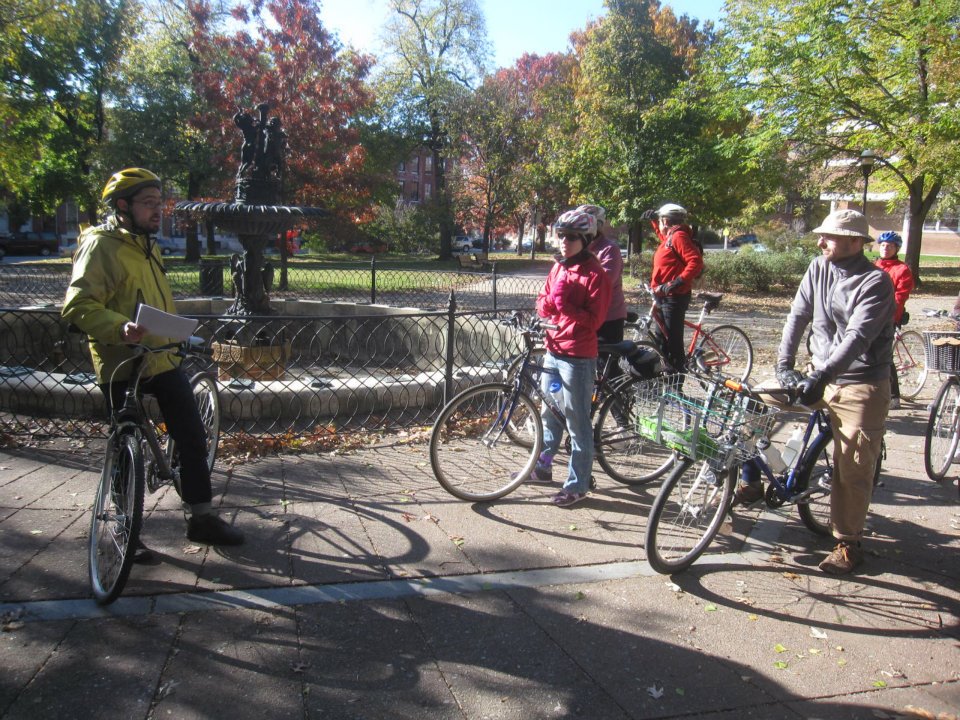
This 90-minute bicycle tour starts and ends at the Mt. Clare Museum House rolling past rowhouses, parks, stables, and shops, scores of historic places grand and modest, where people lived and worked during the Civil War and its aftermath. We’ll learn about Confederate spies at Waverly Terrace in Franklin Square, take a look at the historic artifacts we recently dug up from the site of Lafayette Barracks, and trace the lives of immigrant workers who built the trains, bridges, and more that the Union military depended on at the Irish Shrine at Lemmon Street and the B&O Railroad Roundhouse. Please join us as we pedal through the history of the Civil War in West Baltimore and commemorate this nation-shaping event of 150 years ago.

Thanks to the support of Free Fall Baltimore at the end of the tour participants are welcome to take a free tour of the Mt. Clare Museum House. Mount Clare is a 1760 colonial Georgian home built by Charles Carroll and Maryland’s oldest house museum.

Connect with the Friends of West Baltimore Squares to learn more about heritage and community greening programs in West Baltimore neighborhoods!

Behind the Scenes Tour of the Phoenix Shot Tower

Please join us as we partner with the Carroll Museums for the Phoenix Challenge. No, we aren’t hiking our way to Arizona. Rather, we are hiking up Baltimore’s own Phoenix Shot Tower. The Shot Tower, when it was built in 1828, was the tallest structure in the United States until 1846. Once there were three such towers in Baltimore; now there are only a few left in the entire world. The tour will include a short walk to visit some historic highlights in the surrounding Jonestown neighborhood followed by a tour inside the Tower. We will even have a chance to climb halfway up this iconic structure!

Phoenix Shot Tower

Fallsway & Fayette St.
Sunday,October 16, 10:00 am – 12:00 pm
$10/members, $15/non-members. Refreshments will be served.
Children are welcome.
RSVP for the tour today!

The design of the 215-foot tall Phoenix Shot Tower and its estimated 1.1 million bricks is based on Englishman William Watt’s 1782 patented process of making shot by pouring molten lead through colanders down the open shaft of a high tower. As the molten lead spun and cooled in the air, it became “perfectly globular in form and smooth” as was reported at the time. The “drops” were collected in a large water barrel at the tower’s base, then sorted by size and bagged for distribution. The finished product was called drop shot and was used for small game hunting, among other things. The Shot Tower annually produced 2.5 million pounds of it until 1892 when new methods of shot production made the Tower obsolete. In 1921, permits were granted to tear down the Tower and clear the site to make way for an automobile garage. In one of the first acts of historic preservation in Baltimore, public reaction against the demolition plans was strong, and leading citizens were able to raise funds for its preservation. On October 11, 1924, a group of Baltimore citizens bought the Shot Tower for $17,000 and donated it to the city with the understanding that it would be preserved. More than fifty years passed before the Shot Tower was opened to the public as a museum. In 1973, it was placed on the National Register of Historic Places. Today it is managed by Carroll Museums, a non-profit organization that also manages the Carroll Mansion on nearby Pratt Street.

For our tour, we will meet at the Shot Tower and take a short stroll around Historic Jonestown, one of Baltimore’s oldest neighborhoods. The tour will be led by Urban Rangers from the Baltimore National Heritage Area. The walk will take about an hour. Once back at the Tower, we’ll have a rare opportunity to climb part way up on the wooden stairs that wrap around its interior brick wall. Ms. Paula Hankins, director of the Museums, will talk about the history (and future) of the Tower. Our tour is a prelude to the Museum’s Phoenix Challenge campaign, which has its official kick off just after our tour ends around noon. Crafts and activities will be available to amuse our youngest tour goers, and there will be refreshments for all. The Phoenix Challenge campaign has a goal to raise 1.1 million supporters worldwide – one person for every brick in the tower. I hope you can join us to be among the first.