Year: 2010

Statewide and National Support for the Preservation of the Hebrew Orphan Asylum

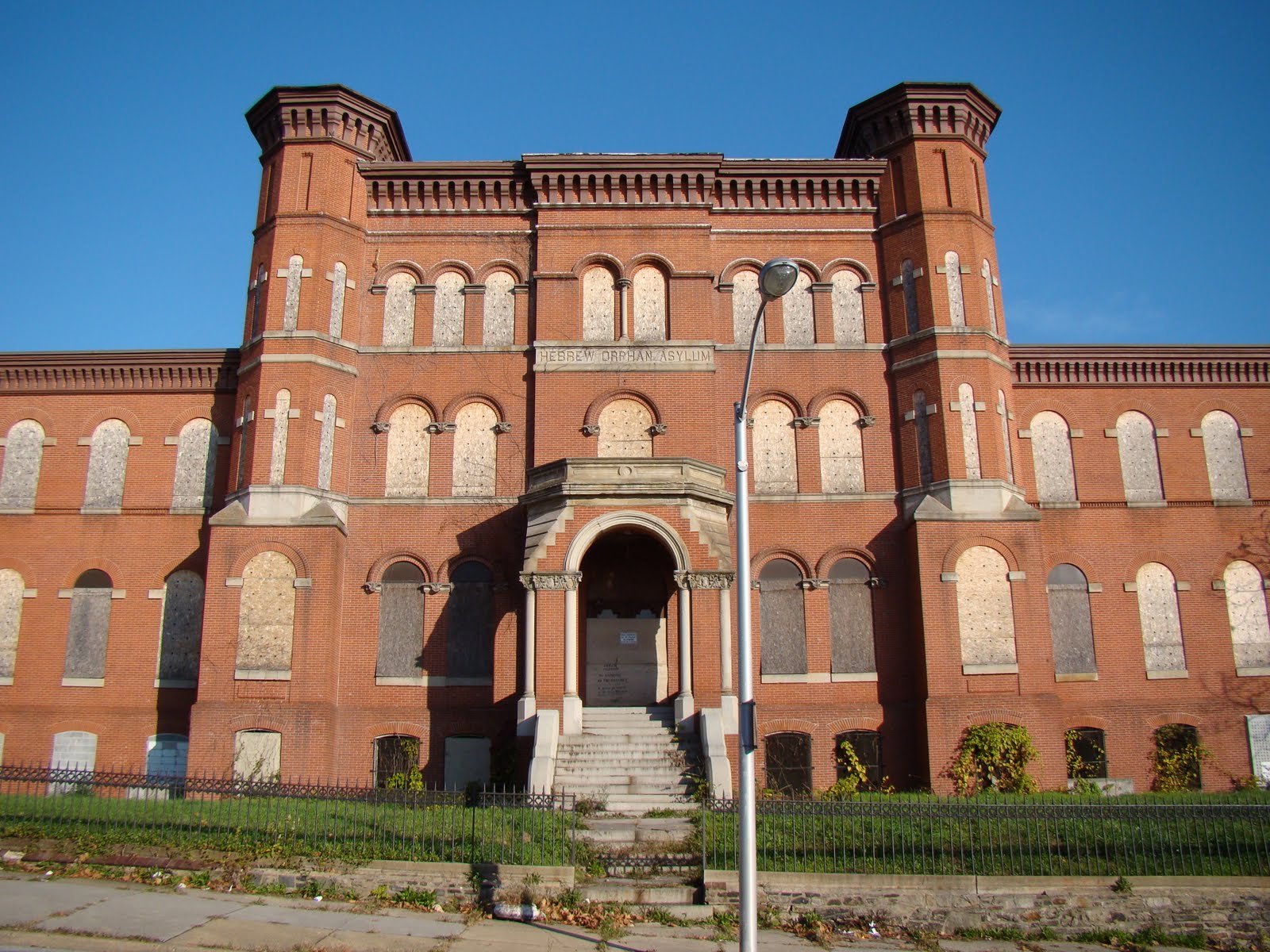
Over the past several months Baltimore Heritage worked closely with the Coppin Heights Community Development Corporation and Coppin State University to support their efforts to preserve the Hebrew Orphan Asylum in West Baltimore. Built in 1876, the Hebrew Orphan Asylum is not only the first Jewish orphanage in Baltimore, it is now the oldest standing Jewish orphanage in the United States.

Today we are glad to share the news that with our assistance the Coppin Heights CDC has received grants for preservation planning from both Preservation Maryland and the National Trust for Historic Preservation. Their generous support is a strong vote of confidence in the future of this remarkable Romanesque landmark and a testament to the importance of the building, not only to Baltimore, but also to the state of Maryland and the nation as a whole. These funds will help enable  the Coppin Heights CDC to prepare a redevelopment plan with a step-by-step guide to return the structure to an economic use and restore the site to its historic role as a vital asset to the broader West Baltimore region. Read more on the history of the Hebrew Orphan Asylum and our partnership with the Coppin Heights CDC in our update this past May.

Our work to preserve the Hebrew Orphan Asylum and our broader West Baltimore initiative is supported by the Partners in the Field program of the National Trust for Historic Preservation.
Pente Family: 100 Years in Little Italy

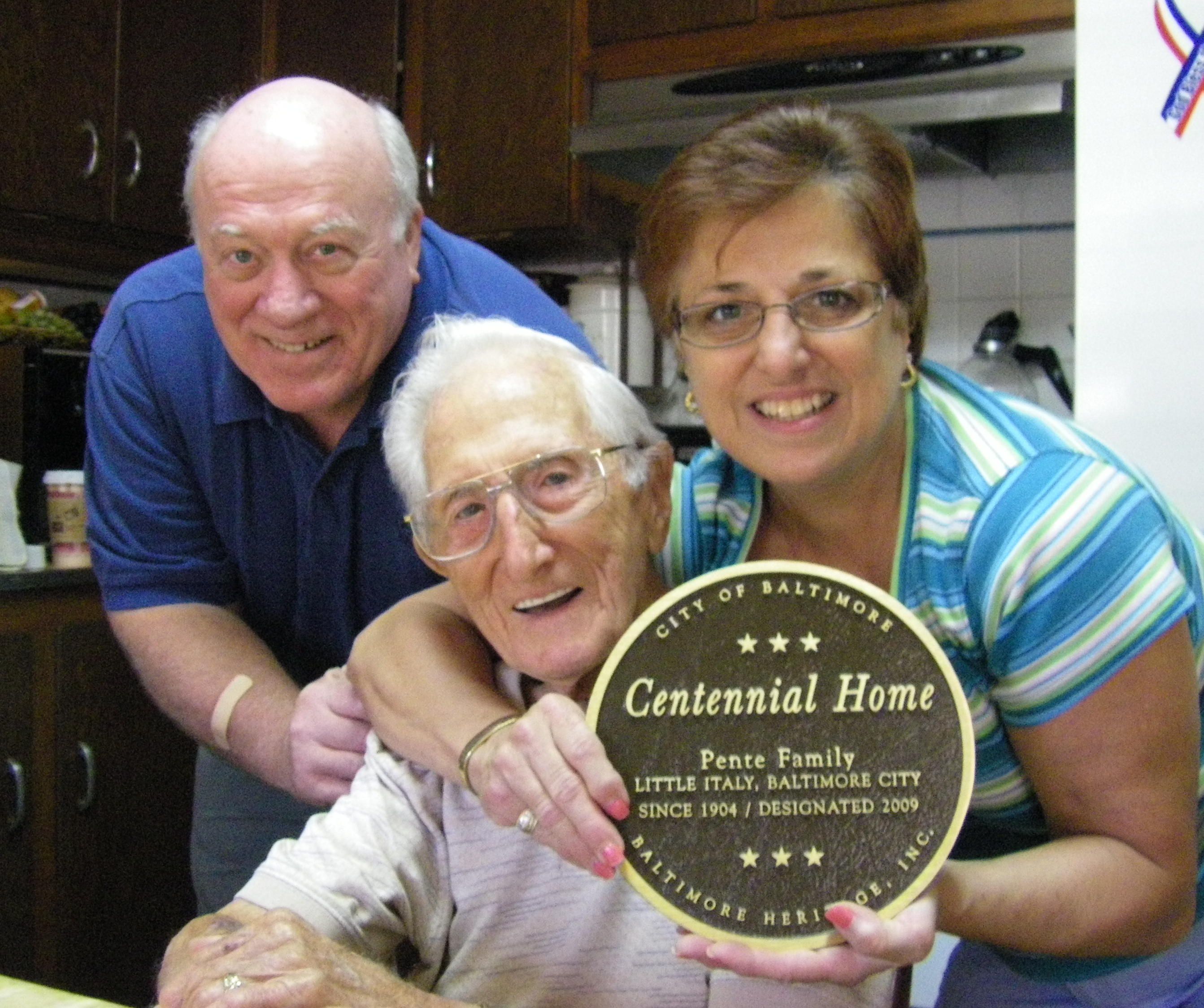
John Pente with daughter Margaret Schwartz and son-in-law Al Schwartz celebrate over 100 years in Little Italy. Photo by Lisa Doyle.

Sadly, Little Italy’s John Pente passed away earlier this week at age 100. Mr. Pente was a lifelong resident of Little Italy and Baltimore Heritage’s first honoree in the Centennial Homes program. Mr. Pente’s family moved into the house on High Street in 1904, and Mr. Pente lived there almost his entire life. His grandfather settled along President Street in Baltimore as an immigrant from Abruzzi, Italy in the 1890s when “Little Italy” was more German and English than Italian.  The area became known as “Little Italy” in the 1920s after the first Italian restaurant opened then. As part of Baltimore’s growing Italian community in the area, the Pente family found work where they could and carried on a family tradition as musicians in various local Italian bands. As a volunteer with St. Leo’s Church, the Sons of Italy, and the ambassador for the Little Italy Film Festival (which projected from a window on his second floor), John Pente was an active participant for decades in helping neighborhood grow and prosper. Part of this remarkable man’s legacy is certainly the Little Italy neighborhood that he took such good care of.

Click here to download a brief profile of the Pente Family by Cristina Ambroselli for our Centennial Homes program.

The Baltimore Sun ran a nice article on Mr. Pente in today’s paper.  Also, WYPR will re-broadcast an interview with Mr. Pente from 2009 when he helped launch the Centennial Homes program.  The interview will air on Friday, July 30, between 9:15 and 9:30 a.m. A viewing will be held at Zanino’s Funeral Home in Highlandtown on Friday between 2:00 and 9:00 p.m. and a funeral mass will be held at St. Leo’s Church in Little Italy on Sunday at 10:00 a.m.

Baltimore Building of the Week: Camden Station

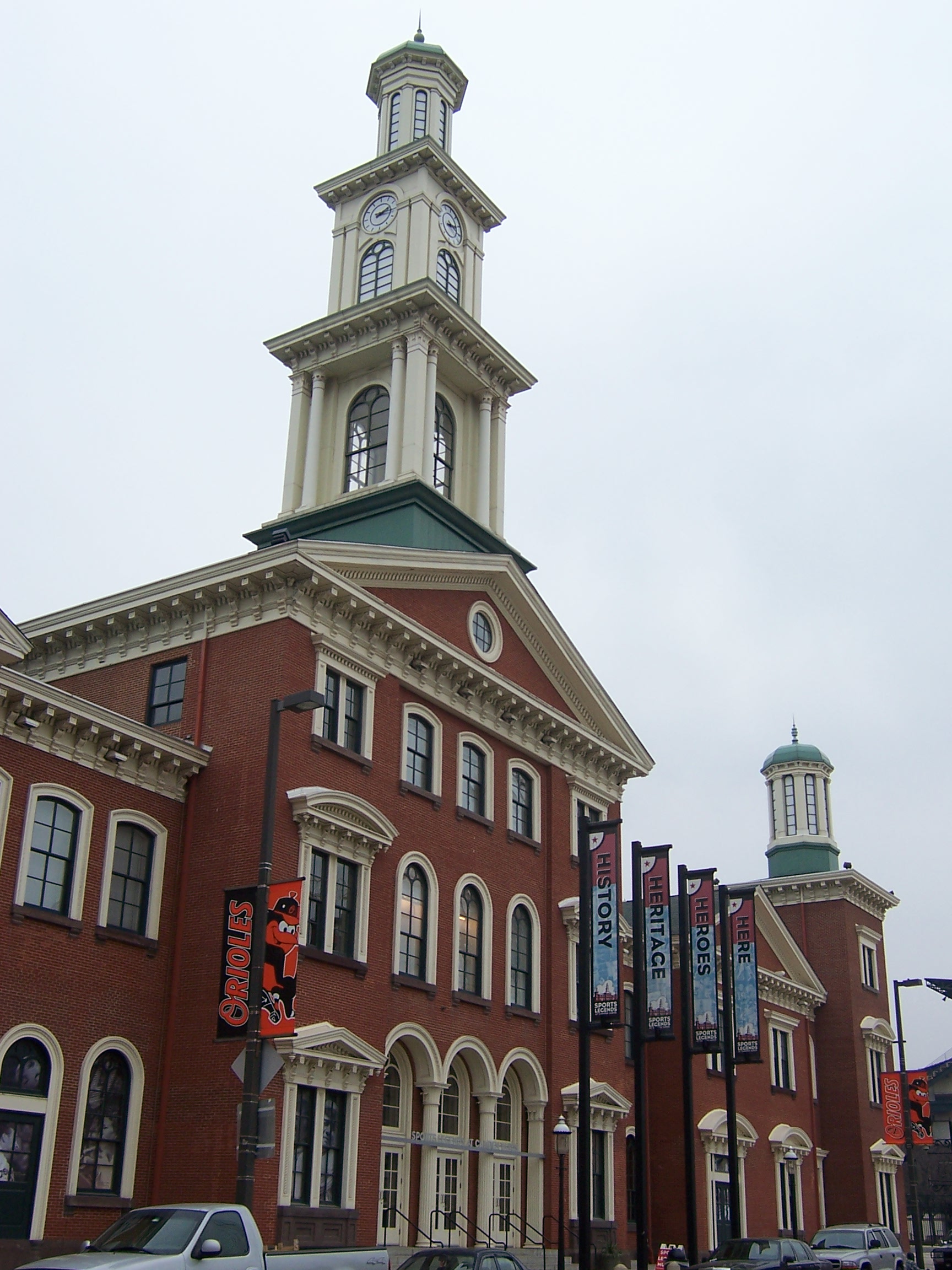
Image courtesy Jack Breihan

At the beginning of the railroad era, no one knew what a grand metropolitan rail terminus should look like. In the mid-1850s the Baltimore and Ohio Railroad chose the Italianate style, with bracketed cornices and window arches; a long, symmetrical composition of pavilions and lower hyphens; and a curious skyline of tower and cupolas seemingly drawn from church architecture. At 185 feet, the central tower was the tallest structure in Baltimore when the building was completed in 1867, a beacon for travelers making their way to their trains through the crowded commercial district. As with so many mid-19th century buildings, the architects were Niernsee and Neilson.

With the decline of train service Camden Station declined as well, eventually losing its crowning array of tower and cupolas. In the early 1990s, however, the old station was taken in hand by the architects Cho, Wilkes, and Benn as part of the Oriole Park sports complex. Using fiberglass and other modern materials they reconstructed the stations skyline and prepared the interior for reuse as museum space.

Behind the Scenes Tour of the Lloyd Street Synagogue

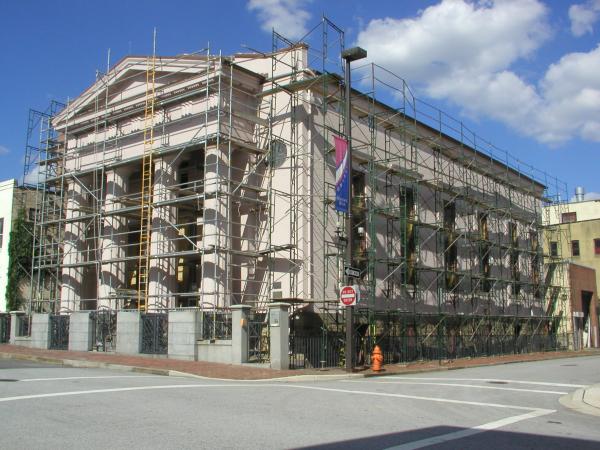
Restoration of the Lloyd Street Synagogue 2008, courtesy JMM

Did you know that Baltimore is home to one of the oldest synagogues in the nation? Built in 1845 at the center of the historic Jewish community of East Baltimore, the Lloyd Street Synagogue was the first synagogue erected in Maryland and today it is the third-oldest standing synagogue in the country. Please join us for a tour of this rare restored landmark with preservation architect John Srygley, AIA, and the staff of the Jewish Museum of Maryland (also celebrating its 50th anniversary this year).

Tour Information

Note: We are holding two identical tours. The first starts with a reception at 5:00 and the tour at 5:30, and the second starts with a reception at 6:00 and the tour at 6:30.

Date: Tuesday, July 20, 2010
Time: 5:00 p.m. reception; 5:30 to 6:30 tour
6:00 p.m. reception; 6:30 to 7:30 tour
Place: Jewish Museum of Maryland, 15 Lloyd Street (Baltimore, MD 21202)
We’ll walk next door to the Lloyd Street Synagogue after meeting at the Museum.
Free parking is available in a lot across from the Museum. It is a brick lot in front of the Museum entrance.
Cost: $15 (includes wine and cheese reception)
Registration: Click Here to Register!

Read more