
Preservationists launch web campaign to save Baltimore’s Hebrew Orphan Asylum, Baltimore Brew, September 6, 2010
This Place Matters Community Challenge: Vote for the Hebrew Orphan Asylum
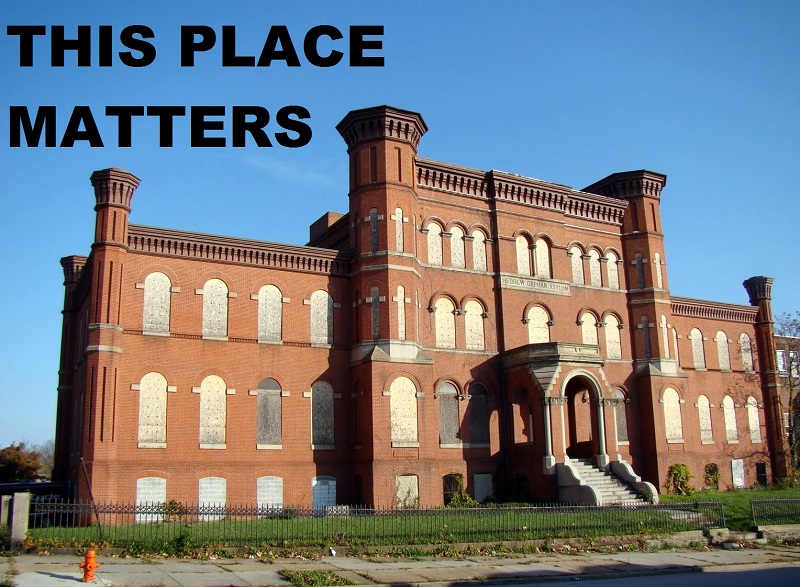
Over the past few months, we have shared a few updates on our efforts to preserve Hebrew Orphan Asylum– an 1876 Victorian Romanesque landmark in the Greater Rosemont neighborhood of West Baltimore and the oldest Jewish orphanage building in the United States. We developed a partnership with the Coppin Heights CDC and Coppin State University and received grant support from both Preservation Maryland and the National Trust for Historic Preservation. Now you have a chance to declare that this place matters and support the preservation of the Hebrew Orphan Asylum.
In partnership with Coppin State University, the building’s owner, and the Jewish Museum of Maryland we have submitted the Hebrew Orphan Asylum to the “This Place Matters Community Challenge” a national competition sponsored by the National Trust for Historic Preservation. For the next two weeks, people across the country are voting online to support historic places in their communities and the place with the most votes wins $25,000.
Please help us preserve the Hebrew Orphan Asylum by voting online right now. In less than a minute you can help us save over 130 years of Baltimore history. You can only vote one time, so please share this request with friends, family and neighbors who can help us all save this important Baltimore building. The contest ends on September 15 so we only have two weeks to get the word out, but we are still keeping our fingers crossed. Thank you, as always, for your interest and support as we continue our work to save and restore this historic Baltimore place.
Baltimore Building of the Week: Victorian Gothic Churches
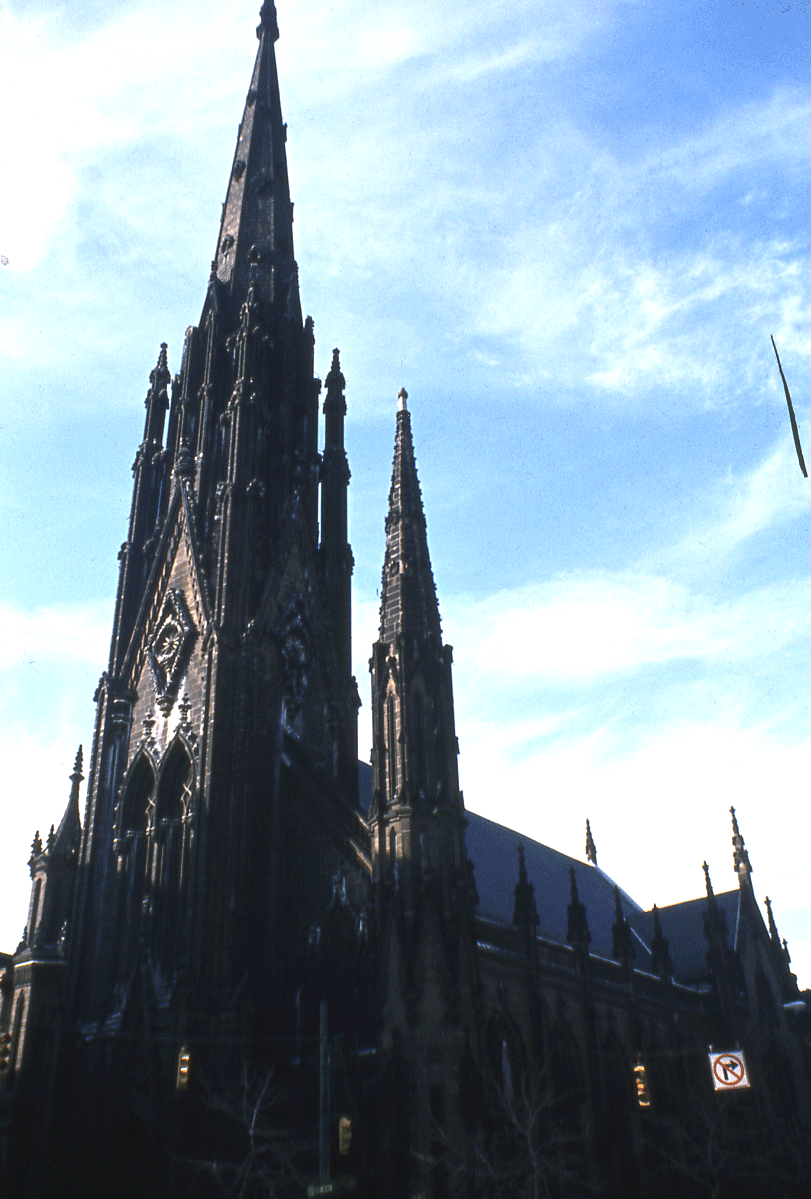
This edition of the Baltimore Building of the Week series features two Victorian Gothic Churches that should be familiar to Baltimore Heritage members from our Mt. Vernon Open Houses during our 50th Anniversary Celebration and our February Behind the Scenes Tour of First and Franklin.

These highly visible churches represent another Victorian style originating in Europe, known here as Victorian Gothic. Like the contemporary Second Empire style, the Victorian Gothic shows off modern industrial materials like polished marble, encaustic tiles, and structural iron. Unlike the Second Empire, Victorian Gothic buildings tend to be deliberately asymmetrical in plan. Completed in 1872, the Mount Vernon Place Methodist Church marked a change in style for Methodists, who had previously worshiped in simple, classical buildings. Not so here! The polychrome exterior combines brown sandstone with a greenish “serpentine” stone and polished marble. At about the same time and only a few blocks away on West Madison Street, First Presbyterian (now merged with the congregation of the Franklin Street Presbyterian) added a radically asymmetric pair of steeples to a pretty antebellum Gothic Revival sanctuary. The steeples, built mostly of iron, are hard-edged and dramatic–anything but pretty.
Baltimore Building of the Week: American Brewery
This week’s Baltimore Building of the Week from Dr. John Breihan serves double duty as the first in a new series highlighting the 2010 Baltimore Heritage Preservation Award Winners! The American Brewery Building at 1701 North Gay Street might be the most “Baltimore” of all buildings in the city. It is in the style of High Victorian architecture, as so much of our city was built and it is just plain quirky. Since 1973, the 1887 J.F. Weisner and Sons brewery building (later known as the American Brewery) stood as a hulking shell lording over a distressed neighborhood. Its restoration is a noteworthy symbol of optimism for the historic building the surrounding community. The conversion of the brewery into a health care and community center for Humanim more than fits the organization’s motto: “To identify those in greatest need and provide uncompromising human services.” We are thankful that they chose this grand building in Baltimore to carry out that mission. A 2010 Baltimore Heritage Preservation Award in the Adaptive Reuse and Compatible Design category goes to owner Humanim, Inc., architects Cho Benn Holback + Associates, and contractor Struever Bros. Eccles & Rouse.
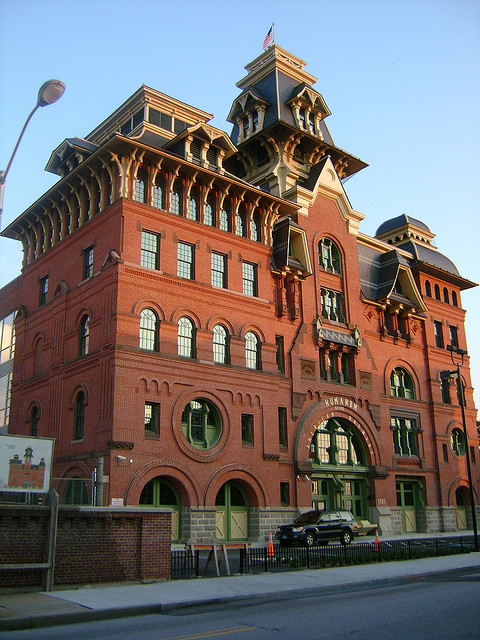
On a prominent ridge-top site in East Baltimore, this flamboyant Second Empire extravaganza was actually a working industrial complex between 1887 and 1973 (with a break for Prohibition). Perhaps John Frederick Weissner, who presided over the American Brewery, hoped that its towering turrets and Mansard roof, visible over much of the city, would generate a profitable thirstiness for his product. After years of vacancy and decay, the brewery buildings have been restored to life by Humanim, a community-service nonprofit active in the impoverished neighborhood around the brewery.
Summer news from Baltimore Heritage
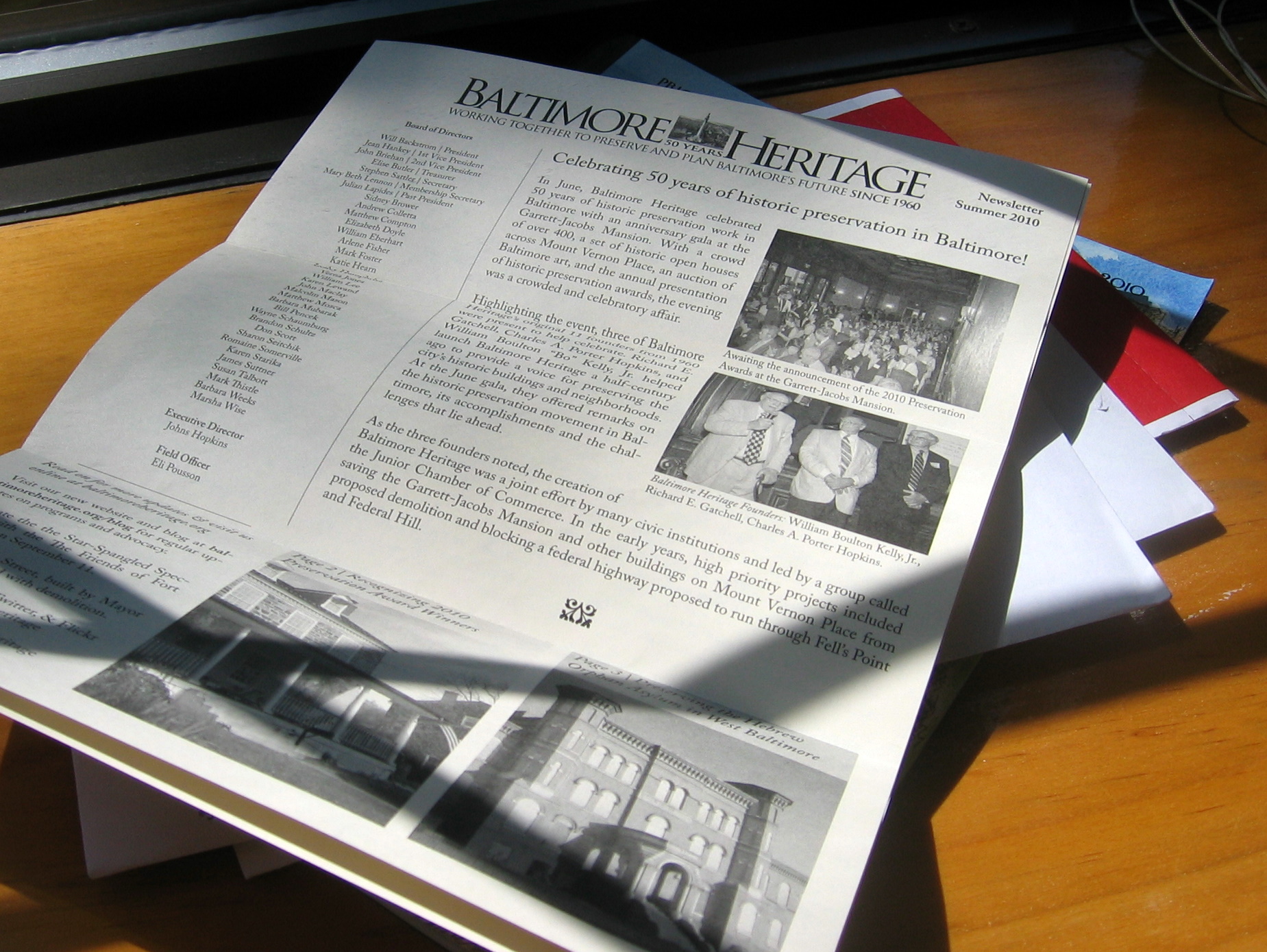
Baltimore Heritage members should discover a bit of preservation news in their mailbox this week as we just sent out a late summer edition of our Baltimore Heritage newsletter. A few of our features may be familiar to readers of this blog, including our piece on John Pente and an update on the Hebrew Orphan Asylum, but the newsletter also includes previews for upcoming events, a list of this year’s Preservation Award winners, and an advocacy update on a threatened building in Ridgely’s Delight. With a fresh visual design and a new format, we welcome any questions or comments on the issue.
You too can receive a copy of the Summer 2010 Baltimore Heritage newsletter by becoming a member of Baltimore Heritage today! Individual memberships start at only $35 (less than $3 a month!) and include discounts on all of our Behind the Scenes tours and first chance at registration for our popular Baltimore by Foot spring walking tour series. Read up on the membership benefits at each level of support and consider becoming a member or renewing your support for historic preservation in Baltimore.