Baltimore Building of the Week: Baltimore’s Columnar Monuments

This week’s Baltimore Building of the Week is not, in fact, a building. Instead, it is three of Baltimore’s notable “Columnar Monuments.” Both the Battle Monument and Mount Vernon’s Washington Monument have also been featured on the Monument City website. Visitors can take a tour of the Shot Tower’s ground floor exhibit, sound and light show, and informational video are available with appointment at 10:30 AM on Saturday or Sunday. The Washington Monument is open for visitors Wednesday to Friday 10 AM to 4 PM and Saturday and Sunday 10 AM to 5 PM up until Memorial Day.
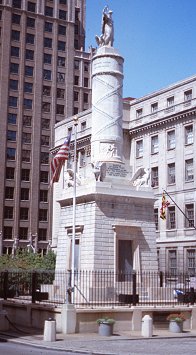
Battle Monument, Image courtesy Jack Breihan

Completed during the 1820s, two of these towering structures established Baltimore’s distinction as “the Monumental City.” Maximilian Godefroy’s Battle Monument, depicted on the City flag, commemorated the Defenders who died beating off the British attack in 1814. It combines Egyptian and Roman themes, including a giant set of fasces. A gigantic Roman Doric column, Robert Mills’ Washington Monument portrays the Father of Our Country, dressed in a toga, performing what its builders considered his most heroic act. (What was it? answer next week!) The contemporary Phoenix Shot Tower was a monument to Baltimore’s growing industrial sector; it manufactured lead shot for the Chesapeake Bay duck-hunting industry.
Read more

Baltimore Building of the Week: The Basilica

This week’s featured Baltimore Building of the Week from Dr. John Breihan is the Basilica of the National Shrine of the Assumption of the Blessed Virgin Mary, a National Historic Landmark, National Shrine, Marian Shrine, and Co-Cathedral of the Archdiocese of Baltimore. You can become a fan of this incredible building on Facebook or take a guided tour Monday through Saturday.

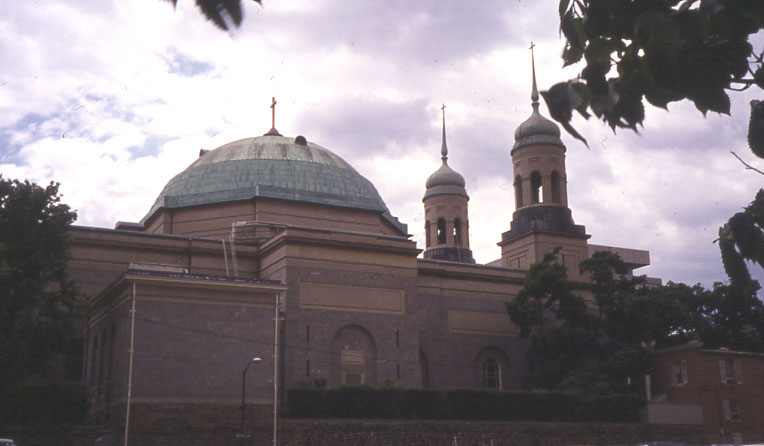
Image courtesy Jack Breihan

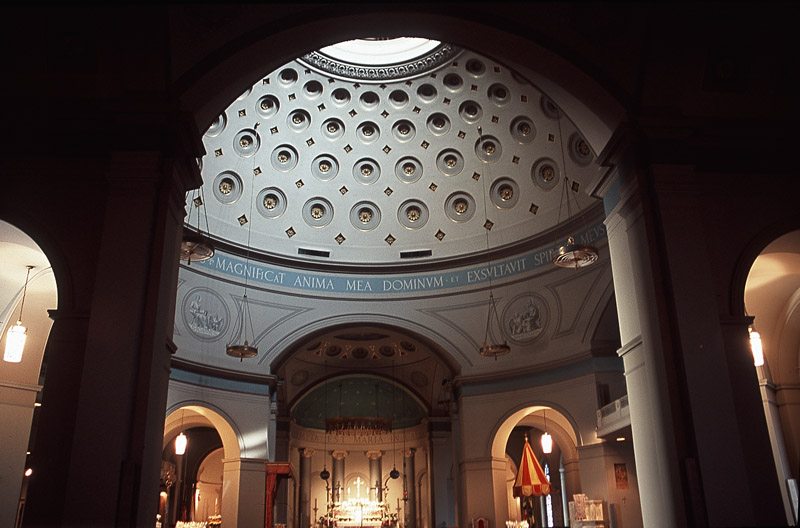
By far the greatest architectural masterpiece in Baltimore is its long-time Catholic cathedral, now known as the Basilica of the Assumption. Designed by Benjamin Henry Latrobe for Archbishop John Carroll, the Basilica was built between 1806 and 1820. The great domed church with its curious cylindrical towers, our Hagia Sophia, long dominated the Baltimore skyline. To mark its bicentennial in 2006, the Basilica underwent a much-needed rehabilitation of its basic systems and a conjectural restoration of the interior to its appearance in 1820. While some welcome the new bright pastels, others miss two centuries’ accretions of church furniture, gold leaf, and stained glass.

Image courtesy Jack Breihan

Call for 2010 Preservation Award Nominations

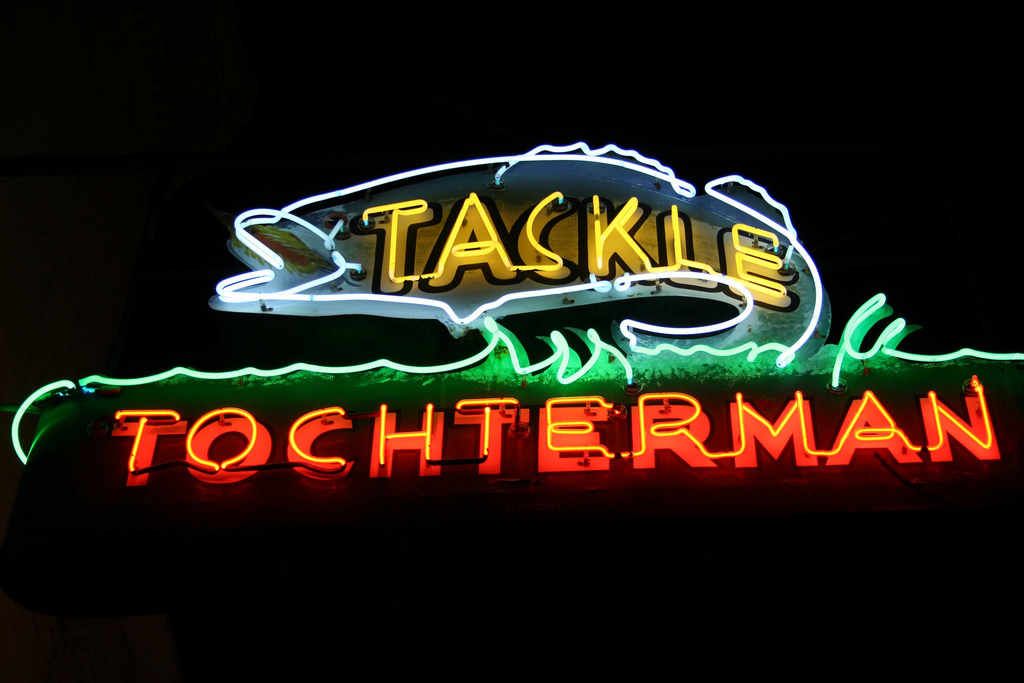
Tochterman-Fishing-Tackle-neon-sign
Image courtesy elh70 on Flickr

What do the the Clarence Mitchell Courthouse, the SS John Brown, and the neon Tochterman’s Fishing Tackle sign on Eastern Avenue have in common? They have all won historic preservation awards from Baltimore Heritage over the last 50 years, of course.

This year, Baltimore Heritage turns 50. Please help us celebrate a half-century of preserving historic places in our great city by submitting a nomination for a 2010 Preservation Award. Whether it’s your own do-it-yourself home rehabilitation project, a neighbor who has put her heart and sole into preserving a historic space, or an organization that has shown commitment to preserving the city’s heritage, we’d love to get a nomination from you.

Read more

Baltimore’s West Side Story Revisited

In a great new post on Baltimore Brew, Joan Jacobson and Elizabeth Suman lay out the story of the continuing threats to Baltimore’s historic West Side, an area that has been listed on the Baltimore Heritage Preservation Watch List for nearly 10 years. Among the dozens of irreplaceable buildings still threatened with demolition is the Art Deco styled 1934 Read’s Drug Store, designed by renowned Baltimore architecture firm Smith & May, the same firm that created the iconic Bank of America Building. In January 1955, following a year of negotiations with Read’s, a sit-in demonstration organized by the Baltimore Congress of Racial Equality led to the desegregation of 37 Read’s lunch counters citywide, establishing a enduring association between this downtown corner and the struggle for civil rights in Baltimore and the state of Maryland.

Baltimore’s West Side Story from Baltimore Heritage on Vimeo.

For many, the story of fighting for preservation on Baltimore’s West Side is a familiar one. In 1999, the National Trust for Historic Preservation identified the West Side as one of America’s 11 Most Endangered Historic Places. In the early 2000s, Baltimore Heritage, Preservation Maryland, and West Side Renaissance created Baltimore’s West Side Story, produced by West Side Renaissance director Ronald Kreitner. This documentary screened daily at the historic Senator Theater, introducing audiences to the vital issues at stake in the preservation of historic buildings and small businesses on Baltimore’s West Side. Enjoy the whole 9 minute video to learn more or jump to 1:04 for a special cameo by former Mayor and Governor William Donald Schaefer as a born-again preservationist.

Baltimore Building of the Week: Homewood House

This week’s featured Baltimore Building of the Week from Dr. John Breihan is Homewood House at 3400 North Charles Street on the campus of The Johns Hopkins University.

Image courtesy of John Breihan

Even the wealthy Charles Carroll was shocked by the cost of his son’s country villa, Homewood, built early in the 19th century on a hillside north of town.  A federal-style version of the standard five-part Georgian Palladian mansion house (see Mt. Clare), Homewood’s principal floor is tall, elegant, airy, and cool.  Service rooms are tucked away in the basement or attic (there is a fine brick privy in back).  The Johns Hopkins University acquired the surrounding estate and built a new campus there early in the 20th century.  Homewood is open to the public as part of Johns Hopkins University Museums.

The Homewood House Museum is currently hosting a four-part speaker series in association with their fourth annual student-curated focus show, On the Road: Travel and Transportation in Early Maryland. The first event in the series is David Shackelford, Chief Curator at the Baltimore & Ohio Railroad Museum, speaking tonight, February 18, 2010 at 4:30 PM.