How can you help save Baltimore’s historic places? Support our work.

With sincere thanks for your past interest and support, I am writing today to ask you to join or renew your membership with Baltimore Heritage.

Baltimore Heritage is a small nonprofit organization. We rely on the many kind people who volunteer their time and commit their support each year to help save Baltimore’s unique historic places.

One historic place we’re helping right now is the Village Learning Place. For the past few months, we’ve worked with the Liesje Gantert, director of the VLP, along with staff and volunteer architects from the Neighborhood Design Center to take a close look at the condition of their former Pratt Library branch on Saint Paul Street. Over the next year, we will build on these efforts to help more local nonprofits improve maintenance of their historic civic spaces across Baltimore. Not all historic buildings are museums: they also provide affordable housing, child care, community meeting space, and more. We are eager to help keep these buildings working well for all the people who rely on them.

In addition to helping us save Baltimore’s historic places, as a member you also get the benefit of discounts on our heritage tour program. With great volunteers like Patricia Hawthorne, who has led our Monumental City tours for years, and new volunteers like Sarah Krum who just started this year, our we are grateful to the many people who make our heritage tours possible. Over the last ten years, our volunteers have organized and led nearly four hundred tours of over two hundred different historic places!

Membership support has been the foundation for nearly eight years of advocacy for the Hebrew Orphan Asylum, the nation’s oldest surviving Jewish orphanage. Today, we are a proud partner with the Coppin Heights Community Development Corporation in turning this long-threatened and neglected building back into a health care facility for people in West Baltimore. We expect construction to begin soon.

Thank you again for considering joining or renewing your membership, and I hope you can join us on October 3 at Whitehall Mill for our 2017 annual meeting, tour, and reception.

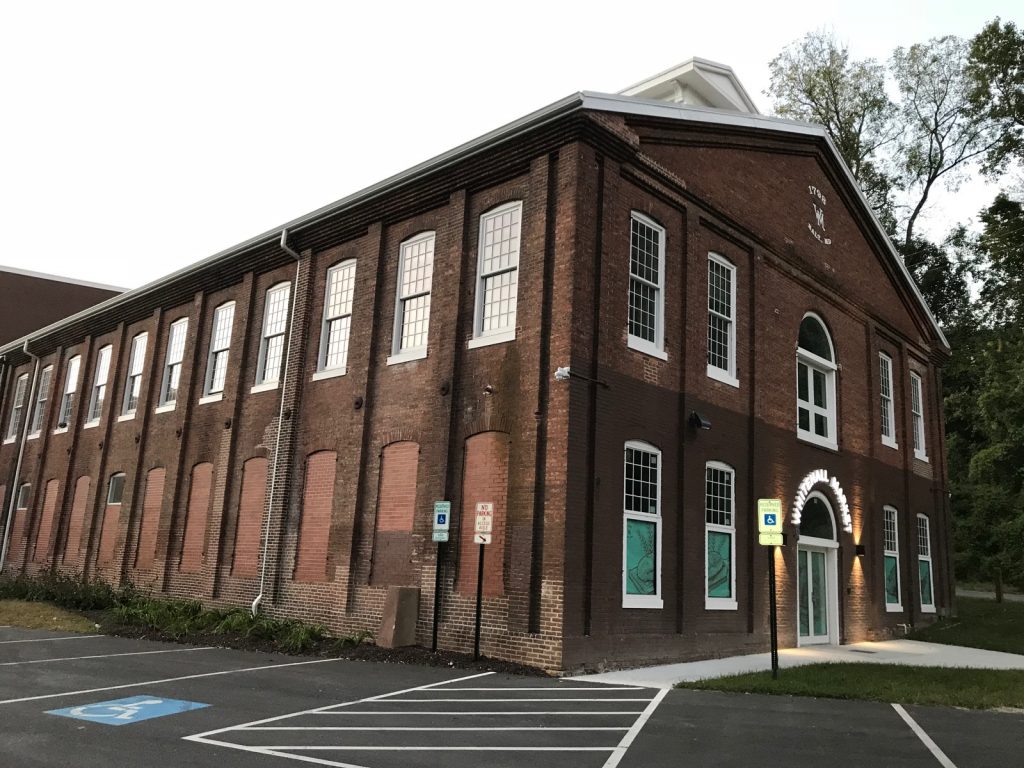
Large brick building with a sign reading "Whitehall Mill" painted on the side.

We say “Thank you!” at Whitehall Mill on October 3

At Baltimore Heritage, we rely on support from hundreds of people in and around Baltimore: volunteers who make all our events possible, history-lovers who come on our heritage tours, and people who support our work as members, donors, and sponsors. Thank you!

We hope all of you can be our guests on October 3, 6:00 pm at the historic Whitehall Mill on for a reception, tour, and chance to help us give away four micro-grants for preservation in Baltimore. The evening program is also this year’s annual meeting where we elect board members and officers. Special thanks to Delbert Adams Construction Group for sponsoring this event. Please join us and help guide our work in the year ahead.

Reception & Tour

Enjoy light fare, wine, beer and more! We’ll take a tour through this former 1700s grist mill including the spectacular apartment home of artist Hilton Carter. Mr. Carter has turned his apartment at Whitehall Mill into an oasis with hundreds of plants and his own industry-inspired artwork. He has been featured in Baltimore Magazine and Baltimore Art, and is graciously opening his home for us.

Preservation Micro-Grants

We are giving out four micro-grants of $250 and $500 to deserving preservation efforts in Baltimore. Six people will give three-minute “pitches” of their ideas and then we will ask you to cast a vote for the ideas you’d like us to fund. We’ll learn about some great initiatives underway in Baltimore and have a little fun while helping them out. If you have a good idea, please send it in!

Board Elections

Finally, since our founding in 1960, Baltimore Heritage has been run by a board of directors elected by members who have contributed in the last year. We’ll elect our board and officers for the coming year and hope you will participate. If you haven’t made a membership gift this year, please make a donation today.

Thank you again for supporting Baltimore’s historic buildings and neighborhoods, and for supporting our work to keep them vibrant. We hope you can sign up to join us on Tuesday, October 3 at Whitehall Mill.

Francis Scott Key Monument splashed with red paint and spray painted with the words “Racist Anthem”

This morning, we learned that the Francis Scott Key Monument at Eutaw Place was splashed with red paint over night and the stone pedestal at the center of the monument was spray painted with the words “Racist Anthem.” The monument by French sculptor Marius Jean Antonin Mercié shows Key standing in a marble rowboat next to a seated bronze sailor. The statue was dedicated on May 15, 1911, and restored in 1999 after a major fundraising campaign by local residents. You can see more photographs of the Key Monument and the graffiti in our Flickr album.

Photograph by Eli Pousson, 2017 September 13.

The spray painted graffiti on the east side of the stone curb surrounding the monument fountain included “Blood on his hands,” “Racist Anthem,” “Fuck FSK,” and “Hater U Just Mad.” On the pavement in front of the monument was written “Slave Owner” and one of the lesser-known stanzas that make up Key’s Star-Spangled Banner:

“No refuge could save, Hireling or slave,
From terror of flight, Or gloom of grave”

The words are a reference to the black men who escaped from slavery in Maryland and Virginia to join the British in their fight against the United States government during the War of 1812. Francis Scott Key’s legacy as a slave holder was the subject of a 2016 post from Smithsonian Magazine and a 2014 biography. As a member of the Maryland State Colonization Society, Key also promoted the removal of free black people from Maryland to a colony in present-day Liberia.

Photograph by Eli Pousson, 2017 September 13.

The Baltimore City Department of Recreation and Parks was notified about the condition of the monument early this morning and reached out to the Baltimore City Police Department, the Commission for Historical and Architectural Preservation, and other city agencies to file a police report and consider next steps. We have also reached out to the Bolton Hill Architectural Review Committee to alert neighbors to the situation and to help monitor the monument. CHAP and city agencies are working to have the paint and graffiti removed by an art conservator as quickly as possible.

Read more about the Key Monument

Photograph by Eli Pousson, 2017 September 13.
A gothic stone church seen from the roof of a building across the street.

Explore the stories of the people (and landmarks) from Baltimore’s Civil Rights movement

Earlier this summer, we completed the first draft of our context study on Baltimore’s Civil Rights heritage. We’ve been working on this project for two years, together with the Maryland Historical Trust and Baltimore National Heritage Area, with funding from the National Park Service, Preservation Maryland, and PNC Foundation. The completed draft covers nearly 150 years of history, politics, activism, and change from 1831 to 1976. This fall, we’re asking you to take a look and share your reactions, comments, and suggestions!

At the beginning of the project in 2015, we created a website where we could share all of our research materials and writing online. By making our research accessible online to students, educators, historians, and activists, we hope to encourage more people to learn about the history of the Civil Rights movement in Baltimore and to preserve the historic places that help tell stories from the movement. We’re using a Creative Commons license for all of our writing and using GitHub (a popular platform for open source projects) to publish the website. Our goal is to make it easier to people to reuse or help improve the resources we’re making for this project.

A black man in uniform and a black woman wearing a dress and bonnet sitting for a portrait with their two daughters on each side.
Unidentified African American soldier in Union uniform with wife and two daughters, c. 1863-1865. Library of Congress.

Where can you find the context study? You can read all six sections of the context study on our website beginning with the overview or you can download a PDF that compiles all six sections into a single document. But you can also browse a map and database of over 350 related sites, buildings, and landscapes we’ve identified during our research. We put together a new tour on Explore Baltimore Heritage, that you can use to find and see a few of these places for yourself. Finally, our timeline of events is an easy way to learn how local events responded to events affecting the Civil Rights movement in Maryland and the United States.

We welcome your comments on anything big or small. Did our study miss an important place or person? Do you think we have part of the history wrong? Did we cover the most relevant themes for each period? You can send us your comments by email to info@baltimoreheritage.org or by using our project feedback form. We also have a separate form if you want to suggest adding a place to our inventory.

A crowd of African American people looking towards a stage set up in front of a large modern office building.
Charles Plaza during the first Afro-American (AFRAM) Exposition, August 7-8, 1976. Special Collections, Langsdale Library, University of Baltimore, rbcae76n0705 (CC BY-NC-ND).

Do you have a good idea for a small local preservation project?

Do you have a good idea for how you can help preserve Baltimore’s historic places? Would a $250 or $500 help you to make it happen? Consider applying for our 2017 Preservation Pitch Party or read on to learn more about how we are giving away four micro-grants this fall.

For the next two weeks, we’ll be taking your suggestions for small preservation projects. We’ll pick the top six ideas on Friday, September 22 and help the people who proposed these promising ideas prepare to make their case. On the evening of October 3, they’ll have just three minutes to make a pitch for why they deserve one of four “micro-grants”. Then, the crowd at Whitehall Mill will have the chance to vote and award two $500 grants and two $250 grants.

We are happy to consider any application related Baltimore’s history and historic places. Eligible projects could include doing repairs at a historic neighborhood park; planning a tour of a historic neighborhood; hosting an event to celebrate Baltimore’s history; or engaging neighborhood youth around preservation and architecture.

We know the amount of the award ($250 or $500) may not be enough to complete your entire project. But we believe a little help can sometimes make a big difference. You do not need to be a designated nonprofit or other incorporated organization to apply. Individuals and informal groups are welcome.

If you have any questions, pease email me at hopkins@baltimoreheritage.org or call our office at 410-332-9992. Whether you submit a proposal or not, you are welcome to join us at Whitehall Mill on October 3; sign up online today!