
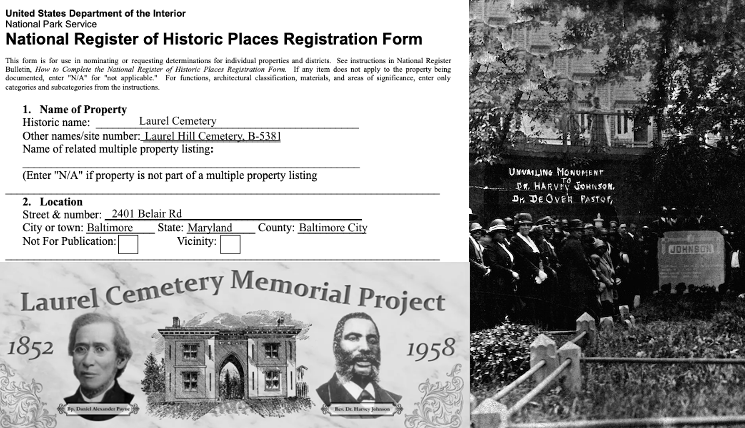
This past Tuesday, Laurel Cemetery was officially listed in the National Register of Historic Places. Baltimore Heritage, in partnership with the Laurel Cemetery Memorial Project, helped write the nomination. This historic property finally has the recognition it deserves as Baltimore’s first non-denominational African American cemetery, incorporated in 1852.
For decades Laurel Cemetery was the premiere burial site for African Americans, used by families across spectrums of social class, occupation, education, and religion. Here, the lives of washerwomen and laborers were commemorated alongside Civil War veterans and some of the most active and influential agents of African American progress. In 1894, Frederick Douglass traveled to Laurel Cemetery to speak at the unveiling of a monument honoring Bishop Daniel Alexander Payne, the sixth Bishop of the AME Church and founder of Wilberforce University. Leading Maryland Civil Rights leaders such as Rev. Harvey Johnson and Rev. Alexander Walker Wayman were also buried here. It is estimated that this burial ground was the resting place of an 37,000-42,000 people.
In 1957, the sole shareholder of the Laurel Cemetery Company sold the land against the wishes of descendants of those interred at the site. The closing of Laurel Cemetery was a politicized maneuver, organized clearly along lines of race and class. A series of lawsuits seeking justice for the disenfranchised descendants failed to prevail in the courts. Thus, after being in existence for 106 years, Laurel Cemetery was leveled and most of the site was paved over and completely forgotten in collective memory. One small undisturbed portion of the cemetery remains hidden in plain sight and this is the portion we nominated to be on the National Register of Historic Places. In February 1962, the former site of Laurel Cemetery became a department store. Today it is the Belair-Edison Crossing Shopping Center. For decades, most Baltimoreans have not known the site’s significance, the identities of those buried here, or even their own family connections to this space.
Thanks to the work of the Laurel Cemetery Memorial Project, Laurel Cemetery is no longer forgotten. It is celebrated as a sacred space and an important site of Black history and our city’s history. This nomination further supports the preservation and education of a key site in Baltimore’s (and Maryland’s) history.
Learn more about Laurel Cemetery on the Laurel Cemetery Memorial Project’s website. And stay tuned for a digitized version of the Laurel Cemetery’s National Register nomination form!