Category: Tours

Civil War 150: West Baltimore’s Civil War History by Bike — Rescheduled

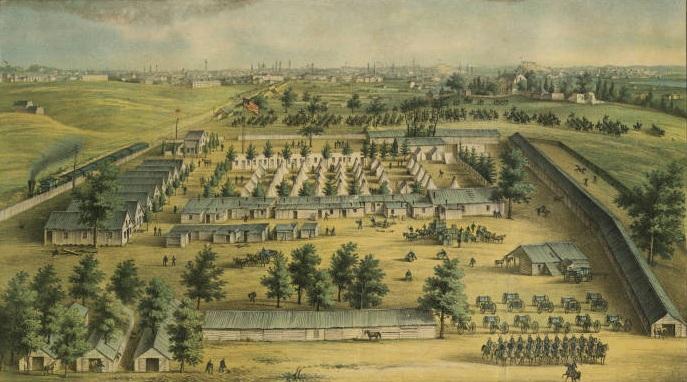
Many people know that President Street Station has its roots in the Civil War, but few know that Civil War history can be found throughout the city, including many sites in West Baltimore. In fact, West Baltimore neighborhoods served a central role in the conflict– housing Union troops on their south to fight, caring for injured soldiers, and witnessing the many ways in which the conflict on the battlefield came home to the city 150 years ago. As the home to the B&O Railroad, West Baltimore supported the movement of troops by train (a key advantage for the Union) and protected the city from invasion by Confederate troops through a ring of camps, hospitals and fortifications in Carroll Park, on Baltimore Street, in Lafayette Square and more.

West Baltimore’s Civil War History by Bike

Update: Due to today’s rainy and snowy weather, we have rescheduled our tour to Saturday, November 5, 10:00 am. Please contact Eli Pousson at pousson@baltimoreheritage.org or 301-204-3337 with any questions or concerns.

October 29, 2011, 10:00 am to 11:30 am
$10 for members & non-members, RSVP today!

This 90-minute bicycle tour starts and ends at the Mt. Clare Museum House rolling past rowhouses, parks, stables, and shops, scores of historic places grand and modest, where people lived and worked during the Civil War and its aftermath. We’ll learn about Confederate spies at Waverly Terrace in Franklin Square, take a look at the historic artifacts we recently dug up from the site of Lafayette Barracks, and trace the lives of immigrant workers who built the trains, bridges, and more that the Union military depended on at the Irish Shrine at Lemmon Street and the B&O Railroad Roundhouse. Please join us as we pedal through the history of the Civil War in West Baltimore and commemorate this nation-shaping event of 150 years ago.

Thanks to the support of Free Fall Baltimore at the end of the tour participants are welcome to take a free tour of the Mt. Clare Museum House. Mount Clare is a 1760 colonial Georgian home built by Charles Carroll and Maryland’s oldest house museum.

Connect with the Friends of West Baltimore Squares to learn more about heritage and community greening programs in West Baltimore neighborhoods!

Behind the Scenes Tour of the Phoenix Shot Tower

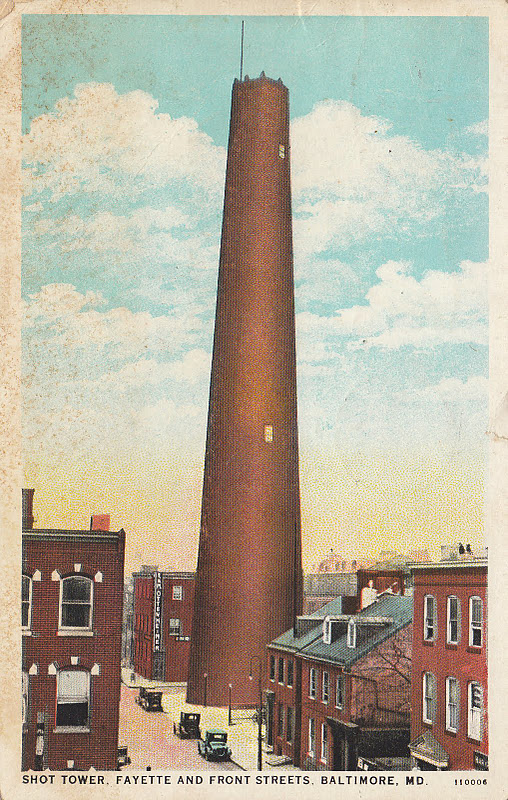
Please join us as we partner with the Carroll Museums for the Phoenix Challenge. No, we aren’t hiking our way to Arizona. Rather, we are hiking up Baltimore’s own Phoenix Shot Tower. The Shot Tower, when it was built in 1828, was the tallest structure in the United States until 1846. Once there were three such towers in Baltimore; now there are only a few left in the entire world. The tour will include a short walk to visit some historic highlights in the surrounding Jonestown neighborhood followed by a tour inside the Tower. We will even have a chance to climb halfway up this iconic structure!

Phoenix Shot Tower

Fallsway & Fayette St.
Sunday,October 16, 10:00 am – 12:00 pm
$10/members, $15/non-members. Refreshments will be served.
Children are welcome.
RSVP for the tour today!

The design of the 215-foot tall Phoenix Shot Tower and its estimated 1.1 million bricks is based on Englishman William Watt’s 1782 patented process of making shot by pouring molten lead through colanders down the open shaft of a high tower. As the molten lead spun and cooled in the air, it became “perfectly globular in form and smooth” as was reported at the time. The “drops” were collected in a large water barrel at the tower’s base, then sorted by size and bagged for distribution. The finished product was called drop shot and was used for small game hunting, among other things. The Shot Tower annually produced 2.5 million pounds of it until 1892 when new methods of shot production made the Tower obsolete. In 1921, permits were granted to tear down the Tower and clear the site to make way for an automobile garage. In one of the first acts of historic preservation in Baltimore, public reaction against the demolition plans was strong, and leading citizens were able to raise funds for its preservation. On October 11, 1924, a group of Baltimore citizens bought the Shot Tower for $17,000 and donated it to the city with the understanding that it would be preserved. More than fifty years passed before the Shot Tower was opened to the public as a museum. In 1973, it was placed on the National Register of Historic Places. Today it is managed by Carroll Museums, a non-profit organization that also manages the Carroll Mansion on nearby Pratt Street.

For our tour, we will meet at the Shot Tower and take a short stroll around Historic Jonestown, one of Baltimore’s oldest neighborhoods. The tour will be led by Urban Rangers from the Baltimore National Heritage Area. The walk will take about an hour. Once back at the Tower, we’ll have a rare opportunity to climb part way up on the wooden stairs that wrap around its interior brick wall. Ms. Paula Hankins, director of the Museums, will talk about the history (and future) of the Tower. Our tour is a prelude to the Museum’s Phoenix Challenge campaign, which has its official kick off just after our tour ends around noon. Crafts and activities will be available to amuse our youngest tour goers, and there will be refreshments for all. The Phoenix Challenge campaign has a goal to raise 1.1 million supporters worldwide – one person for every brick in the tower. I hope you can join us to be among the first.

Behind the Scenes Tour of Gilman Hall at Johns Hopkins University

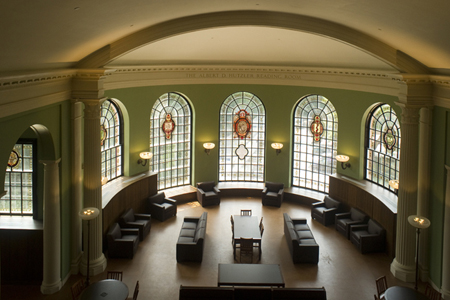
Over 90 years after it first opened its doors to students, Gilman Hall at The Johns Hopkins University, received a careful restoration while keeping an eye on the needs of the modern day student. Mr. Travers C. Nelson, AIA, program manager of design and construction for JHU, will lead us on a tour of this impressive building.

Gilman Hall, Johns Hopkins University Campus

3400 N. Charles Street, Baltimore, MD 21218
Thursday, October 13, 5:30 PM – 7:00 PM
$15/members, $20/non-members. Wine & cheese will be served.
Parking is available at the San Martin or South Parking Garages. Street parking is also available on nearby Charles Street.
RSVP today!

Gilman Hall is 146,000 square feet of classrooms, study space and offices. But it is more than that: it is the intellectual and philosophical heart of the humanities at Johns Hopkins University. Gilman Hall opened in 1915, the first academic building on the Homewood campus, as a single structure with everything a young university student needed for world-class teaching and research. It reopened in 2010 after being closed for two years for renovations, and is now the home at Hopkins for learning in literature, languages, history, philosophy, art, film, and antiquities. “Connections are everything,” said Basil Gildersleeve (1791–1875), the eminent classicist who was the first professor of Greek hired at Johns Hopkins. “Scrap knowledge is the bane of scholars,” he wrote. “Not to see a thing in its connections is not to see it all.” The point of the restoration is to carry out Professor Gildersleeve’s belief.

The Hall’s design – from its seminar rooms to its atrium – is to encourage faculty members and students to collaborate and explore ideas wherever they lead, even (or especially) across disciplines. The renovation work included everything from the careful restoration of the copper roof of the cupola to the creation, out of an airshaft, of a dramatic atrium covered by a state-of-the-art skylight. Important historic elements have been restored, and essential new spaces and building services have been added. The building is expected to be awarded a LEED Silver certification for sustainability. Please join Mr. Nelson in a tour of the renovated space to learn about the history of the building and its renovation.

Behind the Scenes Tour of the Audubon Society at Patterson Park

If you were migrating 5000 miles from Northern Canada to Mexico and passing over Baltimore, why would you pick anywhere else to take a rest other than historic Patterson Park? As it turns out, a large number of migrating birds do just that, and that’s why Audubon Maryland-DC chose to rehab a historic rowhouse at the edge of the park for use as an office and bird center. Please join us for a peek at the restored Patterson Park Audubon Center, a glass of wine on the roof deck overlooking the park, and a stroll through the 155-acre green space with Audubon bird guide David Curson to spot our avian visitors and see how they utilize one of Baltimore’s great historic spaces.

Patterson Park Audubon Center

2901 East Baltimore Street, Baltimore 21224
Wednesday, September 14
5:30 pm – 6:00 pm Wine & Cheese on the Roof
6:00 pm – 7:00 pm Bird Tour of historic park
$15/members, $20/non-members
RSVP for the tour today!

Rain Date: Thursday, September 15 (same times)

Mid-September is peak Fall migration for birds in Patterson Park, a great time to see warblers, vireos, tanagers, and flycatchers as they make their way from the breeding grounds in the Canadian arboreal forest to South and Central America. Over 160 bird species have been seen in the park and the well-spaced trees make for great viewing opportunities. The Patterson Park Audubon Center and Audubon Maryland-DC share a charming space on the second floor of a former rowhouse opposite the northeast corner of the park. The center, occupying two adjacent rowhouses, was built around 1860 and rehabilitated in 2005. With neighboring businesses upstairs and downstairs, Audubon shares a leafy view of Patterson Park, which is even better from the rooftop deck.

Patterson Park has played a vital role in Baltimore’s history. Formerly the estate of William Patterson, the land has been home to soldiers during two wars. During the War of 1812, British soldiers began marching towards the park, then called “Hamstead Hill,” only to find themselves face to face with 100 cannons and 10,000 troops from Baltimore. The Red Coats turned around and left the Baltimore Harbor. Patterson later donated five acres for a public walk in the 1820s, and Baltimore City augmented this gift by acquiring various adjacent parcels through the 1860s. With the advent of the Civil War, the Union military placed a hospital and encampment in the park. In 1905, as with many Baltimore parks, the Olmsted Brothers architecture firm was brought in to put its special touch on the landscape. Most recently, the park underwent extensive maintenance, upgrades and beautification projects pursuant to a 1998 master plan. These include renovating the 1891 observatory (designed by Charles Latrobe), dredging and landscaping the pond, and installing pedestrian lighting. The result is certainly one of Baltimore’s greatest historic assets, for birds and for people.

Behind the Scenes Tour of the Etting Family Cemetery


Our next Behind the Scenes Tour will be of the Etting Family Cemetery, the oldest Jewish cemetery in Baltimore. We will have a unique opportunity to see what lies behind the cemetery’s unassuming brick wall on North Avenue near Pennsylvania Avenue. Deb Weiner, research historian at the Jewish Museum of Maryland, who has investigated the cemetery and the Etting Family, will lead us through this tiny gem. Please join us to learn about this historic place that so many of us drive by and so few know anything about.

Etting Family Cemetery

1510 W. North Avenue, 21217
Thursday, August 11 | 5:30 PM – 6:30 PM
$10/members, $15/non-members
RSVP for the tour today!

Read more