To amplify Baltimore’s diverse cultural heritage through collaboration, advocacy, and education.
Category: Education
Our education programs include technical assistance to property owners, heritage education around the Civil War Sequicentennial and the Bi-Centennial of the War of 1812, and our ongoing Race and Place in Baltimore Neighborhoods project.
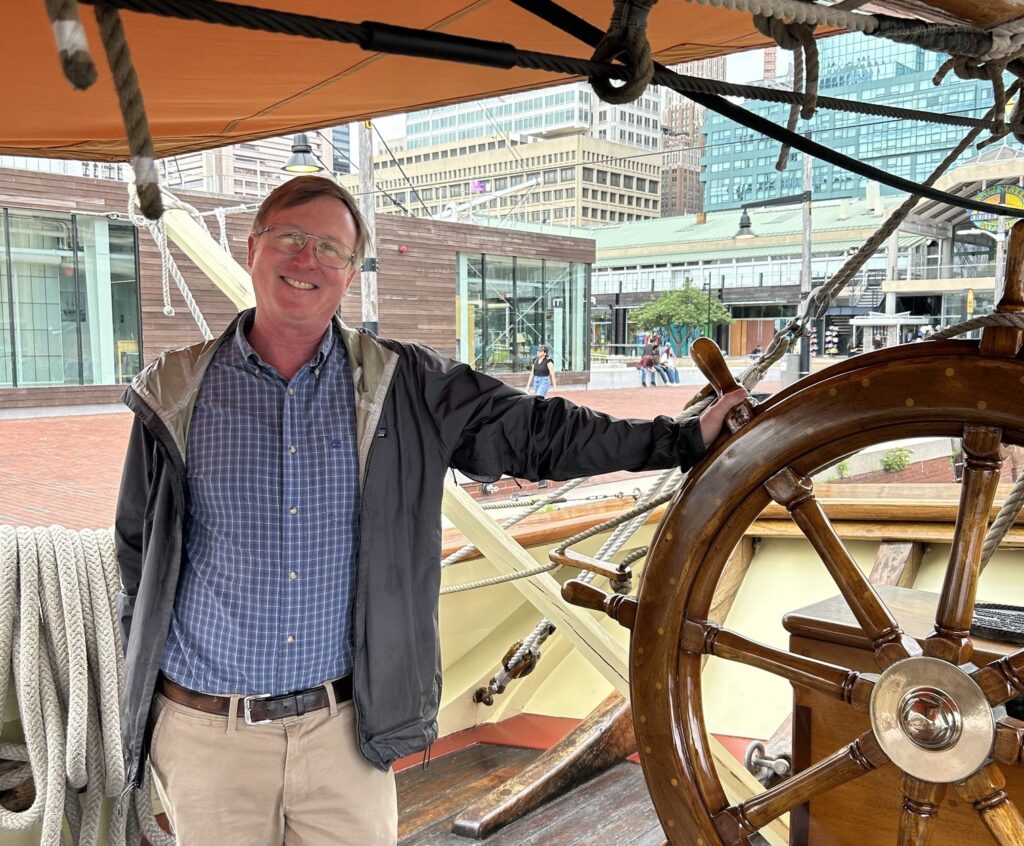
Our very own executive director, Johns Hopkins, is preparing to set sail as a guest crew member on the Pride of Baltimore II! Beginning tomorrow, Johns joins the Pride II crew as the tall ship sails to Lunenburg, Nova Scotia en route to the Great Lakes. Make sure to follow us on social media @bmoreheritage for his daily updates and 2 Minute Histories videos recorded on the ship.
And please join us Friday, May 30 at 11:00am at Constellation Pier 1, 301 E. Pratt St for a special dockside celebration to help us wish Johns and the crew “fair winds and following seas” as they carry Maryland’s maritime legacy, history, and spirit to new audiences across the Great Lakes.
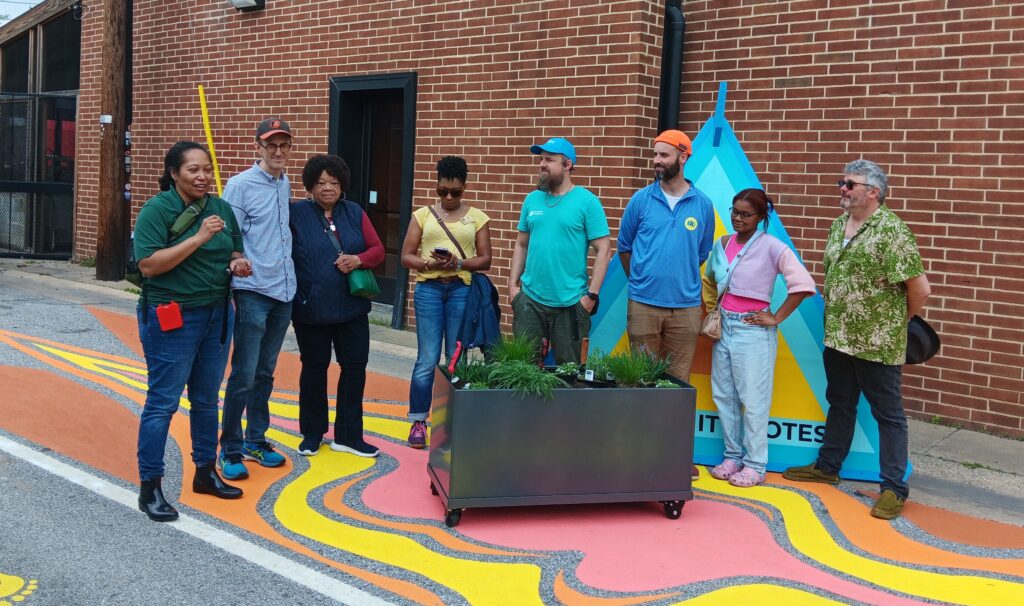
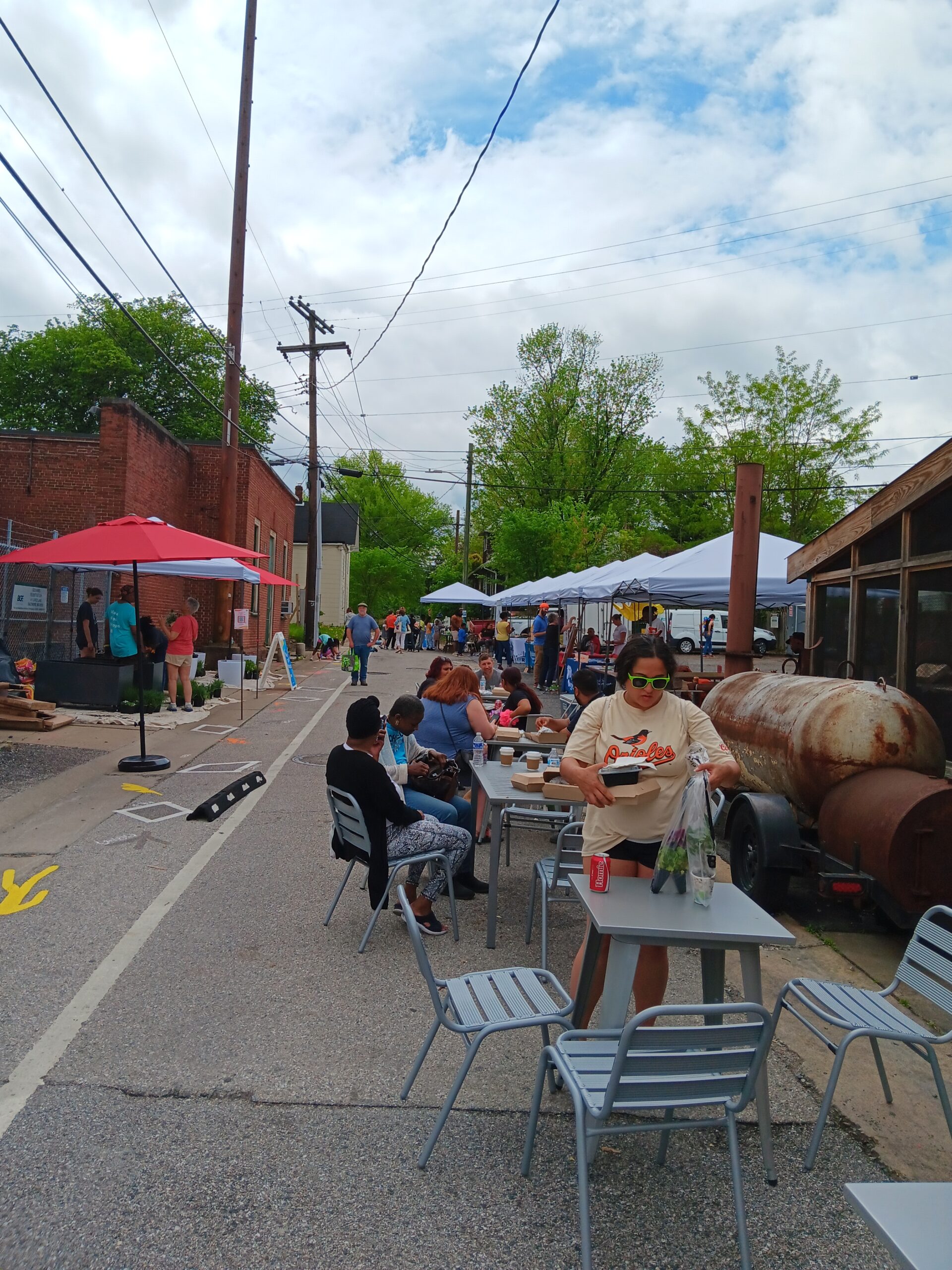
What do you get when you add a Baltimore history trivia contest to a neighborhood event in historic Govans? A great community celebration!
Working with a graduate fellow from the University of Maryland School of Social Work, Diamyn Wilson, we at Baltimore Heritage were proud to contribute to a community event on April 26 where residents of the historic Govans neighborhood came out to celebrate the completion of a street improvement project that will help local elementary and middle school kids walk safely from their school to the nearby Pratt Library Branch. The project focused on separating car traffic from where the kids walk along a street called Lortz Lane, including painting a bright mural on the street. Ms. Wilson worked with numerous community groups and residents to plan the celebration, including a history trivia contest with prizes from local shops along York Road just south of the Senator Theater. It’s one more step forward for this great historic place.
Graduate Fellow Diamyn Wilson (front right) from University of Maryland School of Social Work
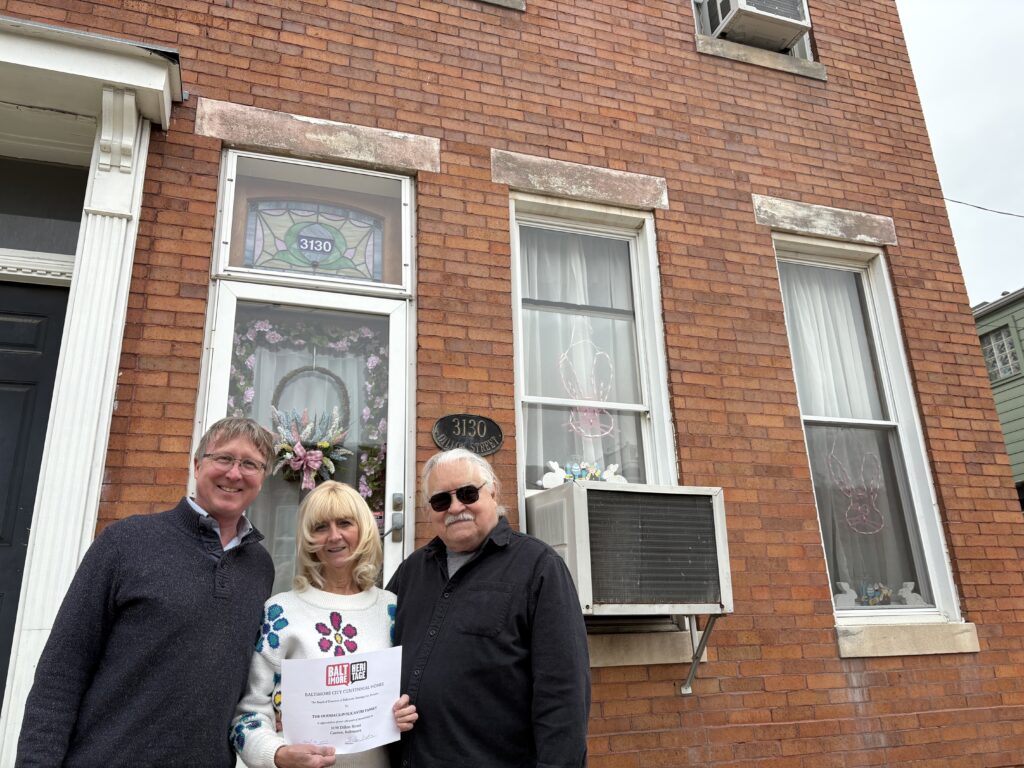
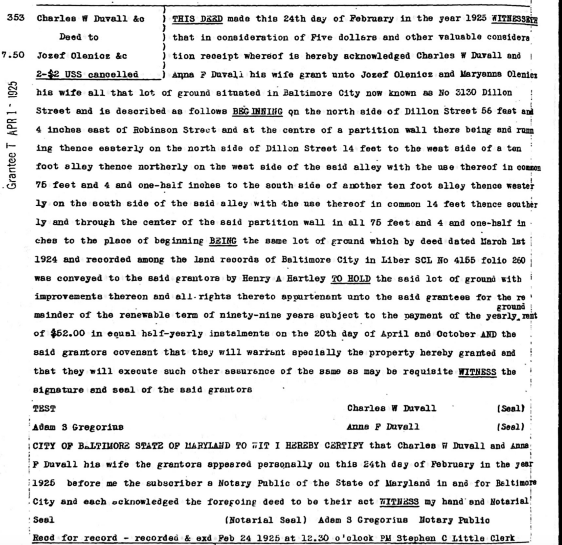
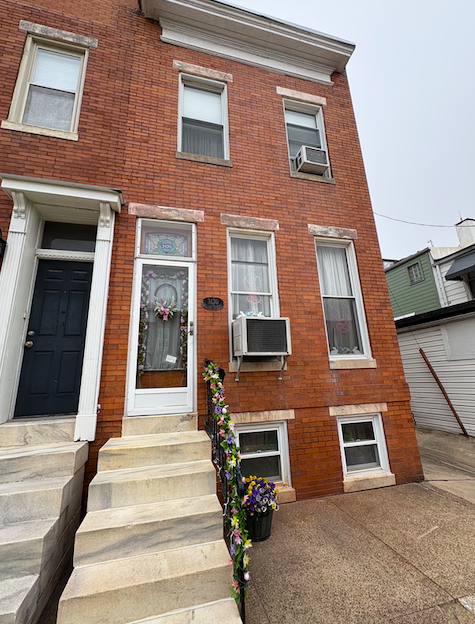
On April 10, 2025, Baltimore Heritage awarded a Centennial Homes certificate to Margie and Joe Policastri. Margie’s grandparents bought this quintessential rowhouse (brick construction, stained glass above the door, and marble steps) in February 1925 and it has remained in the family ever since. When Johns presented the certificate to Margie and Joe, they told him all about the neighborhood back in the 1970s and how it has changed over time. We are grateful for the family’s presence in the neighborhood and their wonderful stewardship of the house!
The Baltimore Centennial Homes project, developed in collaboration between Baltimore Heritage and City Councilman James Kraft, recognizes families that have been in the same house for 100 years or more. These families have anchored Baltimore’s historic blocks and neighborhoods through good times and bad. Their stories show the changes that our communities and our city have experienced as well as the critical roles that neighborhoods and their families have played in keeping historic neighborhoods thriving.
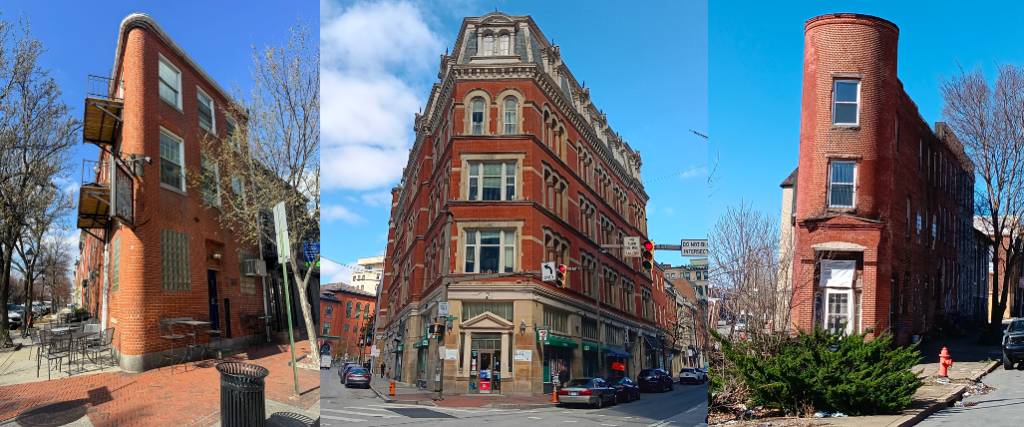
From Sydney to Shanghai, Madrid to Macedonia, the world is full of flatiron buildings – buildings shaped like triangles, or like the old fashioned flatirons that people would heat up on the stove and then use to press their clothes. In Baltimore, we recently set out on a hunt for them. With thanks to the many people who joined us in this search, we’ve rounded up 30 flatiron buildings and counting. We’ve got flatiron houses, flatiron office buildings, flatiron theaters, flatiron banks, even a flatiron building in the shape of a ship! Check out an online map below we put together to document where they are and what they look like. And if you see we are missing a flatiron building you know about, by all means please let us know!
Question 1: Function f is defined as f(x) = x2-6x+14. What is the minimum value of f(x)?
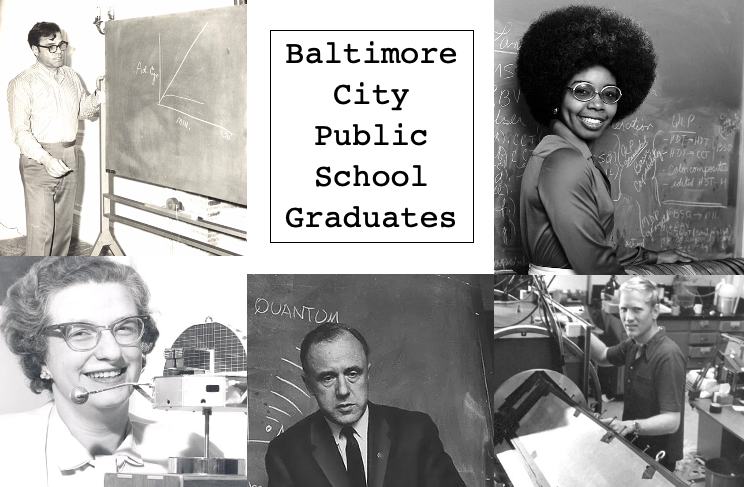
This complicated query above was Question 1 on the Maryland math exam that Donald Trump referenced yesterday in making disparaging remarks about Baltimore City Public School students and our school system generally. Among other things, Mr. Trump said that students who failed the exam could “not [do] even the very simplest of mathematics.” (Can you solve the above math problem? We can’t.) We thought we’d highlight a few Baltimore City Public School graduates who could have solved this question. The list is of course nowhere near complete but we hope it gives a little historical perspective of one of the first public school systems founded in the United States (1829).
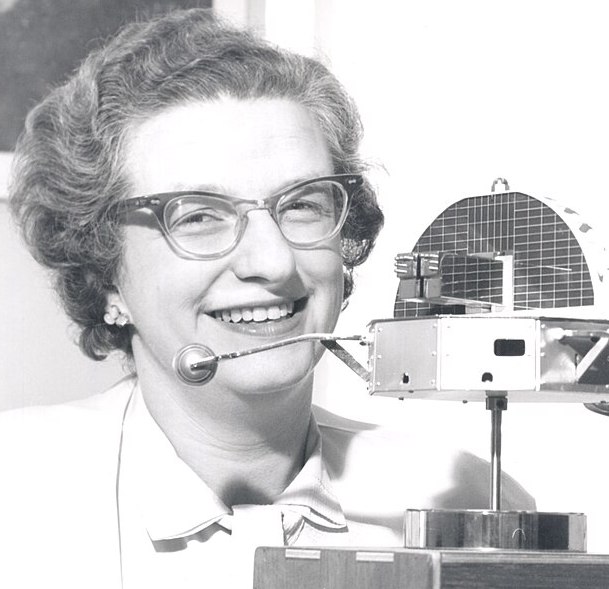
Nancy Roman
Nancy Roman – Astronomer and NASA’s first Chief of Astronomy (Western High School)
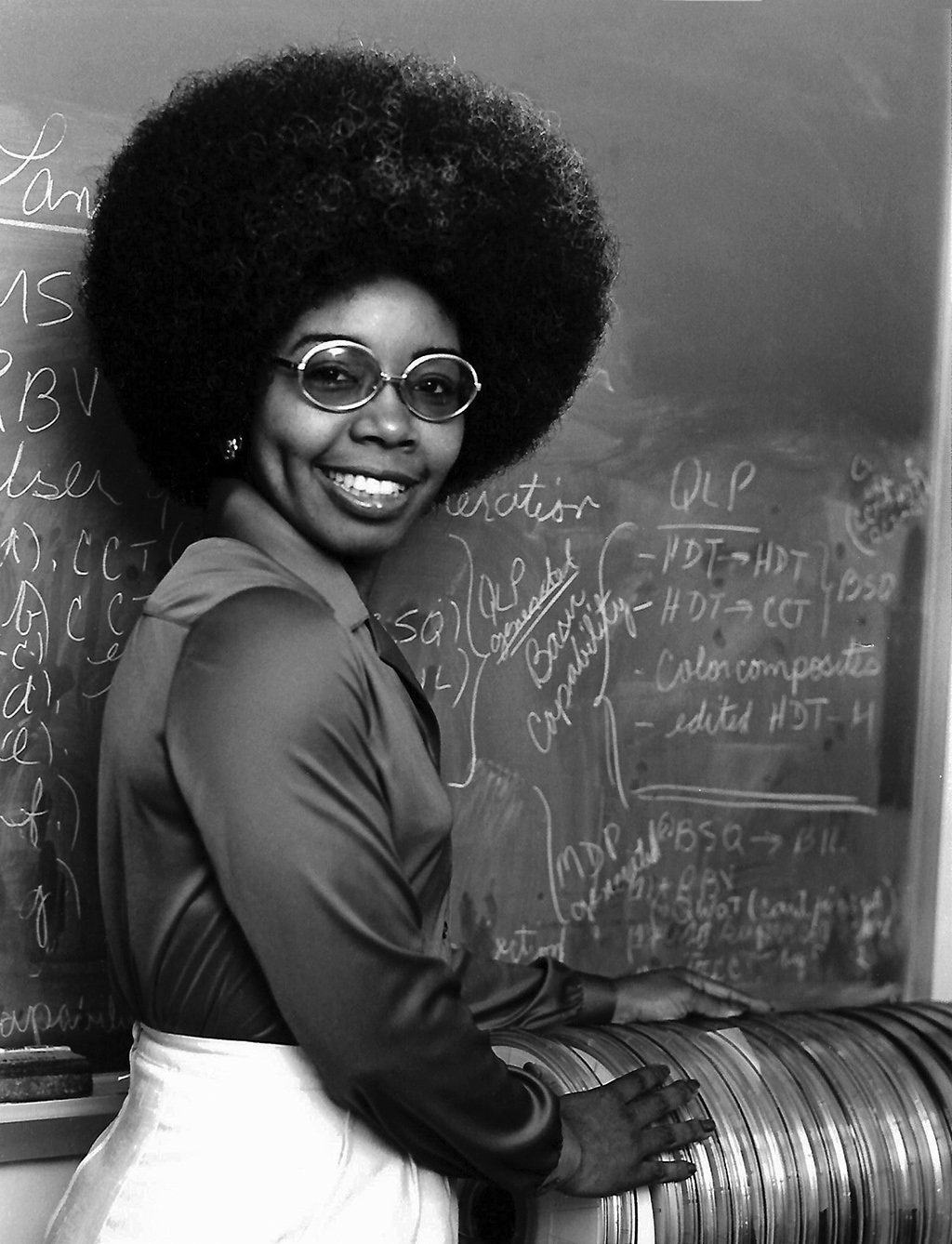
Valerie Thomas
Valerie Thomas – NASA mathematician and inventor (Western High School)
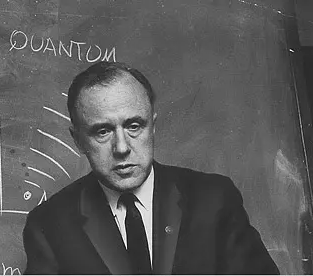
John Archibald Wheeler
John Archibald Wheeler – Theoretical physicist who Stephen Hawking called “the hero of the Black Hole story” (Baltimore City College)
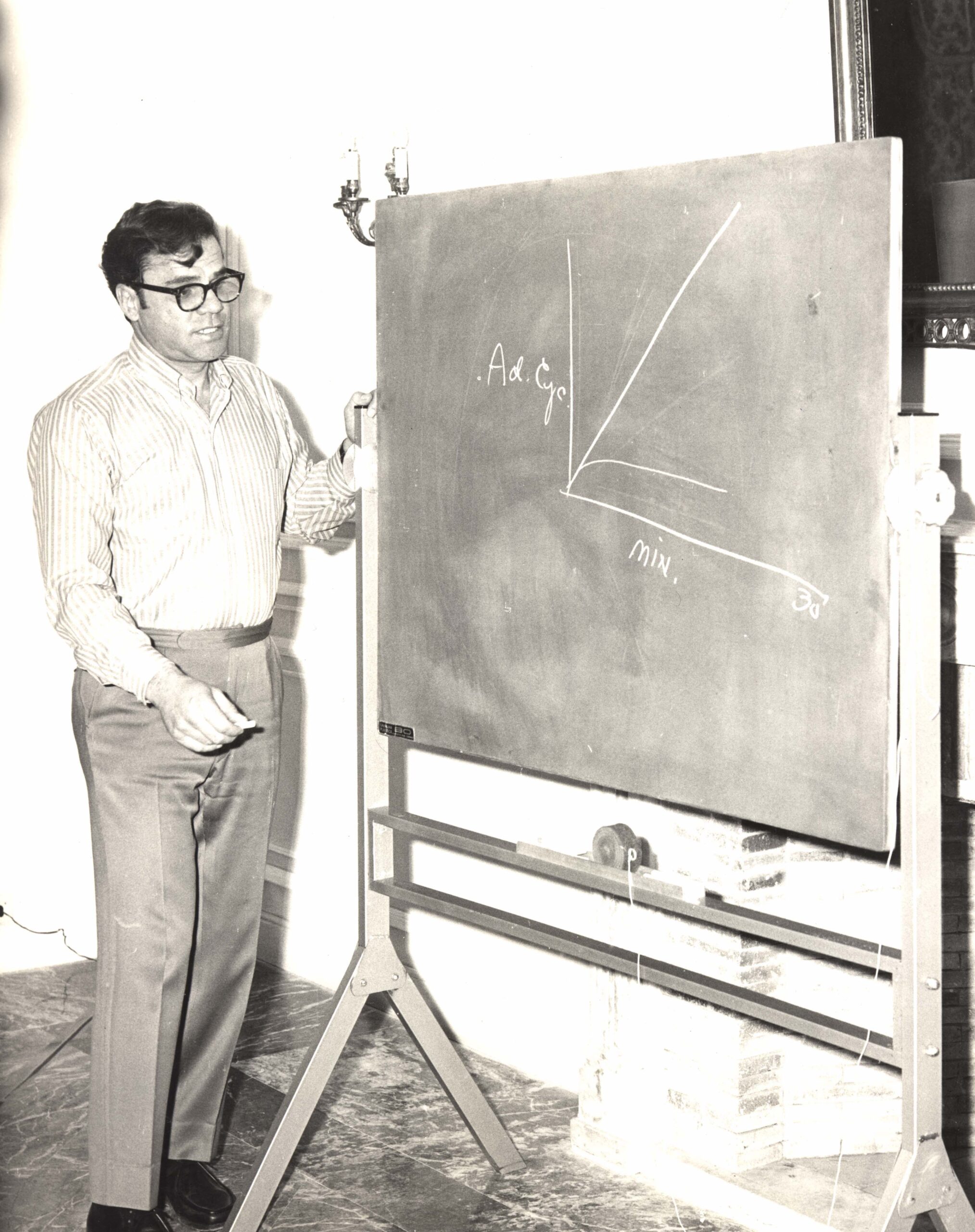
Martin Rodbell
Martin Rodbell – Biochemist and 1994 winner of the Nobel Prize in Physiology (Baltimore City College)
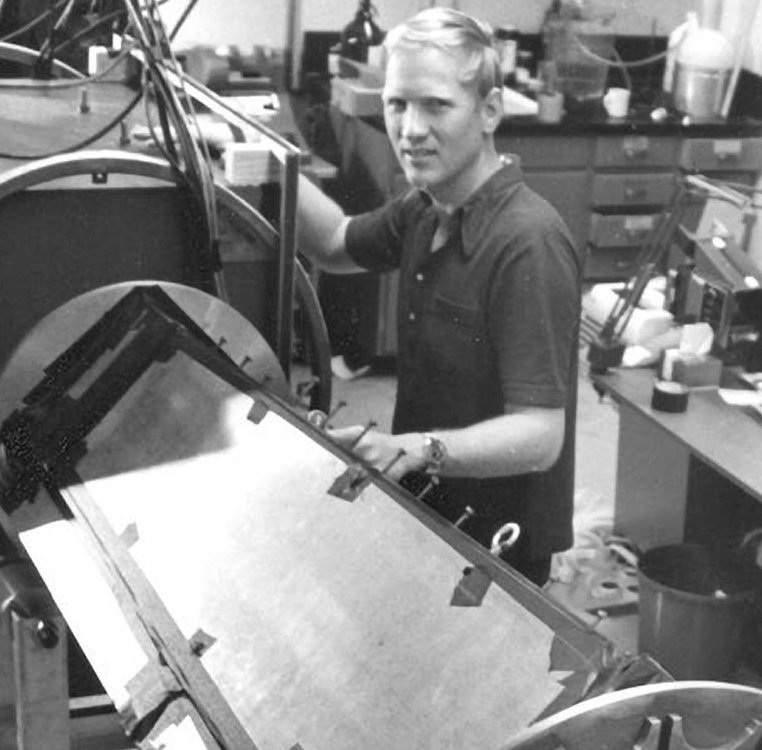
John Clauser
John Clauser – Physicist and winner of the 2022 Nobel Prize in Physics (Baltimore Polytechnic Institute)

 What do you get when you add a Baltimore history trivia contest to a neighborhood event in historic Govans? A great community celebration!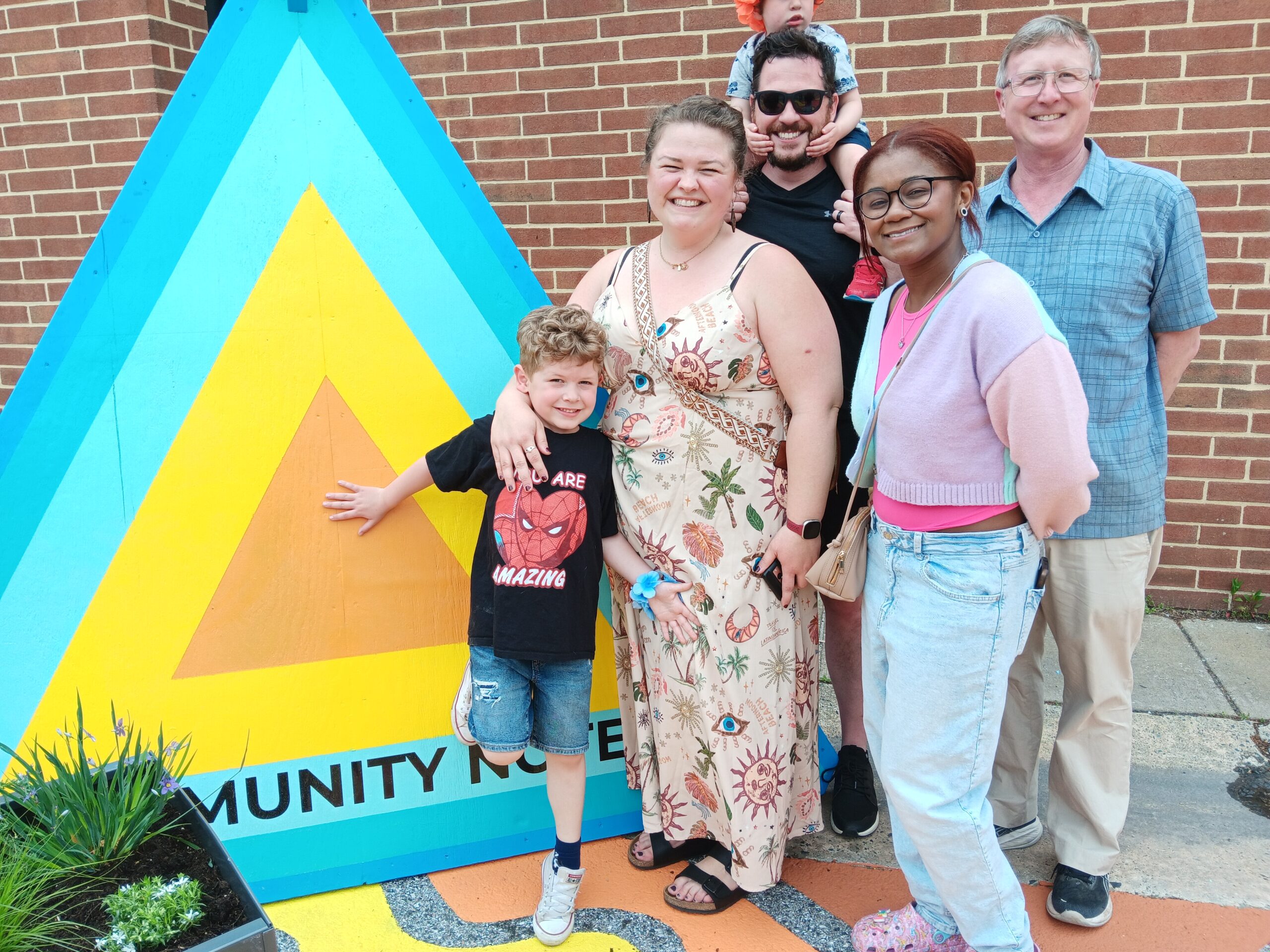
 The Baltimore Centennial Homes project