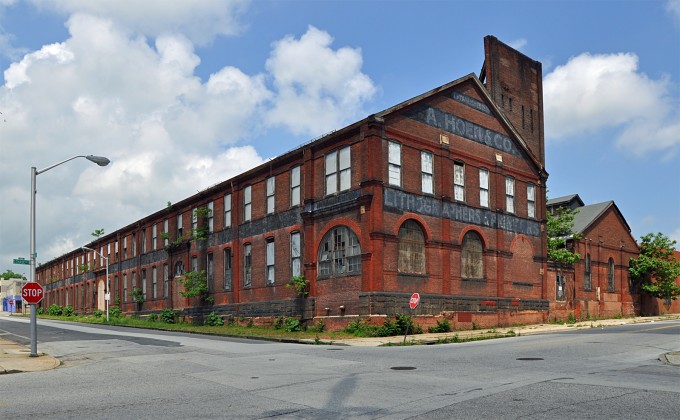
A. Hoen Lithograph Plant

How does an abandoned factory become urban farm?

After decades of neglect, it takes a bit of imagination to look at the cavernous A. Hoen & Co. Lithography Plant and see a unique opportunity for neighborhood revitalization. Fortunately, an exciting partnership between the American Communities Trust, Humanim, East Baltimore Development Inc., Big City Farms, Historic East Baltimore Community Action Coalition Inc., Woodberry Kitchen and Johns Hopkins (whew!) is leading the way to transform the plant and the nearby Eastern Pumping Station site into the new Baltimore Food Hub. By fall of 2014, these long vacant historic buildings will be bursting with entrepreneurs, urban farmers, students, and job trainees working with food-related businesses and learning about healthy food and sustainable agriculture.

The A.  Hoen Co. Lithography Plant includes a series of buildings from the mid 19th century through the turn of the 20th century and remained in use by the company up through the 1980s. Established in the 1840s, owner August Hoen became a pioneer in both the technology and business of printing – distributing affordable color maps, books, decorative prints and more across the country. Built in 1890 just a few blocks away on the opposite side of the railroad tracks, the Eastern Pumping Station was once stylish industrial landmarks in northeast Baltimore even rivaling the architecture of the nearby American Brewery Building (then known as the Bauernschmidt and J.F. Weissner Brewery) with a more dignified Romanesque style. Architect Jackson Gott who designed the Pumping Station completed a number of projects for Baltimore City included the Maryland Penitentiary in 1893 and the Southern District Police Station in 1896.

Join us to discover more on the fascinating history of both buildings and the exciting future of food and healthy living that their preservation and re-use promises for East Baltimore! Our tour guides will include project manager Gregory Heller from Econsult and Bill Streuver, President of the American Communities Trust.

Laser Scanning the “Two Sisters” Historic Wooden Homes in Fell’s Point for The Preservation Society

We are glad to share a guest post from Joe Nicoli, Heritage Scanning Specialist with Direct Dimensions, Inc. – a local technology company that specializes in 3D laser scanning and modelling. Their past work has included scanning the interior of the Maryland State House and documenting cracks in the Tomb of the Unknowns at Arlington National Cemetery in precise detail. Direct Dimensions is now working with The Preservation Society and the Dell Corporation to document the Two Sisters Houses at 612 and 614 Wolfe Street – two of only a handful of Baltimore’s wooden houses that have survived since the late 18th and early 19th centuries:

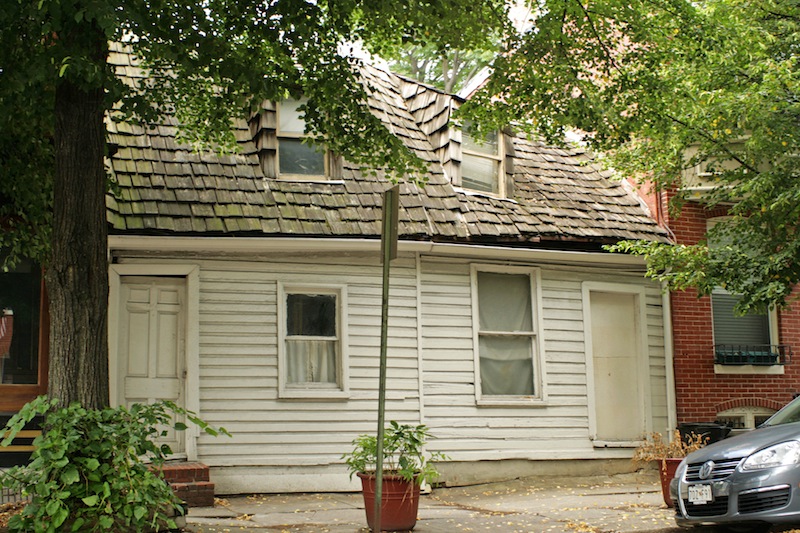
612-614 S. Wolfe Street
612-614 S. Wolfe Street, 2012

Over the winter, Bryan Blundell from Dell Corporation had approached Direct Dimensions with a project to completely laser scan the Two Sisters Houses in Fell’s Point. On a sunny afternoon in March, myself and another technician with Direct Dimensions took our laser scanning equipment down to Fell’s Point and in just 30 minutes created a perfectly accurate 3D digital model of the exterior of the property.

The Two Sisters are two of just a handful of remaining wooden houses in Baltimore’s Fell’s Point. These buildings were donated to the Preservation Society by the Dashiell-Marine family. The name, The Two Sisters, recognizes the efforts of the Dashiell sisters, Mary and Eleanor, to save these and other buildings in Fell’s Point. Since that time, the Society has worked steadily to develop a plan for the saving and utilization of these significant architectural examples of early life in Fell’s Point.

3D scanning is one of the many modern technologies that can be used to help reveal some of the secrets and stories that are part of these amazing structures. The scanning can provide a baseline documentation of the building’s current state, allowing the planning team to design necessary structural supports, and to also serve as a 3D, “as-built” blue print for documenting current conditions and future preservation efforts.

What is 3D scanning?

Laser scanning is the process of collecting millions of individual measurements using laser light. Think of a range finder. A laser beam leaves the scanner on a specific orientation and the time it takes to reflect off a surface and return to the scanner establishes the distance. This happens thousands of times per second. By moving the equipment to various positions and perspectives, an entire site can be “scanned” in 3D. Once the data is merged, the resulting “point cloud” can be used to create traditional drawings, 3D models, and virtual reconstructions & walkthroughs.

So far, Direct Dimensions has only scanned the exterior on Wolfe Street, and will complete the project with funds provided to The Preservation Society by an African American Heritage Preservation Program Grant from the Maryland Historical Trust. This initial scan effort is also valuable as an archived “3D snapshot”, a record of the state of the structure in the spring of 2013.


Exploring the Guilford Mansion & Estate – “Billy” McDonald’s 52-room mansion and A.S. Abell’s family home

We’re excited to share a guest blog post from Tom Hobbs, President of the Guilford Association highlighting 100 years of history in Guilford. The Guilford Association is planning many great events this year to recognize the centennial anniversary which you can find on their website or on the Guilford Centennial Facebook page. Today’s post features the early history of the Guilford Mansion – home to “Billy” McDonald and Arunah S. Abell:

guilfdb4[1].source Charles Hall Abell album.
Image courtesy Charles Hall/Guilford Association.
What we now identify as Guilford initially comprised ten land patents granted to British citizens from the mid 1600’s through the 1700’s. The entire region was sold in 1780 as confiscated property to Revolutionary War veteran Lieutenant-Colonel William McDonald. McDonald gave Guilford its name to commemorate the battle of Guilford Court House, North Carolina His son William, better known as “Billy,” inherited the estate and in 1852 built the Guilford Mansion.

The Italianate design of the mansion was a collaboration of British architect Edmond Lind and American William T. Murdock. According to Baltimore: Its History and Its People, the 52-room wood house was built over walls of masonry and was imposing in size and rich finishes. A solid walnut staircase rose with a grand sweep in a spiral ascent to the square turret. The drawing-room, library, billiard and reception rooms and great dining room all opened on to a main hall and had exposure to wide verandas shadowed by magnolia trees and draped in wisteria. The main hall itself was as wide as the driveway, paved in marble and lighted with stained-glass windows.

The mansion once stood where Wendover Road now meets Greenway. The entrances of the 300 acre Guilford estate were marked by imposing gates that were guarded by stone lions, reported to be copies of the lions of the Louvre. Frescoes on either side of the drive entrance depicted knights ready for conflict. Gates stood at York Road near present-day Underwood Road, Charles Street at University Parkway and Charles Street just south of Cold Spring Lane. Billy McDonald was an enthusiastic horseman and at Guilford he stabled his renowned mare, “Flora Temple.” The mare was housed at the Guilford estate in stalls that were kept in magnificent style as a suite of four apartments. Above her head was a stained glass window with her portrait.

Flora Temple and her colt, courtesy the Library of Congress
Arunah S. Abell, courtesy the Guilford Association

In 1872, Arunah S. Abell, founder of The Sun, purchased Guilford from McDonald’s heirs. A.S. Abell had a home in the City and several country estates but he spent much time at Guilford living there for 35 years. On August 12, 1887, the New York Times reported that A. S. Abell celebrated his 81st birthday. “Mr. Abell passed the day quietly and pleasantly at his country seat, Guilford, surrounded by his children and grandchildren, who had tastefully arranged in the rooms of the beautiful mansion, particularly Mr. Abell’s private room, many lovely flowers.” Eight months later Arunah S. Abell died.

Arunah S. Abell had 12 children and three sons and five daughters were still living at the time of A.S.’s death. The Sun newspaper was left entirely to the three surviving sons and they managed the considerable estate, a significant income from which was to be distributed to the daughters. The Guilford estate remained in the Abell family holdings for another 35 years but sat vacant during much of that time. Prior to 1888, the northern boundary of Baltimore City was essentially what is known today as North Avenue. The area north of the city was heavily wooded, sparsely settled and largely held in country estates. In 1888, the city annexed 2 miles to the north of the existing city limit and urban expansion was inevitable. With the urban development advancing north from the center of Baltimore the decision was made to sell the Abell property.

With this prospect,a group of Baltimore’s most influential citizens, including Robert Garrett, William H. Grafflin, William Marburg, Thomas J. Hayward and H. Carroll Brown formed the Guilford Park Company. The motive for the organizers was both profit as well as preserving the beautiful piece of property from being sold in small parcels for speculative building. They were determined that the property should be developed as a whole following the best modern city planning practices. The Guilford Park Company raised funds through stock sales and in 1907 the Guilford estate was sold to the Guilford Park Company for one million dollars.

Guilford estate and nearby properties, 1889 Thompson Atlas, courtesy the Baltimore City Archives

However, several years after the property purchase the Guilford Park Company had failed to carry out its 1907 intention to develop the 296-acre country estate and Guilford-the-suburb had remained an “on paper” venture. At the same time in an area west of Guilford the development of the planned community of Roland Park was well underway. In 1891 a syndicate of English capitalists, Midwestern promoters and Baltimore investors came together and incorporated the Roland Park Company. The company had initially purchased 800 acres of land for the purpose of developing a suburban town to the north of Baltimore. The principal members of the Guilford Park Company were impressed by the quality and success of the Roland Park undertaking.

Frederick Law Olmsted Jr.
Frederick Law Olmsted Jr., courtesy the National Association for Olmsted Parks

Edward H. Bouton, the Roland Park Company’s general manager, had engaged Frederick Law Olmsted, Jr. to design a “splendid green suburb.” Bouton also had his eye on the Guilford property development. On February 14, 1911 he wrote to Olmsted: “All of the future suburban growth of Baltimore of the character of Roland Park, is going to be confined in the comparatively narrow space lying between York and Falls Roads.” Later in July, he wrote: “I think it’s more than likely that the consolidation of Guilford with Roland Park is going to be consummated and that this will be determined within the next two weeks. If it goes through I want to consult with you about it as early as possible.”

The country estate of Guilford was acquired by the Roland Park Company on November 20, 1911 from the Guilford Park Company. Bouton, the community planner and builder, would direct the development of this prized parcel of land.

Thanks again to Tom Hobbs for sharing his writing and research. The Guilford Mansion survived up until 1914 when, after several years of standing vacant, the Roland Park Company demolished the structure. You can join in Guilford’s Centennial Celebration with the Centennial Tulip Dig coming up on May 25, 2013 from 7:00am to 11:00am at Sherwood Gardens. This piece was originally published in the Fall 2010 and Winter 2011 issues of The Guilford News. Look out for our next guest post from Tom on the history of Guilford later this year!

Resource: Illustrated Guidelines on Sustainability for Rehabilitating Historic Buildings

Sustainability is a critical issue in architecture, design and planning and while we believe “the greenest building is built” we support the many home-owners and property owners who are seeking new ways to improve the efficiency and sustainability of their historic homes, apartment buildings, factories, and Main Street properties.

Thanks to the Technical Preservation Services with the National Park Service we now have an accessible and easy-to-use guide that can help historic property owners make important decisions about everything from weatherization to wind-power. The Illustrated Guidelines on Sustainability for Rehabilitating Historic Buildings offer practical guidelines with dos and don’ts on how to retrofit your home or business for sustainability. Projects that can follow these guidelines may also be eligible for state or federal historic tax credits.

Site Features—Sustainability Guidelines—Technical Preservation Services, National Park Service

You can find the Illustrated Guidelines on Sustainability for Rehabilitating Historic Buildings online or download a PDF copy of the 2011 printed version of the guidelines. If you are interested in learning more about combining historic preservation and weatherization, please join us later this month for our latest introductory workshop with Retrofit Baltimore on May 29.