Year: 2010

Baltimore Building of the Week: St. Mary’s Seminary Chapel

The Baltimore Building of the Week is St. Mary’s Seminary Chapel at 600 North Paca Street in Seton Hill– the first seminary established in the United States. Over two dozen photos of this important building were taken by the Historic American Building Survey in 1936 and tours of both the St. Mary’s Seminary Chapel and the Mother Seton House are offered every day of the week.
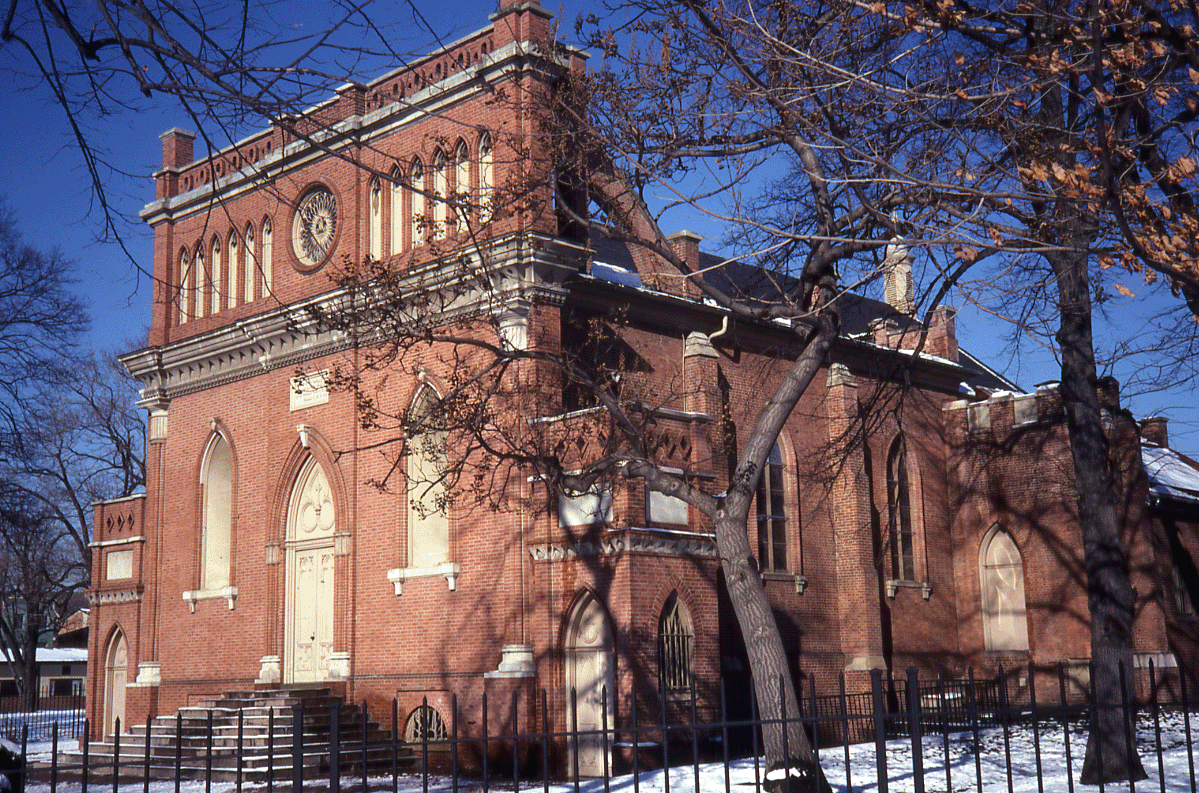
Image courtesy Jack Breihan

At a time when neoclassical architecture was in style, this gothic chapel, built in 1808, was an anomaly. Indeed, it is probably the first Gothic Revival building in the United States. It ushered in an era of eclecticism, in which architects worked different styles at the same time. The architect here was Maximilian Godefroy, recruited as a faculty member at St. Mary’s Seminary, founded in 1781 as Baltimore’s first institution of higher education. Godefroy was clearly happier in the neoclassical style (at the Battle Monument and the First Unitarian Church). The chapel is stiff and symmetrical, with “flying buttresses” facing the wrong way, but it pleased his patrons – Sulpician fathers homesick for the gothic monuments of their native France. The Seminary moved to Roland Park in 1927, but the Sulpicians should be congratulated for continuing to maintain this important building.
Read more

Baltimore Building of the Week: First Unitarian Church of Baltimore

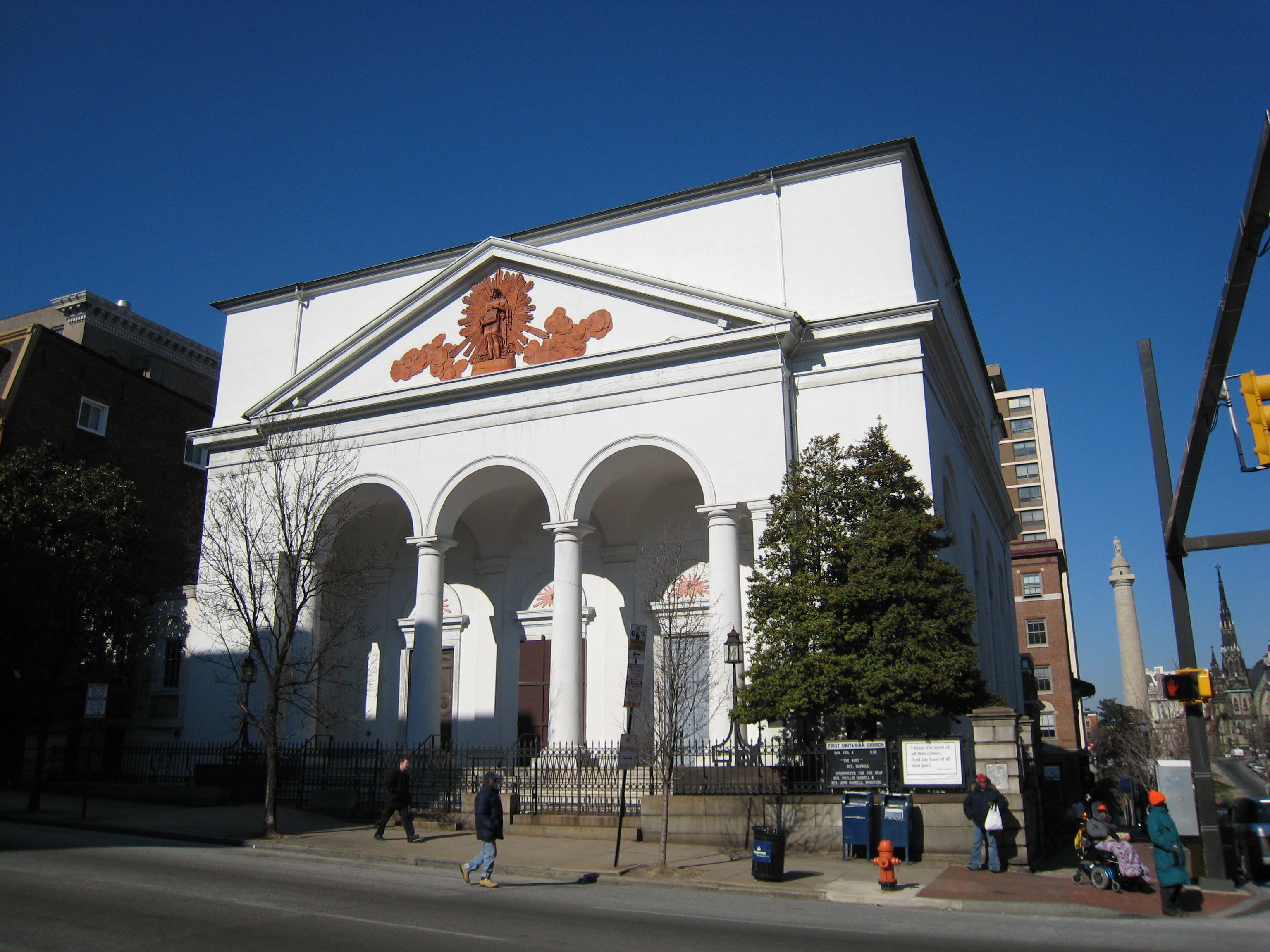
Returning to religious architecture, this week’s entry in the Baltimore Building of the Week series is the First Unitarian Church of Baltimore, the very first building erected for Unitarians in the United States, at the northwest corner of Franklin and Charles Streets. Continue to the end for the answer to the question posed in last week’s post on Baltimore’s Columnar Monuments.

Image courtesy Jack Breihan

If the Basilica is Baltimore’s neoclassical Hagia Sophia, its neoclassical Roman Pantheon stands only a block away. Completed in 1819 to the designs of the French architect Maximilian Godefroy, the First Unitarian Church is a simple cube topped with a hemispherical dome. An arched Roman Doric portico and pediment mark the entrance on Franklin Street (the new prayer garden commemorating Pope John Paul II has opened up the view). Despite its classic simplicity, the dome had notoriously bad acoustics. Eventually a lower plaster vault was constructed beneath it. Baltimore’s other Pantheon is Davidge Hall, the original building of the University of Maryland, at Greene and Lombard Streets.

Read more

Behind the Scenes Tour of the Old Otterbein Church

Image courtesy wallyg/Flickr

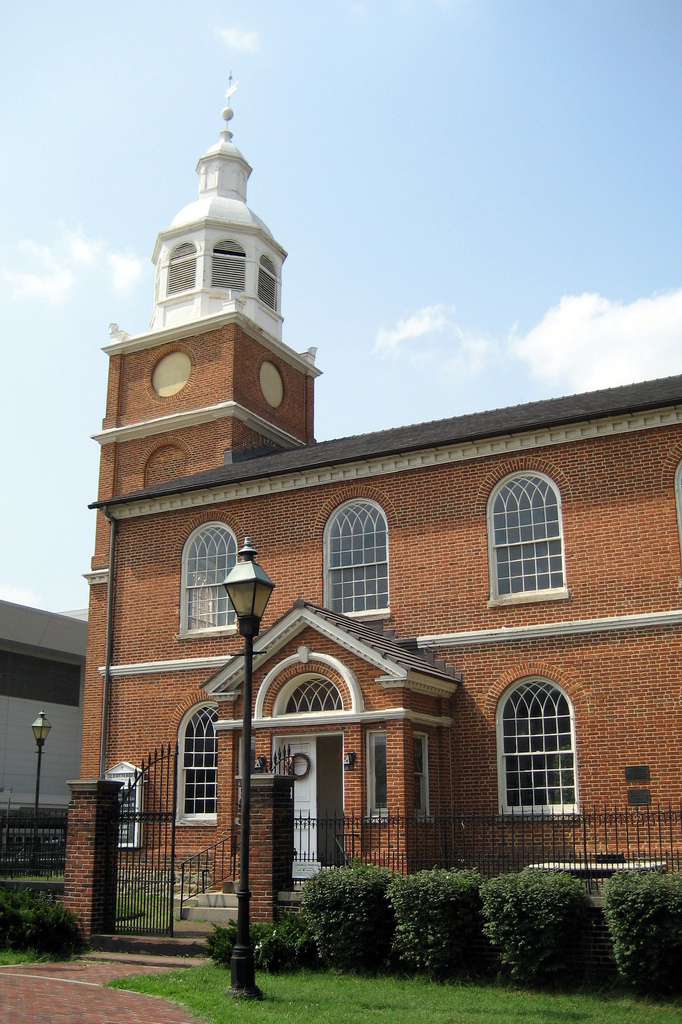
Old Otterbein Church, built in 1785, is the oldest church still standing in Baltimore. With its classic brick and white trim tower (with bells brought over from Germany), the church shows off its landmark stature for countless Orioles fans and anybody traveling around downtown and Camden Yards. Please join us to get a better look at this Baltimore gem and its two historic ancillary buildings, the 1811 Parsonage and the 1872 Sunday School. We’ll also be treated to a demonstration of the church’s one-of-a-kind 1897 Niemann Organ.

Tour Information

Date: Thursday, March 25, 2010
Time: 6:30 to 7:30 p.m. (the organist will start playing at 6:15)
Place: Old Otterbein Church, 112 West Conway Street, 21201
Park in the church lot to the east of the church, entrance off Conway Street
Cost: $10
Read more

Baltimore Building of the Week: Baltimore’s Columnar Monuments

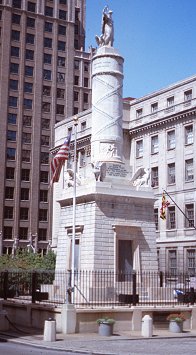
This week’s Baltimore Building of the Week is not, in fact, a building. Instead, it is three of Baltimore’s notable “Columnar Monuments.” Both the Battle Monument and Mount Vernon’s Washington Monument have also been featured on the Monument City website. Visitors can take a tour of the Shot Tower’s ground floor exhibit, sound and light show, and informational video are available with appointment at 10:30 AM on Saturday or Sunday. The Washington Monument is open for visitors Wednesday to Friday 10 AM to 4 PM and Saturday and Sunday 10 AM to 5 PM up until Memorial Day.

Battle Monument, Image courtesy Jack Breihan

Completed during the 1820s, two of these towering structures established Baltimore’s distinction as “the Monumental City.” Maximilian Godefroy’s Battle Monument, depicted on the City flag, commemorated the Defenders who died beating off the British attack in 1814. It combines Egyptian and Roman themes, including a giant set of fasces. A gigantic Roman Doric column, Robert Mills’ Washington Monument portrays the Father of Our Country, dressed in a toga, performing what its builders considered his most heroic act. (What was it? answer next week!) The contemporary Phoenix Shot Tower was a monument to Baltimore’s growing industrial sector; it manufactured lead shot for the Chesapeake Bay duck-hunting industry.

Read more

Baltimore Building of the Week: The Basilica

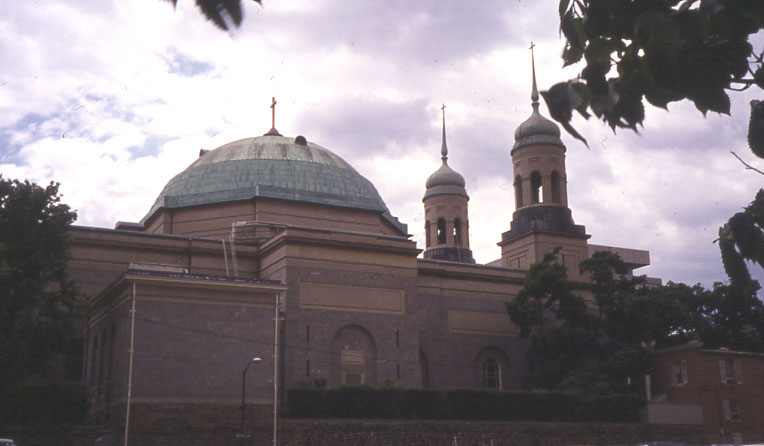
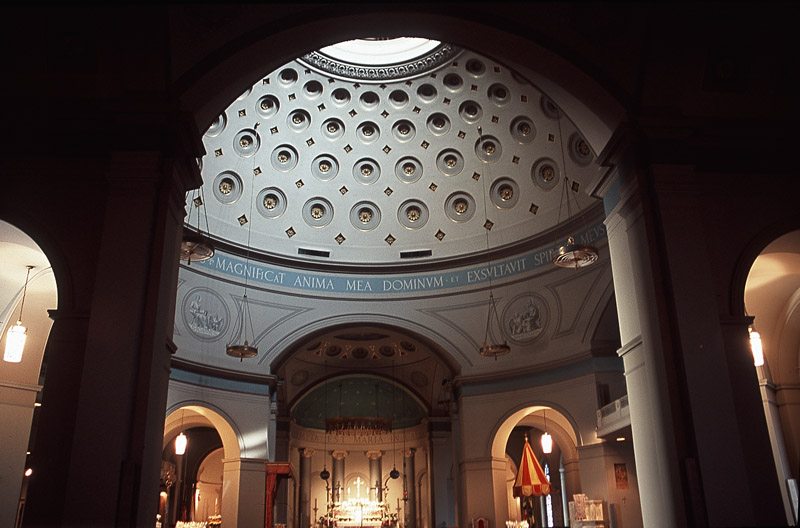
This week’s featured Baltimore Building of the Week from Dr. John Breihan is the Basilica of the National Shrine of the Assumption of the Blessed Virgin Mary, a National Historic Landmark, National Shrine, Marian Shrine, and Co-Cathedral of the Archdiocese of Baltimore. You can become a fan of this incredible building on Facebook or take a guided tour Monday through Saturday.

Image courtesy Jack Breihan

By far the greatest architectural masterpiece in Baltimore is its long-time Catholic cathedral, now known as the Basilica of the Assumption. Designed by Benjamin Henry Latrobe for Archbishop John Carroll, the Basilica was built between 1806 and 1820. The great domed church with its curious cylindrical towers, our Hagia Sophia, long dominated the Baltimore skyline. To mark its bicentennial in 2006, the Basilica underwent a much-needed rehabilitation of its basic systems and a conjectural restoration of the interior to its appearance in 1820. While some welcome the new bright pastels, others miss two centuries’ accretions of church furniture, gold leaf, and stained glass.

Image courtesy Jack Breihan