Category: Education

Our education programs include technical assistance to property owners, heritage education around the Civil War Sequicentennial and the Bi-Centennial of the War of 1812, and our ongoing Race and Place in Baltimore Neighborhoods project.

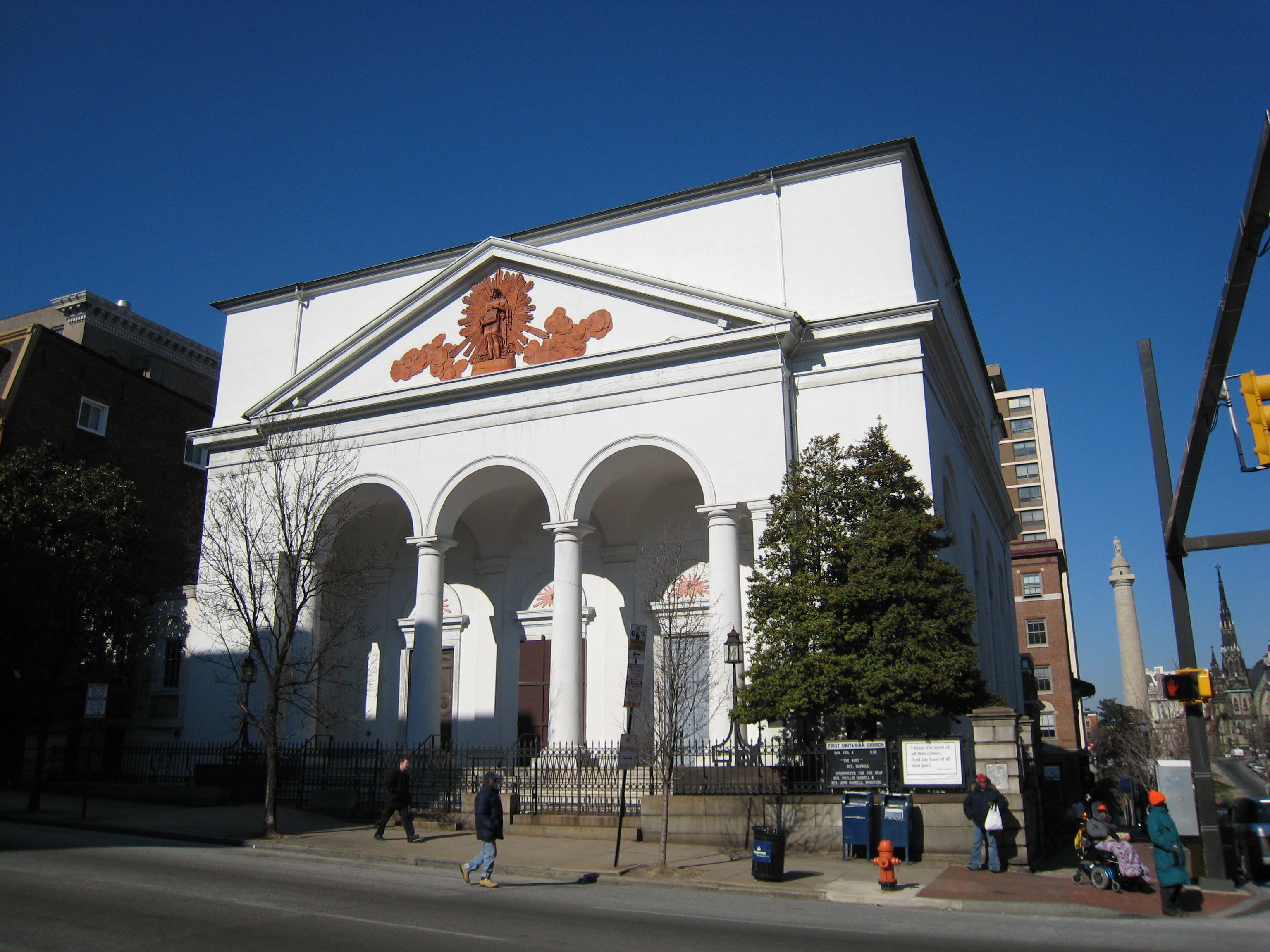
Baltimore Building of the Week: First Unitarian Church of Baltimore

Returning to religious architecture, this week’s entry in the Baltimore Building of the Week series is the First Unitarian Church of Baltimore, the very first building erected for Unitarians in the United States, at the northwest corner of Franklin and Charles Streets. Continue to the end for the answer to the question posed in last week’s post on Baltimore’s Columnar Monuments.

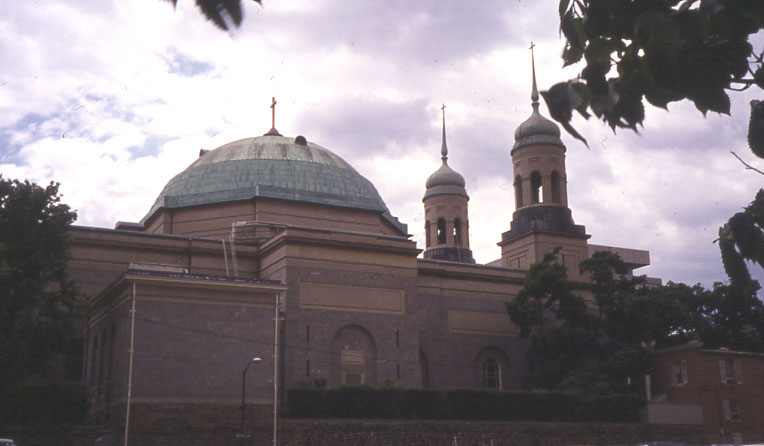
Image courtesy Jack Breihan

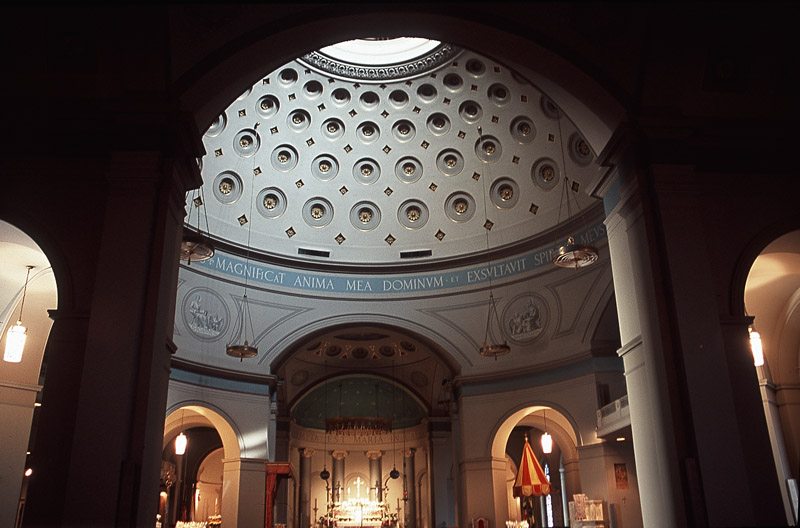
If the Basilica is Baltimore’s neoclassical Hagia Sophia, its neoclassical Roman Pantheon stands only a block away. Completed in 1819 to the designs of the French architect Maximilian Godefroy, the First Unitarian Church is a simple cube topped with a hemispherical dome. An arched Roman Doric portico and pediment mark the entrance on Franklin Street (the new prayer garden commemorating Pope John Paul II has opened up the view). Despite its classic simplicity, the dome had notoriously bad acoustics. Eventually a lower plaster vault was constructed beneath it. Baltimore’s other Pantheon is Davidge Hall, the original building of the University of Maryland, at Greene and Lombard Streets.

Read more

Baltimore Building of the Week: Baltimore’s Columnar Monuments

This week’s Baltimore Building of the Week is not, in fact, a building. Instead, it is three of Baltimore’s notable “Columnar Monuments.” Both the Battle Monument and Mount Vernon’s Washington Monument have also been featured on the Monument City website. Visitors can take a tour of the Shot Tower’s ground floor exhibit, sound and light show, and informational video are available with appointment at 10:30 AM on Saturday or Sunday. The Washington Monument is open for visitors Wednesday to Friday 10 AM to 4 PM and Saturday and Sunday 10 AM to 5 PM up until Memorial Day.

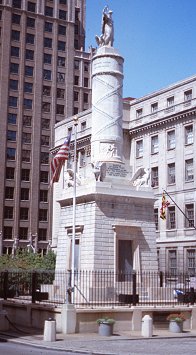
Battle Monument, Image courtesy Jack Breihan

Completed during the 1820s, two of these towering structures established Baltimore’s distinction as “the Monumental City.” Maximilian Godefroy’s Battle Monument, depicted on the City flag, commemorated the Defenders who died beating off the British attack in 1814. It combines Egyptian and Roman themes, including a giant set of fasces. A gigantic Roman Doric column, Robert Mills’ Washington Monument portrays the Father of Our Country, dressed in a toga, performing what its builders considered his most heroic act. (What was it? answer next week!) The contemporary Phoenix Shot Tower was a monument to Baltimore’s growing industrial sector; it manufactured lead shot for the Chesapeake Bay duck-hunting industry.

Read more

Baltimore Building of the Week: The Basilica

This week’s featured Baltimore Building of the Week from Dr. John Breihan is the Basilica of the National Shrine of the Assumption of the Blessed Virgin Mary, a National Historic Landmark, National Shrine, Marian Shrine, and Co-Cathedral of the Archdiocese of Baltimore. You can become a fan of this incredible building on Facebook or take a guided tour Monday through Saturday.

Image courtesy Jack Breihan

By far the greatest architectural masterpiece in Baltimore is its long-time Catholic cathedral, now known as the Basilica of the Assumption. Designed by Benjamin Henry Latrobe for Archbishop John Carroll, the Basilica was built between 1806 and 1820. The great domed church with its curious cylindrical towers, our Hagia Sophia, long dominated the Baltimore skyline. To mark its bicentennial in 2006, the Basilica underwent a much-needed rehabilitation of its basic systems and a conjectural restoration of the interior to its appearance in 1820. While some welcome the new bright pastels, others miss two centuries’ accretions of church furniture, gold leaf, and stained glass.

Image courtesy Jack Breihan

Baltimore Building of the Week: Homewood House

This week’s featured Baltimore Building of the Week from Dr. John Breihan is Homewood House at 3400 North Charles Street on the campus of The Johns Hopkins University.

Image courtesy of John Breihan

Even the wealthy Charles Carroll was shocked by the cost of his son’s country villa, Homewood, built early in the 19th century on a hillside north of town.  A federal-style version of the standard five-part Georgian Palladian mansion house (see Mt. Clare), Homewood’s principal floor is tall, elegant, airy, and cool.  Service rooms are tucked away in the basement or attic (there is a fine brick privy in back).  The Johns Hopkins University acquired the surrounding estate and built a new campus there early in the 20th century.  Homewood is open to the public as part of Johns Hopkins University Museums.

The Homewood House Museum is currently hosting a four-part speaker series in association with their fourth annual student-curated focus show, On the Road: Travel and Transportation in Early Maryland. The first event in the series is David Shackelford, Chief Curator at the Baltimore & Ohio Railroad Museum, speaking tonight, February 18, 2010 at 4:30 PM.

Baltimore Building of the Week: 9 North Front Street

Staying in the historic Jonestown neighborhood for another week in our Baltimore Building of the Week series, Dr. John Breihan shares an exceptional example of the characteristic federal row house: 9 North Front Street. Read on then click here for an additional photo of 9 North Front Street from the interesting Monument City project.

Image courtesy Jack Breihan

The federal style of architecture was popular during Baltimore’s most vigorous period of growth, from the 1790s to the 1850s, when Baltimore vaulted into second place among American cities. The new residents were mostly housed in 1, 2, and 3½-story dormered brick row houses, less ornate than their Georgian predecessors. They are to be found all around the bustling harbor, from Fells Point through Little Italy and Jonestown to Federal Hill. A good example is 9 N. Front Street, the home of Baltimore’s second mayor, Thorowgood Smith, built in 1790. It was saved from deterioration by the Women’s Civic League during the 1970s. Other federal row houses preserved for public use include the Mother Seton House, the Star-Spangled Banner Flag House, and the Edgar Allen Poe House.