Get outside this spring with our Monumental City tours and more

Spring is here and I know you are all eager to get outside! The arrival of spring is a sign that we’re kicking off our 2017 Monumental City Tours with a climb up to the top the Patterson Park Observatory on April 23. In May, we return to the Baltimore Farmers’ Market & Bazaar where we offer tours of Jonestown and downtown landmarks on the first and second Sunday of the month through November.

This month, you can also join our Mount Vernon Pride tour of LGBTQ heritage from the original building of the Chase Brexton Health Center to the locations where early twentieth-century lesbian women helped shape some of Baltimore’s premier educational institutions. We’ll continue to explore downtown with Theatrical Baltimore: a walking tour with theater historian Bob Headley. Spend a morning learning about our city’s rich performing arts history, from vaudeville venues to historic movie houses.

If two wheels are your thing, we’re hosting our first spring bike tour on May 21: Florence Meets Baltimore By Bike: Gelato and Ice Cream. If you promised your sweetheart a trip to Florence but just can’t make it work, do the next best thing by joining our tour. You’ll learn why Baltimore is way more important than Florence in the history of frozen desserts.

Finally, don’t miss two upcoming events from our partners: tomorrow’s Opening Day for Trails and next weekend’s Everyday Utopias public art installation at Pool No. 2 in Druid Hill Park. Pool No. 2 (1921-1956) operated as a segregated pool in the historically black section of Baltimore’s Druid Hill Park. Everyday Utopias invites viewers to consider the promise of both real and imagined aspects of civic participation as they navigate their way through physical structures and spiritual spaces of the pool’s remains. Sheena M. Morrison, MFA Candidate in MICA’s Curatorial Practice Program, brings together eleven contemporary artists who respond to the palpable history of Pool No. 2 with imaginative wit, humor, and compassion. Please join Ms. Morrison on for the opening reception on Saturday, April 15, 4:00 pm to 8:30 pm.

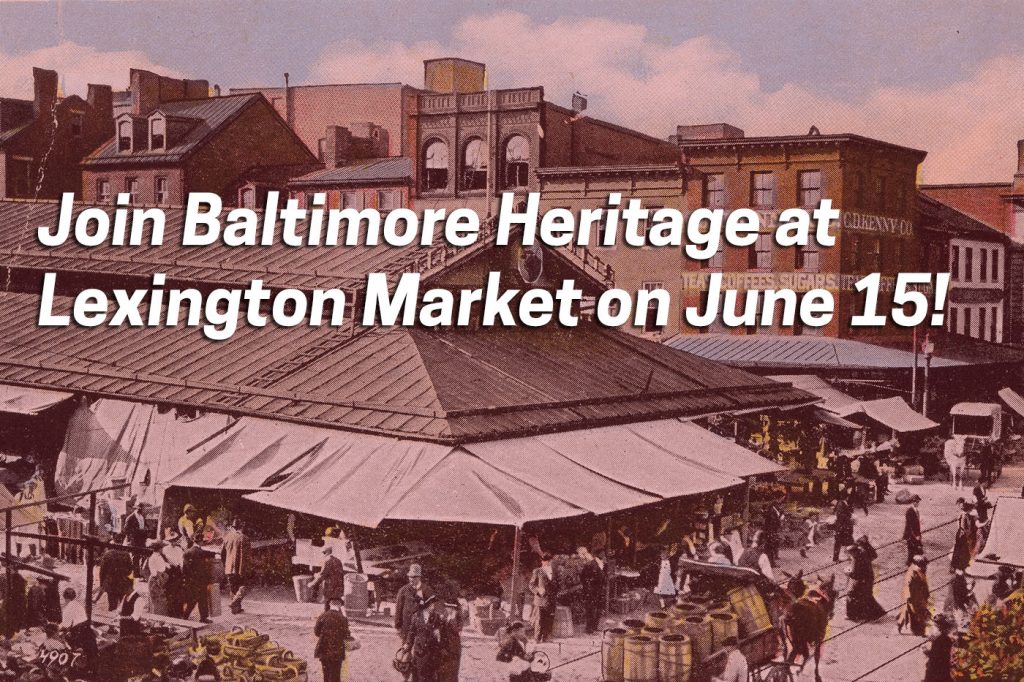
Beware the Ides of March? Not today with new tours at Zion Lutheran Church and Lexington Market

Although Shakespeare warns Julius Caesar “beware the Ides of March,” this March 15 brings a much happier message: we’ve lined up a new tour of Zion Lutheran Church and two more tours of the catacombs under Lexington Market!

As we near the one hundred year anniversary of the U.S. entry into World War I on April 2, please join us on March 29 at Zion Lutheran Church for a look at one of the centers of German heritage in Baltimore. With tributes to German history in everything from stained glass to Maypoles to a piece of the Berlin Wall, the tour will explore how many Baltimoreans identified as German and American at the same time.

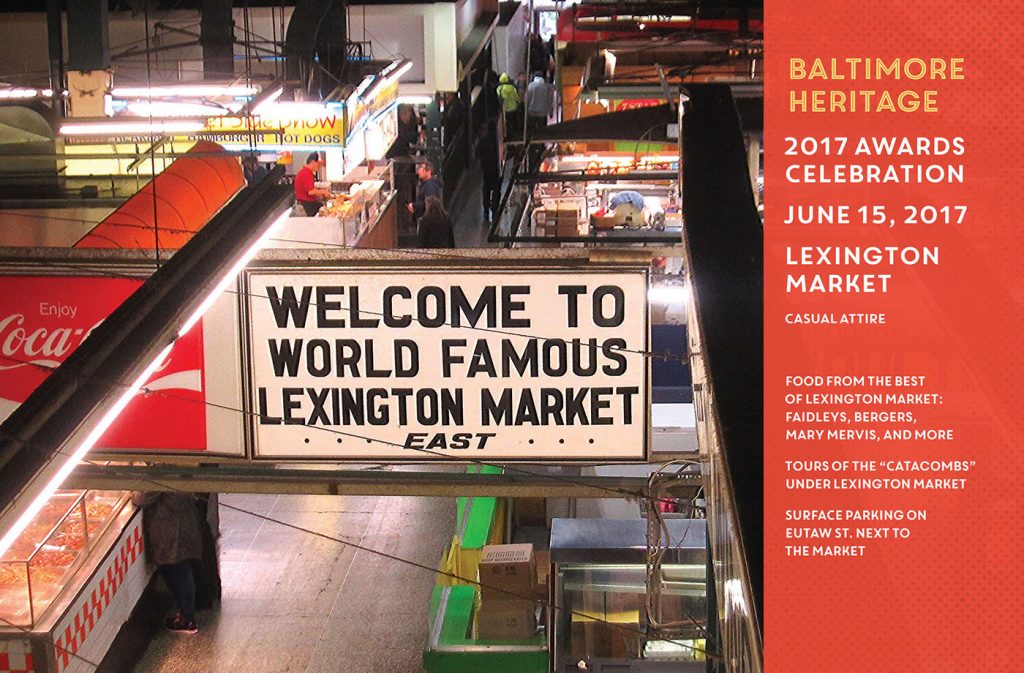
After several sold out tours of the catacombs under Lexington Market, we’ve scheduled two more on April 15 and May 20. In addition to the underground vaults, you’ll meet a few of Lexington Market’s long-standing vendors, learn about the history of market, and discuss the future of city’s public markets.

Also, if you haven’t signed up already, we welcome you to join public artist and Baltimore Heritage board member Graham Coreil-Allen for a people’s history tour of the Inner Harbor on March 18 and a walk across the Highway to Nowhere on April 1. Graham is known for his playful, participatory, and informative tours – you don’t want to miss them!

Project CORE shares plan for the demolition of 149 vacant buildings in 2017

The Maryland Department of Housing & Community Development (DHCD) recently shared their plans to demolish a second round of vacant buildings under the Project CORE program. Since Project CORE (short for Creating Opportunities for Renewal and Enterprise) began last January, the program has supported the demolition around three hundred and seventy-five properties and granted around sixteen million in funding for community development projects. We may not find a new use for every vacant building in Baltimore but we want you to know what buildings Project CORE is tearing down and how can you share your comments.

613 S. Monroe Street, Baltimore

In the second year of Project CORE (known as Phase II), the state and Baltimore City are seeking to demolish one hundred and forty-nine buildings (grouped into thirty-eight “demolition clusters”). You can browse the list of demolition clusters in our open Google Sheet or with our interactive map. You can also see photographs of each demolition cluster on Flickr. You can compare this year’s properties to the list we shared last April before the first round of demolition.

1138 Mosher Street, Baltimore

If you look at our sheet, you can see demolition clusters in fifteen different neighborhoods. The largest number of clusters are in West Baltimore neighborhoods including Sandtown-Winchester, Upton, and Harlem Park (all part of the Old West Baltimore Historic District). In East Baltimore, affected neighborhoods include Broadway East, East Baltimore Midway, and Johnston Square. The vacant buildings are a mix of different ages, styles, and sizes. They include the one remaining building from the Alma Manufacturing Company; small, two-story alley houses on Mosher Street; early worker cottages on Lanvale Street; a distressed shingle-sided home in Arlington; and an unusual brick house on Franklintown Road.

78-84 S. Franklintown Road, Baltimore

Although DHCD administers Project CORE, Baltimore Housing selected these demolition clusters for the state. Last year, Baltimore Housing staff met with community groups and shared possible demolition clusters with residents. They also worked with the Baltimore City Department of Planning to collect feedback from residents on their priorities for demolition and community greening as part of the city’s new Green Network Plan.

https://baltimoreheritage.carto.com/builder/e8f35e80-facf-11e6-bcfe-0e05a8b3e3d7/embed

The state’s preservation review process (commonly known as “Section 106”) gives Baltimore residents, preservation advocates, and community groups another opportunity to share comments or concerns on the proposed demolitions before the state can award funding to demolition contractors.

If you lead community organization affected by this program, we hope you can share any comments with DHCD by contacting Melissa Archer, Project Manager at melissa.archer2@maryland.gov.

We also want to hear your thoughts on Project CORE and these buildings. If we can find a new use for a vacant building, we might be able to avoid a demolition. Your feedback helps us continue to push for reinvestment in historic communities. You can share comments online or contact our director Johns Hopkins at hopkins@baltimoreheritage.org or 410-332-9992.

Finally, we want you to take a look at our new online resource for residents dealing with vacant buildings: Vacant Buildings 101. We are working with the Community Law Center to host workshops and publish an online guide to taking action on vacant buildings in your neighborhood. This program is supported by funding from Preservation Maryland and the Maryland Historical Trust through the Heritage Fund. Please take a look, share your comments, or sign up to join us at our next Vacant Buildings 101 workshop on March 25.

2858–2860 W. Lanvale Street, Baltimore, 21216

What is public space? Ask the question on two unconventional tours of local landscapes

Take a walk around the picturesque Inner Harbor or past the concrete piers that carry the “Highway to Nowhere” over Martin Luther King, Jr. Boulevard. You’ll see two very different public spaces. We can’t help but wonder how these public spaces came to be and how they affect us. You’ll be wondering too when you join public artist and Baltimore Heritage board member Graham Coreil-Allen for a people’s history tour of the Inner Harbor on March 18 and a walk across the Highway to Nowhere on April 1. Graham is known for his playful, participatory, and informative tours – you don’t want to miss them!

We are also excited to share our 2017 Baltimore by Foot tour series this spring – sign up for one or all five but please sign up soon. We expect all our spring walking tours to sell out!

Finally, if you’re looking for another way to explore Baltimore’s history this spring, join us for one of our 2017 bike tours. Our May and June rides include everything from tasty gelato to serene historic parks.

Baltimore Immigration Museum completes work on preservation mini-grant project

Last October, Baltimore Heritage held our first preservation mini-grant “Pitch Party.” We put out a call for good ideas to help preserve Baltimore’s historic places and revitalize our historic neighborhoods and then threw a party to select nominations to receive small grants. Two projects received grants of $500 and another two received grants of $250.

One of our $500 grant award winners was the Baltimore Immigration Museum, located at the Immigrant House in the Locust Point neighborhood. The museum proposed repointing and repairing masonry above the main entry door to stop a leak that was slowly rotting away the woodwork on the door. This job was important in the short term to stop the leak and an important part of the museum’s long-term goal of restoring the building.

The Museum completed the work in early January and its directors are happy to report that the repairs worked: with the masonry shored up, the leak has stopped.

Special thanks to long-time member Ms. Brigid Goody for making the preservation mini-grant program possible, as well as everybody who participated in our first pitch party last fall. In addition to the Baltimore Immigration Museum, three other projects received mini-grant funding.

  • The Herring Run Archaeology Project received $500 to purchase supplies for a spring archaeology project.
  • Taylor’s Chapel in Mount Pleasant Park received $250 as part of a fundraising campaign to stabilize frescoes in this 1850s church that likely were painted by Constantino Brumidi, the fresco artist in the U.S. Capitol building.
  • Lastly, the Market Center Merchant’s Association received $250 to bring Baltimore City public school kids who participate in the Maryland History Day competition to the Market Center Area for a tour of Civil Rights heritage sites.

Stay tuned as we provide updates on these other mini-grant awardees!