

Over the past several years, Baltimore Heritage has worked with photographer Lashelle Bynum to document and record the history of ghost signs across Baltimore City. We are thankful for the amazing research she has contributed to this documentation effort. From ads for local Baltimore businesses like Hendlers Creamery to national products like Coca Cola, we in Baltimore are lucky to have over 150 ghost signs still remaining. Read on to learn more about these amazing historical artifacts in plain sight!
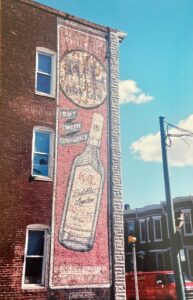 What are Ghost Signs?
Ghost signs are faded, hand-painted advertisements found on exterior walls of buildings, often in urban areas. The white paint on these signs would deteriorate more slowly compared to other brightly-colored pigments due to its high asbestos content, which is how the name “ghost” sign arose. Ghost signs were incredibly popular in the decades before the Great Depression, and lasted through the 1960 before the rise of advertising on billboards led to brick-painted advertisements’ demise.
Who Painted These Signs?
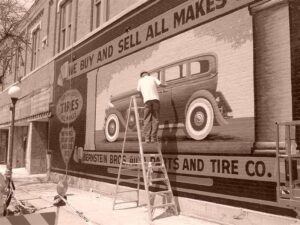 “Walldog” was a common nickname to refer to the skilled craftsmen who painted these signs from detailed scaled drawings. The name arose because sign painters were typically poorly paid, forcing them to “work like dogs” day after day. Additionally, sign-painting was dangerous work, forcing craftsmen to traverse up and down the sides of buildings while tethered to a wall, similar to a dog on a leash. Though the term “walldog” may have been derogatory throughout the early 20th century, it has now been reclaimed by skilled artisans rediscovering the art of sign painting who are proud to be known as “walldogs.”
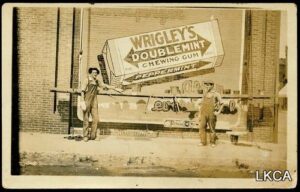 Walldogs typically carried perforated paper outlines up scaffolding with them, and used chalk or powdered charcoal to create a series of dots that they could then connect with paint. Pigments were often mixed with linseed oil, varnish, and occasionally gasoline to create vibrant paints. Often a sign-painters greatest challenge was making sure the lettering appeared level, even when the wall was not.
Historic Advertising Industry in Baltimore
Five sign-painting companies produced the majority of the ghost signs we see around Baltimore today. These companies were Globe Advertising Co., Park Sign Co., Convery Sign Co., Prichett, and Morton Sign Co., all of which were advertising and painting companies dating back to Depression-era Baltimore.

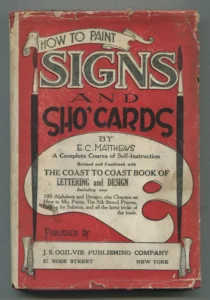
Convery Sign Co. was founded by Mr. John R. Convery, who was born in Montreal, Canada, and immigrated to the United States with his parents to Brooklyn, N.Y. After moving to Baltimore, Convery opened up his own sign business in 1876 and became an author of sign painting textbooks, in addition to designing many of the signs for Baltimore’s fraternal orders at the time.
The Baltimore Painters Union, which many local sign-painters belonged to, was founded in the late 19th century. It was originally a part of the Building Trades Council in Baltimore, before both the electrical workers and the painters and decorators requested they become a part of the Baltimore Federation of Labor in 1901. This came at a time when the Baltimore Federation was fighting then-mayor Haye’s plan to put inmates to work on city streets “in competition with honest labor” according to an article in the Baltimore Sun.
Lashelle Bynum

Lashelle Bynum is Baltimore’s leading researcher on ghost signs. She has built a photo album over the past 20 years that catalogs close to 200 signs across Baltimore City, and is currently working on turning her research into a coffee table book. Though she has no formal training as a photographer, Lashelle has been interested in Baltimore’s urban landscape and architecture for as long as she can remember, and always makes sure to carry her camera around with her in case she spots a new sign.
Featured Ghost Signs
Lenny’s House of Naturals Sign: Currently the only ghost sign found in Baltimore that depicted an African-American owned business. Lenny’s House of Naturals was a hair salon in West Baltimore that serviced many local and national politicians including the basketball star Earl “the Pearl” Monroe and Oprah Winfrey.
Cubanola 5¢ Cigars and N. Faulstich Carriage & Wagon Builder Sign: This ghost sign is particularly unique as it has remained incredibly vibrant over the many years since it was painted. The sign’s colors were kept safe from the elements underneath wall siding for many years, and only became visible to the public after the siding was torn down a couple of years ago.
Vote Against Prohibition Sign: Probably the most famous ghost sign in Baltimore, this sign was painted in the 1920s and stands as a living monument to the prohibition era, when alcohol was illegal and Baltimoreans famously protested.
CD Kenny Sign: A historic Baltimore business, C.D. Kenny Co. was a tea and coffee business made up of 60 coffee and tea shops across 12 states. It was founded by Cornelius D. Kenny in 1872.
Coca Cola Sign: One of the over 16,000 wall murals painted by the Coca-Cola Company in the first half of the 20th century. This sign is located on the side of Trinacria, an Italian Deli and gourmet grocery store serving customers in the same location for over 115 years.
Fort Avenue Pharmacy and Hendlers Ice Cream Sign: Built in the early 1900’s, this building was originally the Fort Avenue Pharmacy. It closed its doors in 1990 when it was bought by South-Baltimorean Earl Gallion, who converted the pharmacy into a early 20th century soda fountain and ice cream shop known as “Earl’s Old Malt Shop.”