
This week’s Baltimore Building of the Week could go by many different names. It began as the Baltimore Trust Company but was later known as the Maryland National Bank, Nations Bank and at the present the Bank of America Building–
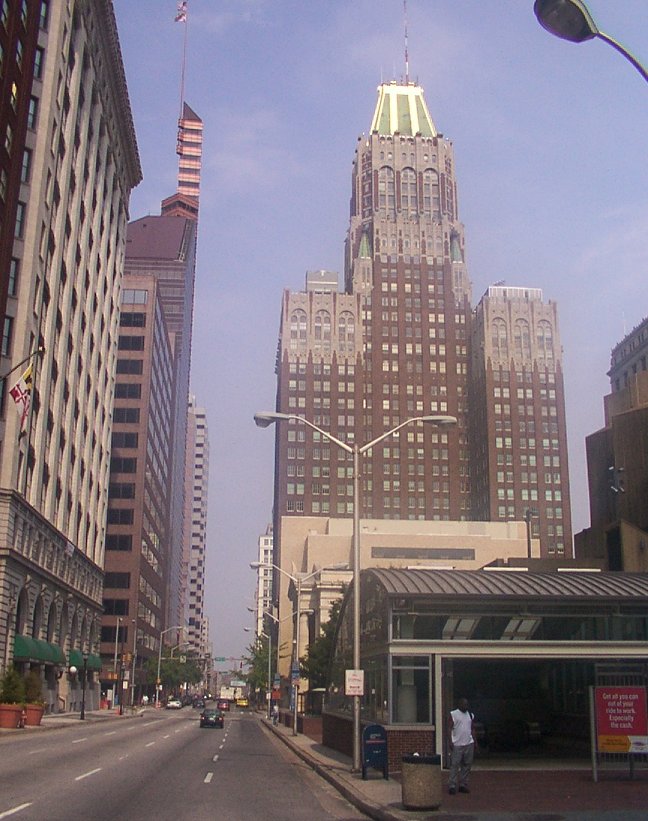
Besides college campuses, the Beaux-Arts combination of the historical Gothic style and modern technology was very popular for skyscrapers. Some, like the Woolworth Building in New York or the Chicago Tribune tower, were directly modeled on medieval precedent – just enormously taller. Other early 20th-century skyscrapers combined Gothic verticality with streamlined decorations derived from the new airplane and automobile industries. New York’s Chrysler Building is a prime example. Its contemporary in Baltimore, originally the Baltimore Trust Co., leans more to Gothic than to Art Deco, especially in its cavernous banking floor. At 34 stories and 509 feet, it was Baltimore’s tallest building for a generation before being edged out by I.M. Pei’s USF&G tower, 529 feet. Baltimore Trust went bankrupt in the Great Depression, but a succession of banks have maintained this crowning spire of the Baltimore skyline.
This building will need a lot of attention in the coming years. Unfortunately, the vacancy rate is increasing, and it will need a large investment to repurpose it.
Hi Jack, Just a minor correction: Pei’s firm designed the World Trade Center. USF&G was designed byCzech architect Vlastimil Koubek
Hi, my name is Julian Koulish, and I am an undergraduate student at Bard College; however, I was born and raised in West Baltimore. I am currently taking an architecture history course on modernism and would like to do my final project analyzing 10 Light Street. I am very interested in learning more about the history of the building, from the intentions of the architects to the reception of the building by Baltimoreans in the 1930s. I would appreciate any additional information or sources you can share regarding the building’s history.
Hi Julian! Thanks for reaching out and best of luck with your project. We suggest reaching out to the Baltimore Architecture Foundation for more information!